
[論文レビュー] Confidence on the Focal: Conformal Prediction with Selection-Conditional Coverage
本稿では、実用的応用における選択バイアスを解消するために、データ駆動型のテストユニット選択に基づく有限標本における正確な被覆を保証する、コンformal予測フレームワークを提案する。選択されたユニットに対する有効な不確実性評価を可能にする一般化された手法を導入し、任意の選択ルールに適用可能であり、創薬や医療予測の場面で正確な被覆を達成したことが実証された。
Conformal prediction builds marginally valid prediction intervals that cover the unknown outcome of a randomly drawn test point with a prescribed probability. However, in practice, data-driven methods are often used to identify specific test unit(s) of interest, requiring uncertainty quantification tailored to these focal units. In such cases, marginally valid conformal prediction intervals may fail to provide valid coverage for the focal unit(s) due to selection bias. This paper presents a general framework for constructing a prediction set with finite-sample exact coverage, conditional on the unit being selected by a given procedure. The general form of our method accommodates arbitrary selection rules that are invariant to the permutation of the calibration units, and generalizes Mondrian Conformal Prediction to multiple test units and non-equivariant classifiers. We also work out computationally efficient implementation of our framework for a number of realistic selection rules, including top-K selection, optimization-based selection, selection based on conformal p-values, and selection based on properties of preliminary conformal prediction sets. The performance of our methods is demonstrated via applications in drug discovery and health risk prediction.
研究の動機と目的
- 実践者がテストユニットのデータ駆動型サブセットに注目する状況において、マージン的に有効なコンフォーマル予測の限界を是正すること。これは、選択バイアスによって被覆が不足する可能性があるためである。
- 任意の選択ルールを使用しても、特定のテストユニットの選択を条件とした有限標本における正確な被覆を保証する一般フレームワークの開発。
- Mondrian Conformal Predictionなどの既存のコンフォーマル予測手法を、任意の選択手順下での複数テストユニットおよび非等価分類器に対応させる拡張。
- トップ-K選択、最適化ベース選択、p値または予備の予測集合に基づく選択など、現実的な選択ルールに対して計算的に効率的な実装を提供すること。
- 創薬や健康リスク予測の分野における実験的検証を通じて、選択下でも正確な被覆を達成し、予測集合のサイズを合理的に保つことの妥当性を検証すること。
提案手法
- 選択に依存しないキャリブレーション手順に基づき、選択されたユニットを条件とした正確な有限標本被覆を保証する予測集合の構築フレームワークを提案。
- 選択ルール下でも交換可能性を保証するリファレンス集合の構築法を用い、置換不変性による有効な条件付き被覆を実現。
- 最終的な予測集合が真の条件付き予測集合のスーパーセットであることを保証するスーパーセット構築技術を適用し、選択下でも被覆を維持。
- 複数の不連続区間を必要に応じて許容できるように、3成分のユニオン構造(式26)を用いて最終的な予測集合を構築。特に過剰被覆率が高い状況で有効。
- トップ-K、最適化ベース、コンフォーマルp値または予備の予測集合サイズに基づく選択など、特定の選択ルールに対して計算的に効率的なアルゴリズムを導入。
- 予備のコンフォーマル集合構築の基盤として、ランダムフォレストを用いて点予測と条件付き標準偏差を推定し、これに基づいて選択ルールを定義。

実験結果
リサーチクエスチョン
- RQ1選択がデータ駆動的かつキャリブレーションデータに依存する場合、コンフォーマル予測は選択されたテストユニットのサブセットに対しても正確な被覆を維持できるか?
- RQ2置換に対して不変である任意の選択ルールに対して、選択条件付き被覆を保証する一般フレームワークをどのように設計できるか?
- RQ3トップ-K、最適化ベース、サイズベースの選択といった異なる選択ルールが、予測集合のサイズと被覆に与える影響は何か?
- RQ4提案手法JOMIは、選択されたユニットに適用した場合、バニラコンフォーマル予測に比べて被覆の妥当性と予測集合サイズの両面で優れているとまでは言えるか?
- RQ5予備の予測集合を用いて選択を誘導する場合、この手法はどのように対処するか。また、被覆と集合サイズのトレードオフはどのようなものか?
主な発見
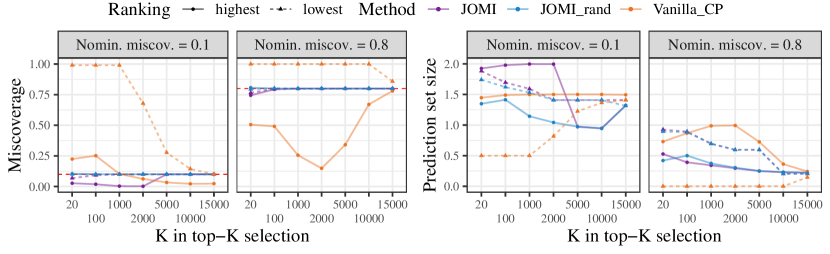
- バニラコンフォーマル予測は、特にサイズベースや最適化ベースの選択ルール下では顕著な過剰被覆(例:α=0.1のとき最大30%の誤被覆)を示す。
- 提案手法JOMIは、トップ-K、制約付き最適化、小規模な予測集合選択といったすべてのテスト選択ルールで正確な被覆を達成し、実証的誤被覆率は常に名目水準に近い。
- 予備の予測集合サイズが小さい(|C| ≤ 5)場合の選択において、JOMIは正確な被覆を維持しつつ、予測集合サイズはわずかに増大する。最終集合の不連続セグメント平均数はほぼ1(平均0.98)であり、単一の連結区間であることを示唆。
- 予備の予測集合の上限値(例:上限 < 6)をしきい値として選択する場合、バニラコンフォーマル予測は小規模なα値で過剰被覆を示すが、JOMIはスーパーセットを構築しても正確な被覆を維持。
- 予算制約付き最適化ベース選択では、JOMIは正確な被覆を維持しており、選択集合サイズとリファレンス集合サイズの間にわずかな正の相関が見られる。これは選択の複雑さに対して高いロバストネスを示す。
- 本手法は計算的に効率的かつスケーラブルであり、公開されたGitHubリポジトリを通じて再現可能で、創薬や医療分野における多様な応用に容易に適用可能。
この論文を読む
Nubintのビューアで原文を開き、読みながら気になる箇所をすぐに質問できます。
Nubintでこの論文を読むこのレビューはAIが論文の原文をもとに作成しました。引用する前に原文をご確認ください。