
[論文レビュー] Continuously Learning, Adapting, and Improving: A Dual-Process Approach to Autonomous Driving
LeapADは、人間の認知を模倣した二段階処理、クローズドループ型の自律走行システムを提案する。高速なヒューリスティックプロセス(システムI)と遅いアナリティカルプロセス(システムII)を用いて推論と意思決定を行う。自己自己認識と高品質な走行経験の蓄積されたメモリーバンクを活用することで、従来の手法よりも1〜2桁少ないラベル付きデータで継続的な改善が可能となり、CARLAシミュレーションにおいて多様な環境で優れた汎化性能を達成する。
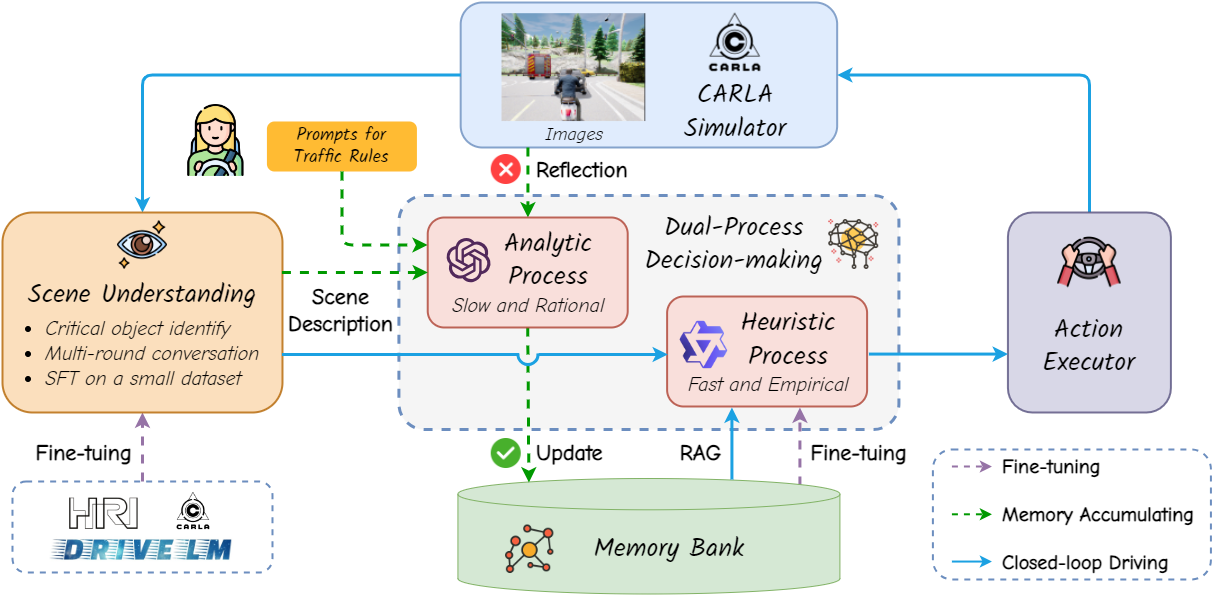
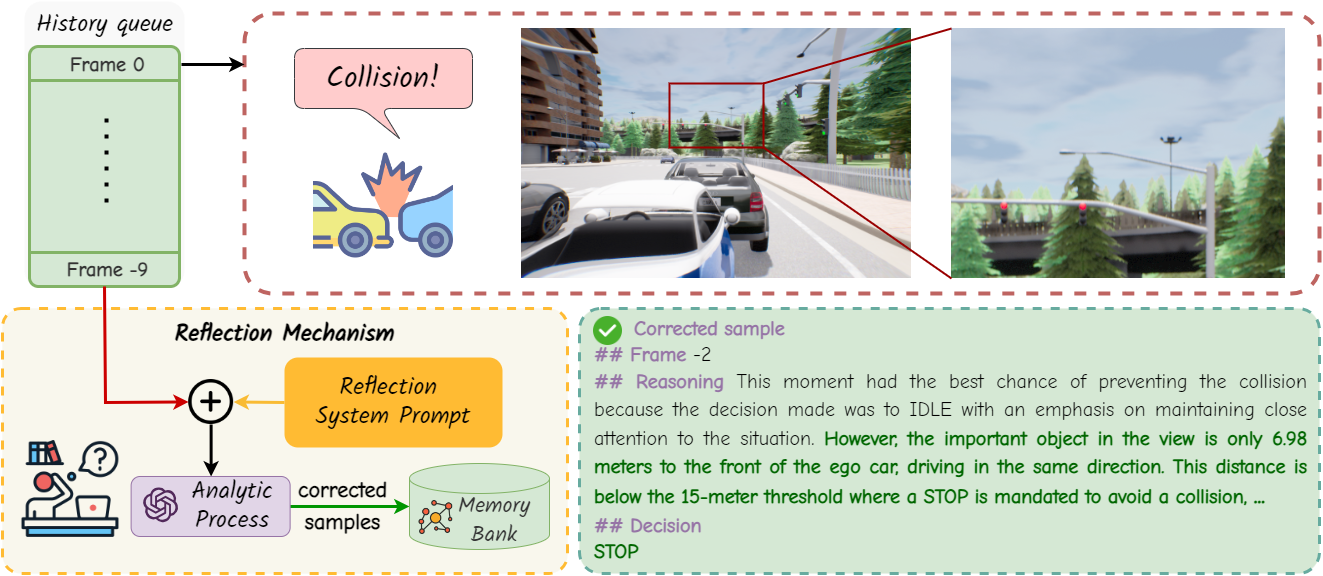
Autonomous driving has advanced significantly due to sensors, machine learning, and artificial intelligence improvements. However, prevailing methods struggle with intricate scenarios and causal relationships, hindering adaptability and interpretability in varied environments. To address the above problems, we introduce LeapAD, a novel paradigm for autonomous driving inspired by the human cognitive process. Specifically, LeapAD emulates human attention by selecting critical objects relevant to driving decisions, simplifying environmental interpretation, and mitigating decision-making complexities. Additionally, LeapAD incorporates an innovative dual-process decision-making module, which consists of an Analytic Process (System-II) for thorough analysis and reasoning, along with a Heuristic Process (System-I) for swift and empirical processing. The Analytic Process leverages its logical reasoning to accumulate linguistic driving experience, which is then transferred to the Heuristic Process by supervised fine-tuning. Through reflection mechanisms and a growing memory bank, LeapAD continuously improves itself from past mistakes in a closed-loop environment. Closed-loop testing in CARLA shows that LeapAD outperforms all methods relying solely on camera input, requiring 1-2 orders of magnitude less labeled data. Experiments also demonstrate that as the memory bank expands, the Heuristic Process with only 1.8B parameters can inherit the knowledge from a GPT-4 powered Analytic Process and achieve continuous performance improvement. Project page: https://pjlab-adg.github.io/LeapAD.
研究の動機と目的
- 現在のデータ駆動型自律走行システムが未確認のシナリオや因果的推論、解釈可能性に課題を抱えることに対処すること。
- クローズドループ型で人間の認知にインspiredされたフレームワークを通じて、自律走行車両における継続的学習と適応を可能にすること。
- 高容量の推論モデルと軽量でリアルタイム推論に適したモデルの間のギャップを埋えるために、大規模なアナリティカルプロセスからコンパクトなヒューリスティックプロセスへの知識転送を実現すること。
- 転送可能なメモリーバンクと自己認識メカニズムを活用し、多様な走行環境における汎化性能と耐性を向上させること。
- 実世界での展開を想定し、クラウドエッジアーキテクチャと互換性を持つシステムの開発
提案手法
- LeapADは、重要な物体に注目する人間らしい注視メカニズムを適用するシーン理解モジュールを採用し、意思決定のための環境入力を簡素化する。
- 二段階処理の意思決定アーキテクチャを実装する:遅い合理的なアナリティカルプロセス(システムII)は論理的推論を、高速な経験的ヒューリスティックプロセス(システムI)はリアルタイム推論を担当する。
- アナリティカルプロセスは言語的走行経験を蓄積し、高品質な意思決定軌道を生成する。これらの軌道は、教師あり微調整(SFT)を用いて転送可能なメモリーバンクに蒸留される。
- 自己認識メカニズムが交通事故を特定・分析し、教訓を抽出してメモリーバンクを更新することで、クローズドループ構成での自己改善を可能にする。
- ヒューリスティックプロセスは、メモリーバンクを用いた少サンプルプロンプティングにより、新しいシナリオに素早く適応し、エッジでのリアルタイム意思決定を実現する。
- 本システムは、動的相互作用とフィードバックを保証するクローズドループ型のCARLAシミュレーションで訓練・評価される。これは、オープンループ評価とは異なり、動的なフィードバックが得られる。
実験結果
リサーチクエスチョン
- RQ1二段階処理の認知的アーキテクチャは、自律走行システムにおける継続的学習と適応性を向上させ得るか?
- RQ2知識蒸留を通じて、軽量なヒューリスティックプロセスが大規模なアナリティカルプロセスの複雑な推論能力をどれほど効果的に継承できるか?
- RQ3自己認識ベースのメモリーバンクは、多様な走行環境において性能と汎化能力をどの程度向上させるか?
- RQ4LeapADは、既存のカメラオンリーメソッドと比較して、顕著に少ないラベル付きデータで優れたパフォーマンスを達成できるか?
- RQ5記憶バンクの収集時に見なかった町でテストされた場合、システムの汎化性能はどの程度保たれるか?
主な発見
- LeapADはCARLAにおけるすべてのカメラオンリーメソッドを上回り、クローズドループ評価で最先端のパフォーマンスを達成した。
- 効率的な知識転送と継続的学習のおかげで、従来の手法よりも1〜2桁少ないラベル付きデータで学習が可能となった。
- メモリーバンクが拡大するにつれ、1.8Bパラメータのヒューリスティックプロセスは、教師あり微調整によりGPT-4搭載のアナリティカルプロセスと同等の性能を達成した。
- 自己認識メカニズムのおかげでドライブスコアが著しく向上し、困難なルートで複数ラウンドにわたる自己改善の過程で平均スコアが上昇した。
- メモリーバンクは強力な汎化性能を示した:他の町から収集した記憶を用いてTown05で高いパフォーマンスを発揮し、逆にTown05の記憶を他の町で使用しても同様に高い性能を示した。これは、強力な環境間転送能力を示している。
- 低品質なサンプルがメモリーバンクに含まれても、システムは高いパフォーマンスを維持した。これは、ノイズの多いデータに対しても耐性があることを示唆している。
この論文を読む
Nubintのビューアで原文を開き、読みながら気になる箇所をすぐに質問できます。
Nubintでこの論文を読むこのレビューはAIが論文の原文をもとに作成しました。引用する前に原文をご確認ください。