
[論文レビュー] Contrastive Learning for Robust Android Malware Familial Classification
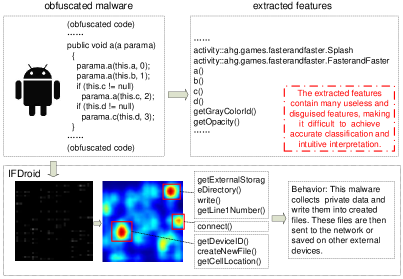
本稿では、変形されたAndroidマルウェアの家族分類において堅牢かつ解釈可能であることを目指した、対照学習に基づくIFDroidを提案する。関数コールグラフを中心性分析を用いて画像に変換し、教師あり対照学習を適用することで、69,421件の変形済みサンプルにおいて98.4%のF1スコアを達成し、最先端の手法を上回る性能を発揮するとともに、学習済み表現の可視化によりGrad-CAM++を用いたヒートマップによる解釈可能性を実現した。
Due to its open-source nature, Android operating system has been the main target of attackers to exploit. Malware creators always perform different code obfuscations on their apps to hide malicious activities. Features extracted from these obfuscated samples through program analysis contain many useless and disguised features, which leads to many false negatives. To address the issue, in this paper, we demonstrate that obfuscation-resilient malware family analysis can be achieved through contrastive learning. The key insight behind our analysis is that contrastive learning can be used to reduce the difference introduced by obfuscation while amplifying the difference between malware and other types of malware. Based on the proposed analysis, we design a system that can achieve robust and interpretable classification of Android malware. To achieve robust classification, we perform contrastive learning on malware samples to learn an encoder that can automatically extract robust features from malware samples. To achieve interpretable classification, we transform the function call graph of a sample into an image by centrality analysis. Then the corresponding heatmaps can be obtained by visualization techniques. These heatmaps can help users understand why the malware is classified as this family. We implement \emph{IFDroid} and perform extensive evaluations on two datasets. Experimental results show that \emph{IFDroid} is superior to state-of-the-art Android malware familial classification systems. Moreover, \emph{IFDroid} is capable of maintaining a 98.4\% F1 on classifying 69,421 obfuscated malware samples.
研究の動機と目的
- Androidアプリにおけるコードの変形によって引き起こされるマルウェアの家族分類の不正確さという課題に対処すること。
- 構造的コード変換に対しても高い精度を維持できる、変形に強いマルウェア分類システムの開発。
- 学習済み表現におけるGrad-CAM++を用いた可視化により、重要な特徴を可視化することで、分類の解釈可能性を実現すること。
- 対照学習が、変形に起因するノイズを低減するとともに、マルウェア家族間の意味的差を強調できることを示すこと。
提案手法
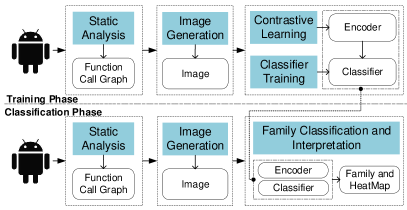
- 度数、近接度、媒介性、固有ベクトル中心性の4つの中心性指標を用いて、各Androidアプリの関数コールグラフを2次元画像に変換する。
- 正例ペア(オリジナル版と変形版)間の類似度を最大化し、負例ペア(異なるマルウェア家族)間の類似度を最小化するように、教師あり対照学習を適用してエンコーダーを学習する。
- 中心性に基づく画像からの特徴を強力に抽出するためのCNNベースのエンコーダーを用い、訓練中に対照損失を最適化する。
- Grad-CAM++を用いて、分類意思決定に最も寄与した画像領域(つまり、グラフ部分構造)を特定するクラス特徴的なヒートマップを生成する。
- 継続的学習を活用して、完全な再トレーニングなしに、新しいマルウェア家族のゼロショットまたはフェイントショット分類を、事前学習済みエンコーダーを用いて実現する。
- 69,421件の変形済みサンプルを含む2つのデータセットを用いて、F1スコアと耐性を測定する評価を実施する。
実験結果
リサーチクエスチョン
- RQ1対照学習は、コード変形がマルウェア家族分類に与える影響を効果的に低減できるか?
- RQ2中心性に基づくグラフから画像への変換と対照学習の組み合わせは、マルウェア分類に耐性があり汎用性の高い特徴を生成できるか?
- RQ3本手法は、最先端のAndroidマルウェア家族分類システムと比較して、精度と耐性において優れているか?
- RQ4Grad-CAM++のような可視化技術は、モデルの分類意思決定に対して意味のある解釈可能性を提供できるか?
主な発見
- IFDroidは、69,421件の変形済みAndroidマルウェアサンプルにおいて98.4%のF1スコアを達成し、コード変形に対して強い耐性を示した。
- Dendroid、Apposcopy、FalDroid、DroidSIFTを含む10の最先端のマルウェア分類システムを上回った。
- Grad-CAM++によるヒートマップ可視化により、分類に寄与した重要な部分グラフ領域が明確に特定され、モデルの解釈可能性が向上した。
- 複数の中心性指標の使用により、攻撃者による有効な摂動を生成することが難しくなり、アドバーシャル攻撃に対する耐性が向上した。
- 事前学習済みエンコーダーを用いることで、完全な再トレーニングなしに、継続的学習により新しいマルウェア家族のフェイントショット分類が効果的に可能となった。
より良い研究を、今すぐ始めましょう
論文の読解から最終レビューまで、研究時間を劇的に削減しましょう。
クレジットカード登録不要
このレビューはAIが作成し、人間の編集者が確認しました。