
[論文レビュー] Conv-Adapter: Exploring Parameter Efficient Transfer Learning for ConvNets
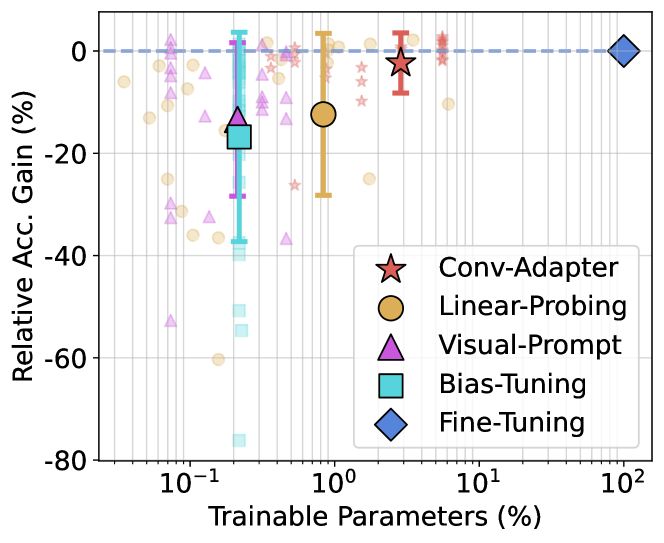
この論文では、ResNet-50の完全微調整パラメータのわずか3.5%しか追加しない、軽量でアーキテクチャに依存しないパrameter効率の良い微調整(PET)モジュールであるConv-Adapterを提案する。残差ブロック内の深度分離畳み込みを用いてタスク固有の特徴調製を学習することで、23の画像分類タスクで完全微調整と同等の性能を達成し、検出やセグメンテーションへも効果的に一般化され、パラメータを50%以上削減できる。
While parameter efficient tuning (PET) methods have shown great potential with transformer architecture on Natural Language Processing (NLP) tasks, their effectiveness with large-scale ConvNets is still under-studied on Computer Vision (CV) tasks. This paper proposes Conv-Adapter, a PET module designed for ConvNets. Conv-Adapter is light-weight, domain-transferable, and architecture-agnostic with generalized performance on different tasks. When transferring on downstream tasks, Conv-Adapter learns tasks-specific feature modulation to the intermediate representations of backbones while keeping the pre-trained parameters frozen. By introducing only a tiny amount of learnable parameters, e.g., only 3.5% full fine-tuning parameters of ResNet50. It can also be applied for transformer-based backbones. Conv-Adapter outperforms previous PET baseline methods and achieves comparable or surpasses the performance of full fine-tuning on 23 classification tasks of various domains. It also presents superior performance on the few-shot classification with an average margin of 3.39%. Beyond classification, Conv-Adapter can generalize to detection and segmentation tasks with more than 50% reduction of parameters but comparable performance to the traditional full fine-tuning.
研究の動機と目的
- 自然言語処理(NLP)における成功にもかかわらず、コンピュータビジョン分野におけるConvNetsのための効果的なパrameter効率の良い微調整(PET)手法の欠如に対処すること。
- 大規模なConvNets向けに、軽量でドメイン移行可能かつアーキテクチャに依存しないPETモジュールを開発すること。
- 事前学習済みバックボーン重みを凍結したまま、最小限の可学習パラメータで高い性能を達成すること。
- PETをNLPにとどめず、画像分類、オブジェクト検出、セマンティックセグメンテーションを含む多様なコンピュータビジョン(CV)タスクへ一般化すること。
- 視覚タスクにおける特徴の局所性とドメインシフトの文脈において、PETモジュールの設計選択と適応性を調査すること。
提案手法
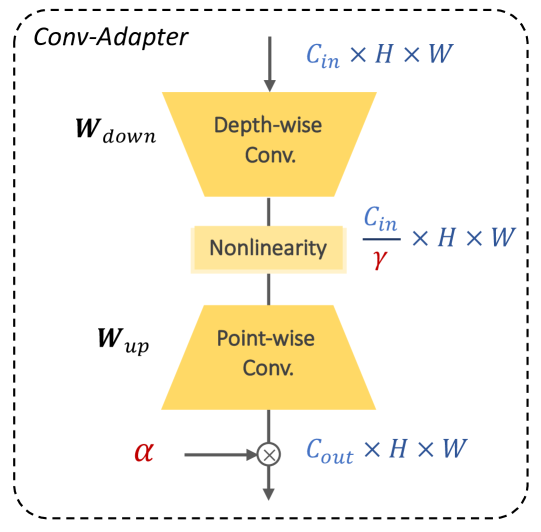
- 残差ブロック内の中間特徴を調整するために、深度分離畳み込みと非線形関数を用いたボトルネック構造を持つPETモジュールであるConv-Adapterを提案する。
- 適応表現(チャネル対、空間対)と挿入形式(ブロック単位対、ステージ単位)の2つの設計次元を導入し、最適な構成を特定するためにアブレーションスタディを実施する。
- Heら(2022)らのNLP PET手法と同一の数学的フレームワークに従ってConv-Adapterを定式化することで、クロスモダリティの一貫性を実現する。
- 特徴調製を制御するための学習可能なスケーリングベクトルαと圧縮係数γを導入し、初期化とハイパーパramータ感度に関するアブレーションを実施する。
- 事前学習済みのResNet-50およびConvNeXt-Sにモジュールを適用し、バックボーン重みをすべて凍結した上でアダプタのみを微調整する。
- ImageNet、VTAB-1k、FGVCデータセットを含む標準ベンチマークを用いて、多様な下流タスクで評価する。
実験結果
リサーチクエスチョン
- RQ1アーキテクチャ的およびデータ分布的差異を考慮すると、NLPで成功したPET技術をコンピュータビジョン分野のConvNetsに効果的に適応できるか?
- RQ2畳み込みタイプ、挿入形式、表現適応といった設計選択が、ConvNet PETにおけるパフォーマンスとパラメータ効率を最大化するために果たす役割は何か?
- RQ3大規模なドメインシフト下でConv-Adapterはどの程度の性能を示すのか?また、そのような状況下で移行性が制限される要因は何か?
- RQ4分類、検出、セグメンテーションタスクのすべてにおいて、顕著に少ない可学習パラメータで完全微調整のパフォーマンスにどの程度近づけるか?
- RQ5スケーリングベクトルαの初期化や圧縮係数γといったハイパーパラメータの変更に、Conv-Adapterのパフォーマンスはどの程度感度を示すか?
主な発見
- Conv-Adapterは、ResNet-50の可学習パラメータの3.5%しか使用せず、23のクロスドメイン画像分類タスクで完全微調整と同等またはそれ以上の性能を達成した。
- 少データ分類タスクにおいて、Conv-Adapterはベースラインより平均で3.39%の精度向上を達成し、低データ環境下での一般化性能が優れていることを示した。
- オブジェクト検出およびセマンティックセグメンテーションにおいて、Conv-Adapterはパラメータ数を50%以上削減しながら、完全微調整と同等の性能を維持した。
- アブレーションスタディの結果、チャネル単位での適応と深度分離畳み込みを組み合わせた構成が、パフォーマンスとパラメータ効率の最良のトレードオフを実現していることが確認された。
- Conv-Adapterの性能は、スケーリングベクトルαの初期化に最も敏感であり、初期化を1に設定した場合が最も良いパフォーマンスを示したが、圧縮係数γの変化に対しては頑健であった。
- CKA類似度分析の結果、事前学習済み重みと微調整済み重みが非常に類似している(高CKA)状況下で、Conv-Adapterが完全微調整を上回る性能を示した。これは、小さな分布シフト下でもより良いアライメントを実現していることを示している。
この論文を読む
Nubintのビューアで原文を開き、読みながら気になる箇所をすぐに質問できます。
Nubintでこの論文を読むこのレビューはAIが論文の原文をもとに作成しました。引用する前に原文をご確認ください。