
[論文レビュー] Cosmological constraints from weak lensing scattering transform using HSC Y1 data
本研究は、HSC Y1データに対する弱引力レンズの散乱変換を用いた最初の宇宙論的制約を提示する。これは解釈可能性、ロバスト性、高い制約力を持つ統計推定量である。パワー スペクトルと比較して、Ωₘ に対する制約を2倍に厳しくし、S₈推定における主な制限要因は空間統計の選択ではなく、特に z ≈ 1 の赤方偏移領域における光度赤方偏移のキャリブレーションであることが明らかになった。
As weak lensing surveys go deeper, there is an increasing need for reliable characterization of non-Gaussian structures at small angular scales. Here we present the first cosmological constraints with weak lensing scattering transform, a statistical estimator that combines efficiency, robustness, and interpretability. With the Hyper Suprime-Cam survey (HSC) year 1 data, we obtain $Ω_ ext{m}=0.29_{-0.03}^{+0.04}$, $S_8\equiv σ_8(Ω_ ext{m}/0.3)^{0.5}=0.83\pm0.02$, and intrinsic alignment strength $A_ ext{IA}=1.0\pm0.4$ through simulation-based forward modeling. Our constraints are consistent with those derived from Planck. The error bar of $Ω_ ext{m}$ is 2 times tighter than that obtained from the power spectrum when the same scale range is used. This constraining power is on par with that of convolutional neural networks, suggesting that further investment in spatial information extraction may not yield substantial benefits. We also point out an internal tension of $S_8$ estimates linked to a redshift bin around z ~ 1 in the HSC data. We found that discarding that bin leads to a consistent decrease of $S_8$ from 0.83 to 0.79, for all statistical estimators. We argue that photometric redshift estimation is now the main limitation in the estimation of $S_8$ using HSC. This limitation is likely to affect other ground-based weak lensing surveys reaching redshifts greater than one. Alternative redshift estimation techniques, like clustering redshifts, may help alleviate this limitation.
研究の動機と目的
- 弱引力レンズの実データに非ガウス的で解釈可能なロバストな統計推定量である散乱変換を適用し、宇宙論的パラメータ推定を行う。
- パワー スペクトルが捉え損ねる収束マップ内の非ガウス的構造を捉えることで、Ωₘ および S₈ の制約を改善する。
- 散乱変換が従来の2点統計よりも優れているかどうかを評価し、特に光度赤方偏移の誤差に起因する系誤差への感受性を検証する。
- 地上ベースの弱引力レンズ調査における S₈ 評価の主な制限要因を特定する。特に S₈ の不一致問題の文脈で検討する。
提案手法
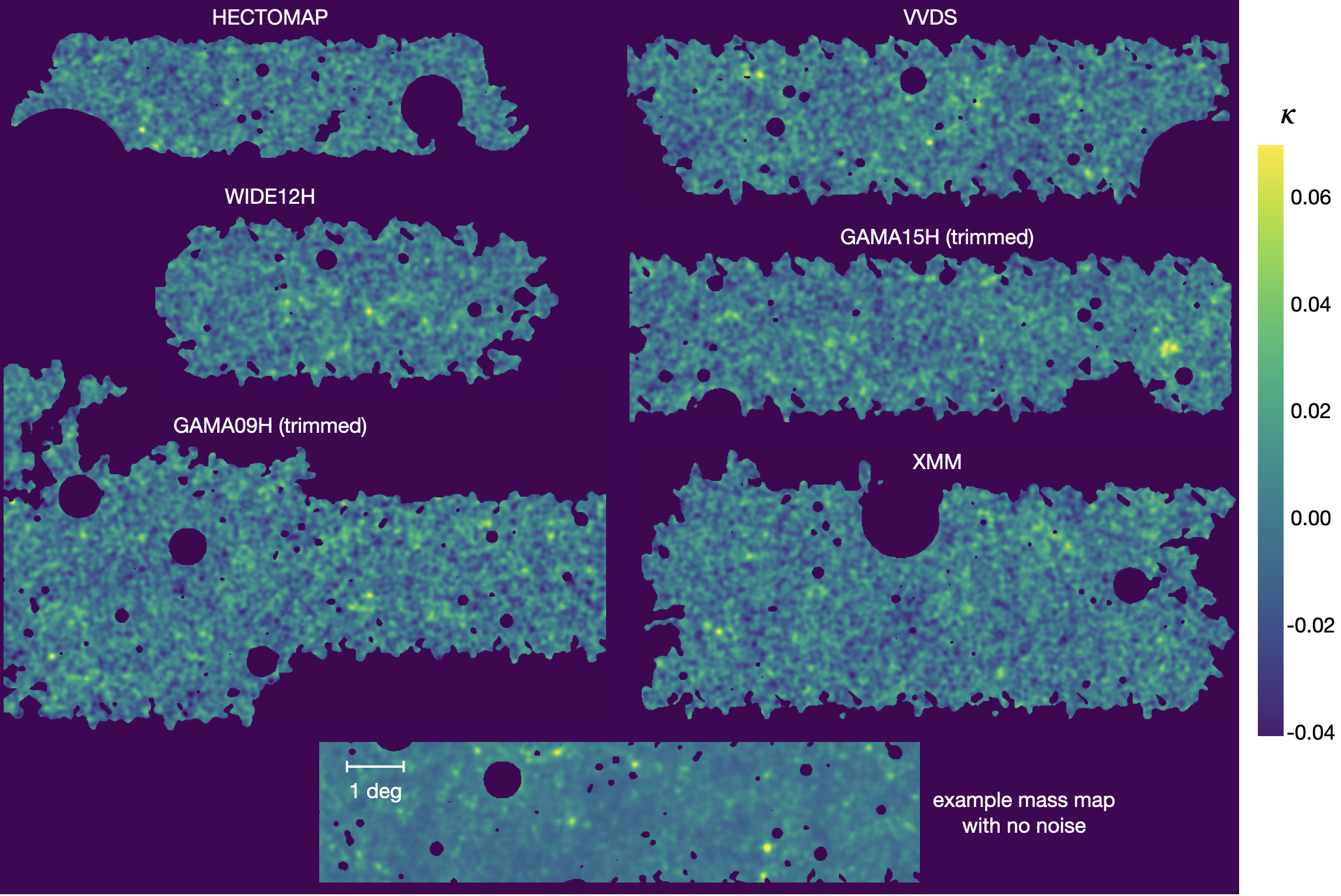
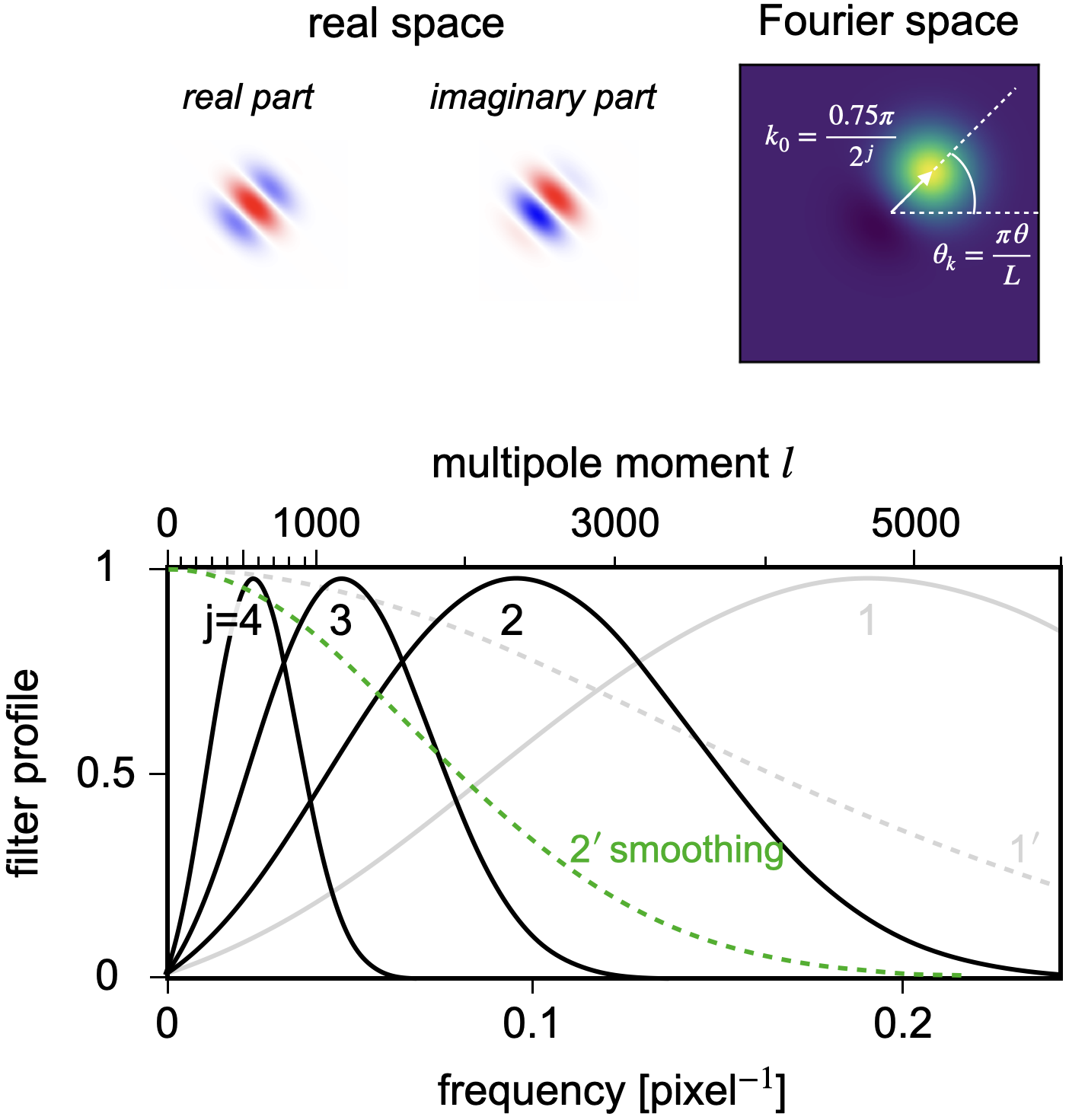
- HSC Y1 剪断カタログから得られた弱引力レンズ収束マップに、マルチスケールでウェーブレットに基づく階層的フィルタリング手法を用いて非ガウス的特徴を抽出する散乱変換を適用する。
- 観測条件がHSC Y1調査と一致するように調整された大規模なN体シミュレーションおよびマock銀河カタログを用いたフォワードモデリングフレームワークを採用する。
- ベイズ推論を用いて宇宙論的制約を導出し、観測統計とシミュレートされたデータ分布を比較することで、Ωₘ、S₈、および固有配列の振幅 A_IA を推定する。
- 複数の赤方偏移ビンにわたるトロモトニック解析を実施し、z ≈ 1 のビンを除外することで赤方偏移キャリブレーションの影響を評価する。
- 従来のパワー スペクトル解析と比較し、深層学習モデルと同等の制約力を持つが、完全に解釈可能で学習を必要としないことを示した。
- 光度赤方偏移の不確実性を、系統的に第3の赤方偏移ビン(z ≈ 0.9–1.2)を除外し、S₈ の変化を観測することで調べた。
実験結果
リサーチクエスチョン
- RQ1実際の弱引力レンズデータに適用した場合、パワー スペクトルと比較して散乱変換はΩₘの制約をより厳しくできるか?
- RQ2制約力と解釈可能性の観点から、散乱変換は深層学習手法と比較してどのように性能を発揮するか?
- RQ3HSCデータにおけるS₈の不一致は、特にz ≈ 1の赤方偏移ビンにおける光度赤方偏移推定の系誤差に起因しているか?
- RQ4トロモトニックな赤方偏移ビンにわたる非ガウス的特徴が、宇宙論的制約の向上にどの程度寄与しているか?
- RQ5散乱変換は、赤方偏移キャリブレーションに関連する系誤差を特定および定量化するのを支援できるか?
主な発見
- 同じ角度スケール範囲を用いた場合、散乱変換はパワー スペクトルと比較してΩₘの誤差幅を2倍に縮小し、畳み込みニューラルネットワークと同等の制約力を達成した。
- Ωₘ の制約は Ωₘ = 0.29⁻⁰.⁰³⁺⁰.⁰⁴ であり、S₈ = 0.83 ± 0.02 であり、いずれもプランクの結果と整合的である。
- 赤方偏移ビン z ≈ 1(0.9–1.2)を除外すると、すべての統計推定量においてS₈が0.83から0.79に低下し、光度赤方偏移における系誤差があることが示された。
- 本研究では、HSC Y1および他の地上ベースの弱引力レンズ調査でz > 1に達する場合、光度赤方偏移推定がS₈推定における主な制限要因であると特定した。
- 非ガウス的統計、特に散乱変換は、Ωₘの制約において光度赤方偏移バイアスに対してロバストであるが、S₈の推定は赤方偏移キャリブレーションに敏感である。
- 今後のS₈制約の向上は、光度赤方偏移の精度が向上しない限り、より良い空間統計や機械学習ツールの開発によるものではない。具体的には、クラスタリング赤方偏移や欧幾何学的望遠鏡(例:エウリッドやローマン)からの近赤外線フィルタを用いた手法による精度向上が鍵となる。
この論文を読む
Nubintのビューアで原文を開き、読みながら気になる箇所をすぐに質問できます。
Nubintでこの論文を読むこのレビューはAIが論文の原文をもとに作成しました。引用する前に原文をご確認ください。