
[論文レビュー] DART: Domain-Adversarial Residual-Transfer Networks for Unsupervised Cross-Domain Image Classification
本稿では、ドメイン敵対的訓練によるドメイン不変特徴の共同学習と、残差転送戦略による分類のロバスト性向上を組み合わせることで、クロスドメイン画像分類を向上させる、新しい非教師ありドメイン適応手法DARTを提案する。本手法は、ラベル分類器のシフトをモデル化し、特徴量とラベルの共同分布を整列させることで、ベンチマークデータセット上で最先端の手法を上回る性能を達成する。
The accuracy of deep learning (e.g., convolutional neural networks) for an image classification task critically relies on the amount of labeled training data. Aiming to solve an image classification task on a new domain that lacks labeled data but gains access to cheaply available unlabeled data, unsupervised domain adaptation is a promising technique to boost the performance without incurring extra labeling cost, by assuming images from different domains share some invariant characteristics. In this paper, we propose a new unsupervised domain adaptation method named Domain-Adversarial Residual-Transfer (DART) learning of Deep Neural Networks to tackle cross-domain image classification tasks. In contrast to the existing unsupervised domain adaption approaches, the proposed DART not only learns domain-invariant features via adversarial training, but also achieves robust domain-adaptive classification via a residual-transfer strategy, all in an end-to-end training framework. We evaluate the performance of the proposed method for cross-domain image classification tasks on several well-known benchmark data sets, in which our method clearly outperforms the state-of-the-art approaches.
研究の動機と目的
- ターゲットドメインにラベル付きデータが利用できない非教師ありクロスドメイン画像分類の課題に対処すること。
- 既存のドメイン適応手法が同一のソース・ターゲット分類器を仮定するという制限を克服し、ドメインシフトのための失敗を回避すること。
- ドメイン間の特徴量とラベルの共同分布を同時に整列させることで、特徴量の転送可能性を向上させること。
- 摂動関数を用いてソースとターゲット分類器の微小なシフトをモデル化することで、ドメインシフトに対する分類器のロバスト性を向上させること。
- スケーラビリティと実用的導入を可能にするために、標準的なバックプロパゲーションを用いたエンドツーエンド学習を可能とすること。
提案手法
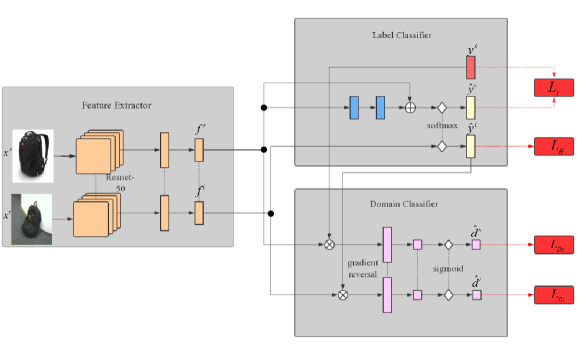
- 特徴抽出器、ラベル分類器、ドメイン分類器の3つのコンponentを備えた、ドメイン敵対的残差転送(DART)ネットワークアーキテクチャを導入する。
- ドメイン敵対的訓練を採用し、特徴量がソースドメインとターゲットドメインで区別不能になるようにすることで、ドメイン差を最小化する。
- ラベル分類器に残差モジュールを組み込むことで、ソースとターゲット分類器間の摂動をモデル化し、ドメインシフトに対するロバスト性を向上させる。
- 特徴量とラベルの共同分布を、クリロネッカー積を用いて生成される特徴量-ラベルマップを介して整列させることで、識別力の向上を図る。
- ドメイン差と分類誤差の両方をエンドツーエンドで最小化する共同最適化フレームワークを採用する。
- 標準的なバックプロパゲーションを用いて学習を実行し、大多数のディープラーニングフレームワークとの互換性を確保する。

実験結果
リサーチクエスチョン
- RQ1特徴量とラベルの共同分布の整列が、周辺分布の整列と比較して、非教師ありドメイン適応の性能向上に寄与するか?
- RQ2ソースドメインとターゲットドメイン間の分類器摂動をモデル化することで、クロスドメイン環境下での分類ロバスト性がどのように向上するか?
- RQ3ドメイン敵対的訓練と残差転送学習を組み合わせることで、既存のSOTA手法を上回る性能を達成できるか?
- RQ4ターゲットドメインにラベル付きデータが存在しない状況下で、本手法はドメインシフトの影響をどの程度軽減できるか?
- RQ5エンドツーエンドで学習可能なDARTフレームワークは、多様なベンチマークデータセットにおいてもスケーラビリティと一般化性能を維持できるか?
主な発見
- DARTは、非教師ありクロスドメイン画像分類の複数のベンチマークデータセットで最先端の性能を達成した。
- 本手法は、特徴量とラベルの共同分布を共同で整列させることで、DANNや他のSOTA手法を顕著に上回った。
- 残差転送戦略は、ターゲットドメインのサンプルに対してソース分類器が誤分類した場合に、効果的に是正することができ、図1に図示されている。
- ドメイン敵対的訓練と共同分布整列を組み合わせることで、より識別力が高くドメイン不変な特徴量が得られた。
- モデルはロバスト性とスケーラビリティを示し、標準的なディープラーニングライブラリと互換性のあるエンドツーエンド学習が可能であった。
- 実験結果から、分類器摂動のモデル化が一般化性能を向上させることを確認した。特に、ソースとターゲットドメインに微小だが顕著な分布シフトが存在する場合に顕著であった。
より良い研究を、今すぐ始めましょう
論文の読解から最終レビューまで、研究時間を劇的に削減しましょう。
クレジットカード登録不要
このレビューはAIが作成し、人間の編集者が確認しました。