
[論文レビュー] DARWIN Series: Domain Specific Large Language Models for Natural Science
DARWINは、自然科学(物理学、化学、材料科学)向けのオープンソースかつ領域特化のLLMを、SIG指示生成とマルチタスク微調整とともに提供し、科学ベンチマークで最先端の結果を達成します。
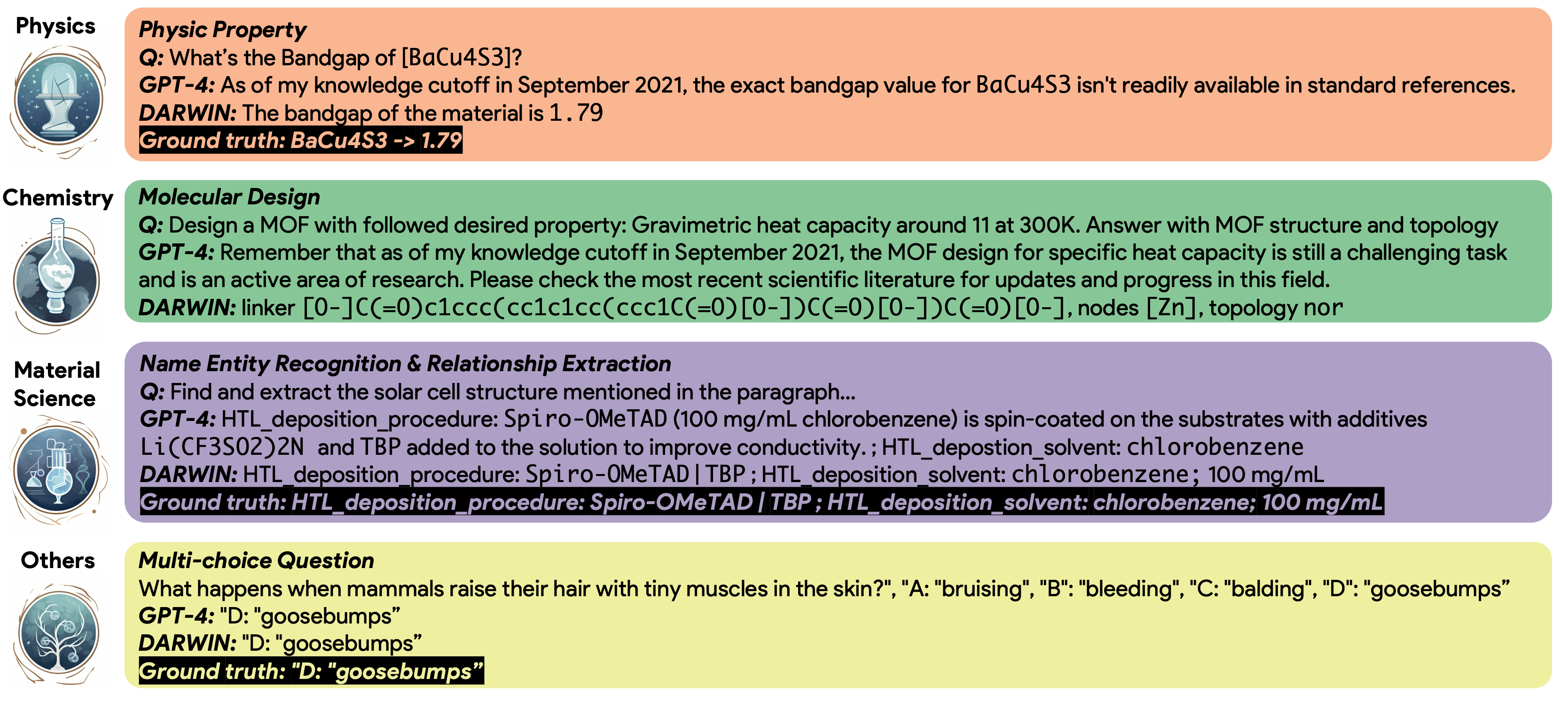
Emerging tools bring forth fresh approaches to work, and the field of natural science is no different. In natural science, traditional manual, serial, and labour-intensive work is being augmented by automated, parallel, and iterative processes driven by artificial intelligence-based experimental automation and more. To add new capabilities in natural science, enabling the acceleration and enrichment of automation of the discovery process, we present DARWIN, a series of tailored LLMs for natural science, mainly in physics, chemistry, and material science. This series relies on open-source LLM, incorporating structured and unstructured scientific knowledge from public datasets and literature. We fine-tuned the models using over 60,000 instruction data points, emphasizing factual correctness. During the fine-tuning, we introduce the Scientific Instruction Generation (SIG) model, automating instruction generation from scientific texts. This eliminates the need for manual extraction or domain-specific knowledge graphs and efficiently injects scientific knowledge into the model. We also explore multi-task training strategies, revealing interconnections between scientific tasks. DARWIN series not only achieves state-of-the-art results on various scientific tasks but also diminishes reliance on closed-source AI models. Our research showcases the ability of LLM in the scientific domain, with the overarching goal of fostering prosperity within the broader AI for science community.
研究の動機と目的
- Motivate and enable accelerated discovery in natural science using tailored LLMs.
- Develop an open-source, cost-effective pipeline leveraging scientific datasets and literature.
- Introduce SIG for automatic instruction generation from scientific texts to inject domain knowledge.
- Demonstrate multi-task training to reveal connections between scientific tasks and improve performance.
- Evaluate DARWIN against baselines on scientific QA and material/device prediction tasks.
提案手法
- Fine-tune open-source LLaMA-7B/Vicuna-7B bases with over 60k scientific instruction demonstrations.
- Develop DARWIN-SIG to generate instruction data from full-text papers using seed QA and iterative prompting.
- Produce DARWIN-BASE by fine-tuning on SciQ-derived and SIG-generated QA pairs.
- Extend DARWIN-BASE to DARWIN-MDP by incorporating 16 FAIR datasets for material/device prediction tasks.
- Use multi-task training to assess performance gains from knowledge-based and cross-task learning.
- Evaluate against baselines (LLaMA-7B, GPT-3/4-derived baselines) on SciQ and MDP benchmarks using accuracy, F1, and MAE.
実験結果
リサーチクエスチョン
- RQ1Can open-source, domain-tailored LLMs achieve state-of-the-art performance on scientific QA and materials design tasks?
- RQ2Does automatic instruction generation from scientific texts (SIG) improve factual accuracy and knowledge injection compared with self-instruct approaches?
- RQ3What gains come from multi-task training across knowledge-based QA and FAIR datasets for material science tasks?
主な発見
- DARWIN-BASE achieves 96.9% accuracy on SciQ (7B model, trained on SciQ plus SIG data).
- DARWIN-MDP yields superior MAE on regression tasks and high F1 on classification tasks across multiple FAIR datasets.
- Multi-task training (DARWIN-MDP) outperforms single-task training (LLaMA-single) and surpasses LLaMA-all in several metrics.
- DARWIN-MDP achieves competitive performance with dedicated ML models on specific tasks, enabling multi-task scientific application with a single model.
- SIG-generated QA pairs provide richer, more content-specific instruction data compared with self-questioning baselines.
この論文を読む
Nubintのビューアで原文を開き、読みながら気になる箇所をすぐに質問できます。
Nubintでこの論文を読むこのレビューはAIが論文の原文をもとに作成しました。引用する前に原文をご確認ください。