
[論文レビュー] Decorrelated Adversarial Learning for Age-Invariant Face Recognition
本論文は、顔の特徴を相関のない身元依存および年齢依存成分に分解することで、年齢に頑健な顔認識を向上させる、新しい深層学習フレームワークである Decorrelated Adversarial Learning (DAL) を提案する。バッチ正準相関分析 (BCCA) を模倣したモジュールを用いて、これらの成分間の相関を敵対的に最小化することで、FG-NET、MORPH Album 2、CACD-VS で最先端の性能を達成し、留出し評価下で FG-NET において 94.5% のランク-1精度を達成した。
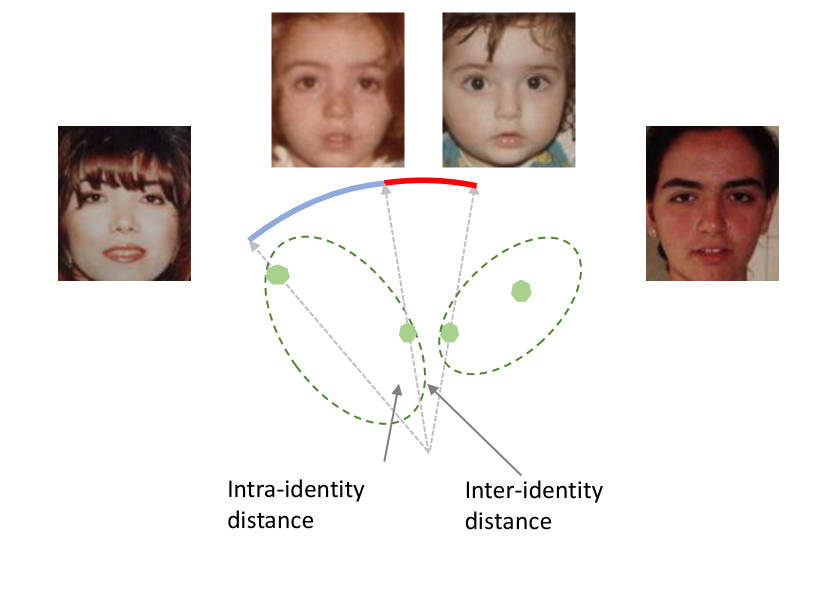
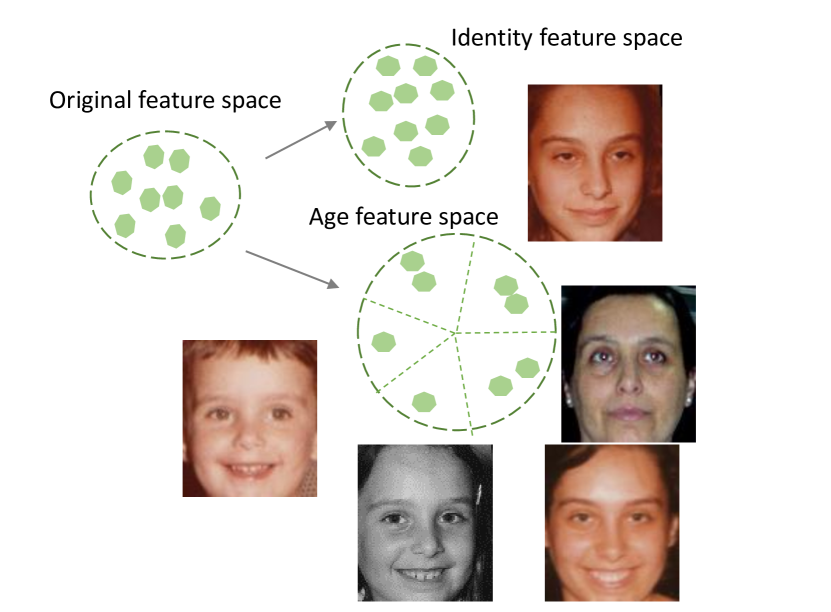
There has been an increasing research interest in age-invariant face recognition. However, matching faces with big age gaps remains a challenging problem, primarily due to the significant discrepancy of face appearances caused by aging. To reduce such a discrepancy, in this paper we propose a novel algorithm to remove age-related components from features mixed with both identity and age information. Specifically, we factorize a mixed face feature into two uncorrelated components: identity-dependent component and age-dependent component, where the identity-dependent component includes information that is useful for face recognition. To implement this idea, we propose the Decorrelated Adversarial Learning (DAL) algorithm, where a Canonical Mapping Module (CMM) is introduced to find the maximum correlation between the paired features generated by a backbone network, while the backbone network and the factorization module are trained to generate features reducing the correlation. Thus, the proposed model learns the decomposed features of age and identity whose correlation is significantly reduced. Simultaneously, the identity-dependent feature and the age-dependent feature are respectively supervised by ID and age preserving signals to ensure that they both contain the correct information. Extensive experiments are conducted on popular public-domain face aging datasets (FG-NET, MORPH Album 2, and CACD-VS) to demonstrate the effectiveness of the proposed approach.
研究の動機と目的
- 顔画像の外見に顕著な変化が生じる年齢変化による顔認識性能の低下という課題に対処すること。
- 従来の手法に見られる、分解が相関しているため、身元特徴に残留する年齢関連情報の制限を克服すること。
- 学習された特徴における身元成分と年齢成分の間の相関を明示的に低減する深層特徴因子分解フレームワークを開発すること。
- 身元分類と年齢分類の信号を同時に用いて、分解された両成分が意味的に意味を持つように保証すること。
- ターゲットデータへの微調整なしに、標準的な年齢に頑健な顔認識ベンチマークデータセットで最先端の性能を達成すること。
提案手法
- 残差ベースの特徴因子分解を提案:$\mathbf{x} = \mathbf{x_{id}} + \mathcal{R}(\mathbf{x})$ で、$\mathbf{x_{id}}$ を身元依存成分、$\mathbf{x_{age}} = \mathcal{R}(\mathbf{x})$ を年齢依存成分とする。
- 正準写像モジュール (CMM) を導入し、$\mathbf{x_{id}}$ と $\mathbf{x_{age}}$ 間の最大相関を微分可能に推定する。
- バックボーンと因子分解ネットワークを、CMM が推定する相関を最小化するように敵対的に最適化する訓練戦略を実装する。
- バッチ正準相関分析 (BCCA) を提案する。これは CCA の確率的勾配ベースの拡張であり、ミニバッチ内で相関勾配を効率的に計算・逆伝播可能にする。
- 身元分類と年齢分類の信号を同時に用いて、$\mathbf{x_{id}}$ と $\mathbf{x_{age}}$ を共同で監視することで、両成分の意味的コンテンツを保持する。
- 推論時、顔認識には常に $\mathbf{x_{id}}$ のみを用いることで、年齢に依存しない身元マッチングを保証する。
実験結果
リサーチクエスチョン
- RQ1身元成分と年齢成分間の敵対的相関最小化は、年齢に頑健な顔認識を向上させ得るか?
- RQ2相関のない身元と年齢成分に特徴を分離することで、未観測の年齢ギャップにおいてより良い一般化性能が得られるか?
- RQ3微分可能で確率的相関推定法(BCCA)は、深層ネットワークにおけるエンドツーエンド学習を効果的にガイドできるか?
- RQ4身元と年齢分類による共同監視は、分解された特徴の品質と分離性にどのように影響するか?
- RQ5提案手法は、標準的な AIFR ベンチマークで、既存の最先端手法をどの程度上回るか?
主な発見
- 提案された DAL 法は、留出し評価プロトコル下で FG-NET データセットにおいて 94.5% のランク-1精度を達成し、HFA (69.0%) や OE-CNNs (88.1%) といった先行手法を顕著に上回った。
- FG-NET の MF2 プロトコルでは、60.01% のランク-1精度を達成し、OE-CNNs による従来の最先端の 53.26% を上回った。
- LFW および MF1-Facescrub の一般顔認識ベンチマークでは、99.47% の認証率と 77.58% のランク-1識別率を達成し、SphereFace や CosFace を上回った。
- アブレーションスタディにより、非相関損失が身元と年齢特徴間の相関を顕著に低減し、より高いロバストネスをもたらすことが確認された。
- モデルはデータセット間で良好な一般化性能を示し、AIFR 専用ベンチマーク(FG-NET、MORPH、CACD-VS)および一般顔認識データセット(LFW、MF1-Facescrub)の両方で最先端の性能を達成した。
- BCCA モジュールは、生成的画像合成に依存せず、安定な勾配伝搬を可能にし、エンドツーエンド学習を有効に支援することで、分離された表現を学習可能にした。
より良い研究を、今すぐ始めましょう
論文の読解から最終レビューまで、研究時間を劇的に削減しましょう。
クレジットカード登録不要
このレビューはAIが作成し、人間の編集者が確認しました。