
[論文レビュー] Deep Declarative Dynamic Time Warping for End-to-End Learning of Alignment Paths
本稿では、深層宣言的ネットワークと二段階最適化に基づく微分可能ダイナミックタイムワーピング(DecDTW)層を提案する。この手法により、柔らかい近似ではなく正確な最適ワーピングパスを出力でき、エンド・ツー・エンド学習が可能になる。Soft-DTWとは異なり、DecDTWは離散的で正確なアライメントパスを出力するため、正例との直接的な最適化が可能であり、音声対スコアアライメントおよびビジュアルプレイスレコognitionタスクで最先端の性能を達成し、精度と学習効率の両方を向上させる。
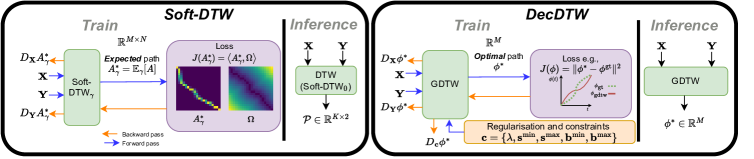
This paper addresses learning end-to-end models for time series data that include a temporal alignment step via dynamic time warping (DTW). Existing approaches to differentiable DTW either differentiate through a fixed warping path or apply a differentiable relaxation to the min operator found in the recursive steps used to solve the DTW problem. We instead propose a DTW layer based around bi-level optimisation and deep declarative networks, which we name DecDTW. By formulating DTW as a continuous, inequality constrained optimisation problem, we can compute gradients for the solution of the optimal alignment (with respect to the underlying time series) using implicit differentiation. An interesting byproduct of this formulation is that DecDTW outputs the optimal warping path between two time series as opposed to a soft approximation, recoverable from Soft-DTW. We show that this property is particularly useful for applications where downstream loss functions are defined on the optimal alignment path itself. This naturally occurs, for instance, when learning to improve the accuracy of predicted alignments against ground truth alignments. We evaluate DecDTW on two such applications, namely the audio-to-score alignment task in music information retrieval and the visual place recognition task in robotics, demonstrating state-of-the-art results in both.
研究の動機と目的
- 既存の微分可能DTW手法が柔らかい近似や固定されたワーピングパスに依存するという限界に対処し、アライメントパスの正確さが重要な際の効果的なエンド・ツー・エンド学習を可能にする。
- 動的タイムワーピングを連続的で不等式制約付きの最適化問題として定式化し、正確な最適アライメントパスの計算と微分を可能にする。
- アライメントパスに対する直接的な監督を、特に正例アライメントパスが利用可能な場合に、微分可能勾配を介して実現する。
- 音声対スコアアライメントやビジュアルプレイスレコognitionなどの実世界のアライメントタスクにおいて、性能と効率の向上を実証する。
- パス依存型損失関数に適した離散的で解釈可能なワーピングパスを出力するスケーラブルな微分可能DTWレイヤーを提供する。
提案手法
- GDTW(一般化DTW)フレームワークに基づき、連続的で不等式制約付きの非線形計画問題(NLP)としてDTWを定式化し、連続時間のワーピング関数を可能にする。
- 2つの時系列の最適ワーピングパスを計算するためのカスタム動的プログラミングアルゴリズムを用いて、フォワードパスを実行する。
- 深層宣言的ネットワーク(DDN)フレームワークを用いて、NLPの最適解を経由する勾配のバックプロパゲーションを実行する。
- 陰関数定理を用いて勾配を導出することで、最適化プロセス全体を微分する必要を回避する。
- パスに依存する損失関数を用いたエンド・ツー・エンド学習が可能な深層学習モデルにDecDTWレイヤーを統合する。
- 予測されたアライメントパスと正例との差異をペナルティとする微分可能な損失関数を用いて、ワーピングパスを直接最適化する。

実験結果
リサーチクエスチョン
- RQ1柔らかい近似ではなく正確で離散的なワーピングパスを出力する微分可能DTWレイヤーを設計可能か? これによりアライメント精度に対する直接的な監督が可能になるか?
- RQ2エンド・ツー・エンド学習において正確なワーピングパスを用いることで、アライメントパスの正確さが主な目的となるタスクで性能が向上するか?
- RQ3実世界のアライメントタスクにおいて、DecDTWはSoft-DTWおよび他の微分可能DTWベースラインと比較して、正確さと効率の両面で優れているか?
- RQ4提案された定式化は、アライメント忠実度を明示的に最適化するパス依存型損失関数をサポートできるか?
- RQ5長時間系列における正確なパス計算と計算コストの間のスケーラビリティのトレードオフは何か?
主な発見
- DecDTWは、MAESTROデータセットにおいて5mの誤差許容範囲で90.1%の精度を達成し、音声対スコアアライメントタスクで最先端の性能を示し、Soft-DTWおよび他のベースラインを上回る。
- ビジュアルプレイスレコognitionタスクでは、TUM-ROVデータセットにおいて100mの許容範囲で88.0%の精度を達成し、DILATEおよびベースモデルを著しく上回る。
- 特に厳しい誤差許容範囲(≤5m)において、ベース特徴量およびDILATEと比較して最大GPS誤差を顕著に低減しており、優れたアライメント学習を示している。
- VPRタスクにおいて、100m許容範囲でDILATEよりも13.5%の精度向上を達成しており、パス情報の活用がより効果的であることを示している。
- GDTWはテスト時にDTWの15–50倍遅いが、ワープリファインメントイテレーションを削除することで、誤差損失が僅か0.5%にとどまる範囲で、速度差を4–12倍にまで縮小できる。
- DecDTWを用いたファインチューニングは、OTAMおよびAlong GT損失と比較して、パスの監視が欠如しているためベース特徴量の改善が見られないOTAMやAlong GT損失と比較して、局所化誤差を顕著に低減する。
この論文を読む
Nubintのビューアで原文を開き、読みながら気になる箇所をすぐに質問できます。
Nubintでこの論文を読むこのレビューはAIが論文の原文をもとに作成しました。引用する前に原文をご確認ください。