
[論文レビュー] Deep Generalized Green's Functions
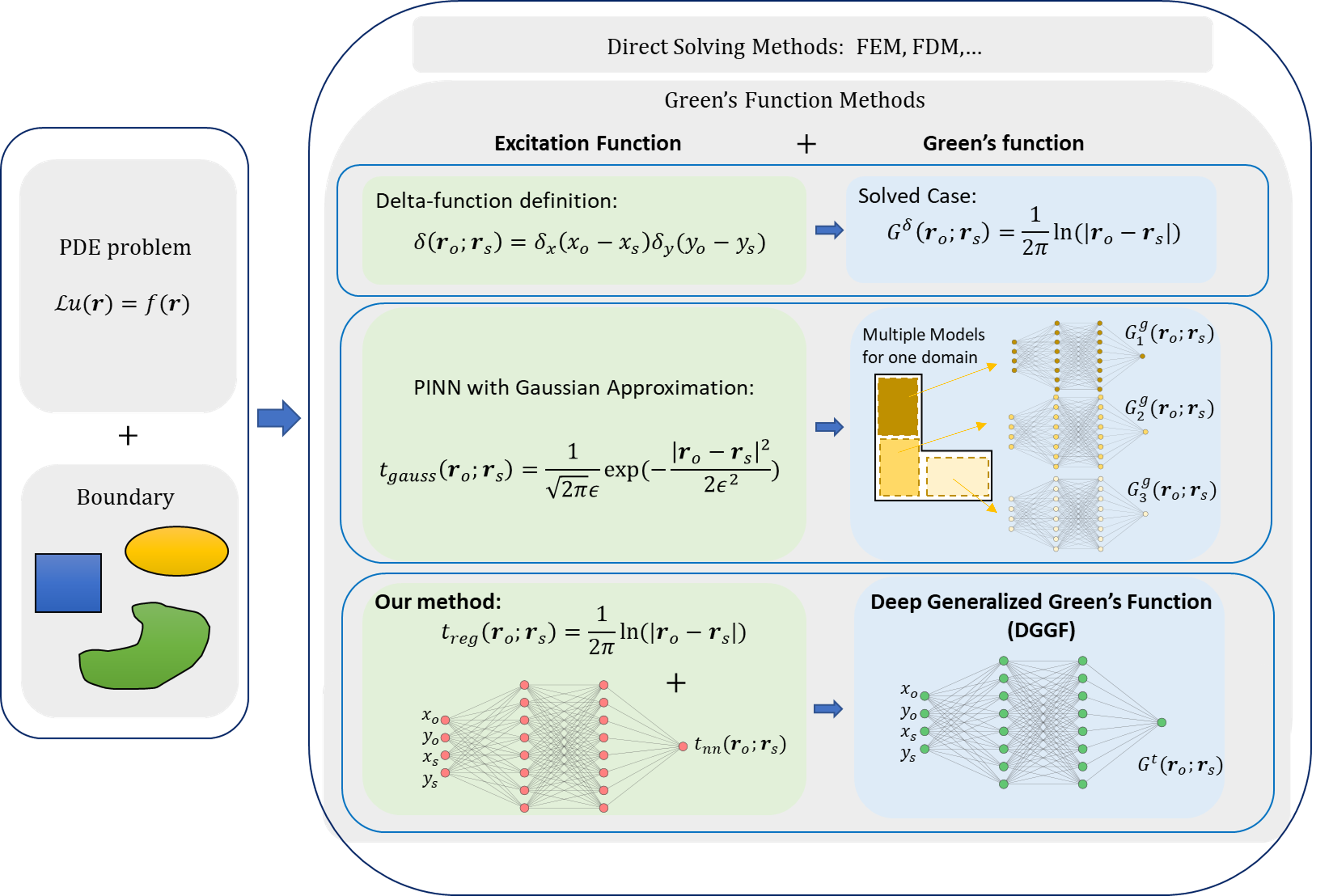
この論文では、従来のグリーン関数におけるデルタ関数特異性を回避するニューラルネットワークベースの手法、Deep Generalized Green's Functions (DGGF) を提案する。DGGF は、メッシュフリーで再利用可能かつ安定した線形偏微分方程式(PDE)の解法を可能にする。DGGF は、PINNs よりも 20,000 倍高速な解法推論を達成しながら、最先端の精度を実現しており、さまざまな PDE 型やドメインにおいて再利用可能でメモリ消費量が低い。
In this study, we address the challenge of obtaining a Green's function operator for linear partial differential equations (PDEs). The Green's function is well-sought after due to its ability to directly map inputs to solutions, bypassing the need for common numerical methods such as finite difference and finite elements methods. However, obtaining an explicit form of the Green's function kernel for most PDEs has been a challenge due to the Dirac delta function singularity present. To address this issue, we propose the Deep Generalized Green's Function (DGGF) as an alternative, which can be solved for in an efficient and accurate manner using neural network models. The DGGF provides a more efficient and precise approach to solving linear PDEs while inheriting the reusability of the Green's function, and possessing additional desirable properties such as mesh-free operation and a small memory footprint. The DGGF is compared against a variety of state-of-the-art (SOTA) PDE solvers, including direct methods, namely physics-informed neural networks (PINNs), Green's function approaches such as networks for Gaussian approximation of the Dirac delta functions (GADD), and numerical Green's functions (NGFs). The performance of all methods is compared on four representative PDE categories, each with different combinations of dimensionality and domain shape. The results confirm the advantages of DGGFs, and benefits of Generalized Greens Functions as an novel alternative approach to solve PDEs without suffering from singularities.
研究の動機と目的
- 線形 PDE における従来のグリーン関数の特異性に起因する解析的・数値的計算の制限を克服すること。
- メッシュに依存する離散化を必要とする FDM や FEM などの従来の PDE ソルバーの代替として、メッシュフリーで再利用可能かつ効率的な手法を開発すること。
- 直接的なデルタ関数のモデリングを避けても、グリーン関数のニューラルネットワーク近似が安定的かつ高精度に可能であることを実現すること。
- グリーン関数の主な利点(再利用可能性と畳み込みに基づく解構築)を維持しつつ、実用的なディープラーニング実装を可能にすること。
- 2次元および3次元のドメインにおいて境界条件が異なる Poisson、Helmholtz、および対流拡散方程式を含む多様な PDE に対して、優れた性能と安定性を示すこと。
提案手法
- ニューラルネットワーク最適化に適合するように、特異性の直接処理を回避する一般化グリーン関数の定式化を提案する。
- PDE と境界条件の満たしを強制するため、残差損失項と境界損失項を用いて、微分可能カーネルとしての一般化グリーン関数を深層ニューラルネットワークで学習する。
- 学習を2段階に分解する:まず時間的または源依存成分 $ G^t $ を学習し、その後、共同最適化により全カーネルを精緻化する。
- 公平な比較のため、PINNs や GaussNet と同等の条件で、100 ニューロン/層の 8 層の標準 ReLU ネットワークを用い、重み減衰なしで ADAM 最適化手法を適用する。
- 弱形式における残差損失 $ \ abla^2 G^t = \delta(\mathbf{x}-\mathbf{x}_0) $ と境界損失を組み合わせた損失関数を実装し、明示的なデルタ関数評価を回避する。
- 公平性を確保するため、同じアーキテクチャとハイパーパrameterを用いて、PINNs、GaussNet(デルタ関数のガウス近似を用いる)、数値グリーン関数(NGF)と比較する。
実験結果
リサーチクエスチョン
- RQ1深層ニューラルネットワークは、デルタ関数特異性を回避しつつ、標準グリーン関数の理論的性質を保持する一般化グリーン関数を学習可能か?
- RQ2DGGF 法は、Poisson、Helmholtz、対流拡散方程式など多様な PDE 型とドメインにおいて、PINNs や GaussNet と比較して、精度と推論速度の点で優れているか?
- RQ3DGGF 法は、複雑または不規則なドメインにおいても、さまざまなランダム初期化に対して安定性を保っているか?
- RQ4DGGF 法は、入力や境界条件が異なる線形問題に対して、再利用可能でメッシュフリーかつ低メモリな PDE 解法構築をどの程度可能にしているか?
- RQ5DGGF 法は、PINNs ら訓練集約型手法と比較して、解法フェーズにおける計算コストを著しく削減しつつ、高い精度を達成できるか?
主な発見
- DGGF は、すべてのテストされた PDE とドメイン設定において、GaussNet よりも少なくとも3桁低い L2 誤差を達成し、優れた学習能力を示している。
- DGGF は PINNs と同等の精度を達成するが、2次元ドメインでは 0.08 秒という解法推論時間を実現した。一方、PINNs は1つの問題に対して約30分の訓練時間を要する。
- 本手法は極めて安定しており、30回の異なるランダム初期化における精度の分散が $ 10^{-11} $ のオーダーにとどまり、強靭性と一貫性のある性能を示している。
- DGGF は再利用可能性を維持している:一度訓練された一般化グリーン関数カーネルは、異なる入力や境界条件を持つ複数の PDE を解くために再利用可能である。
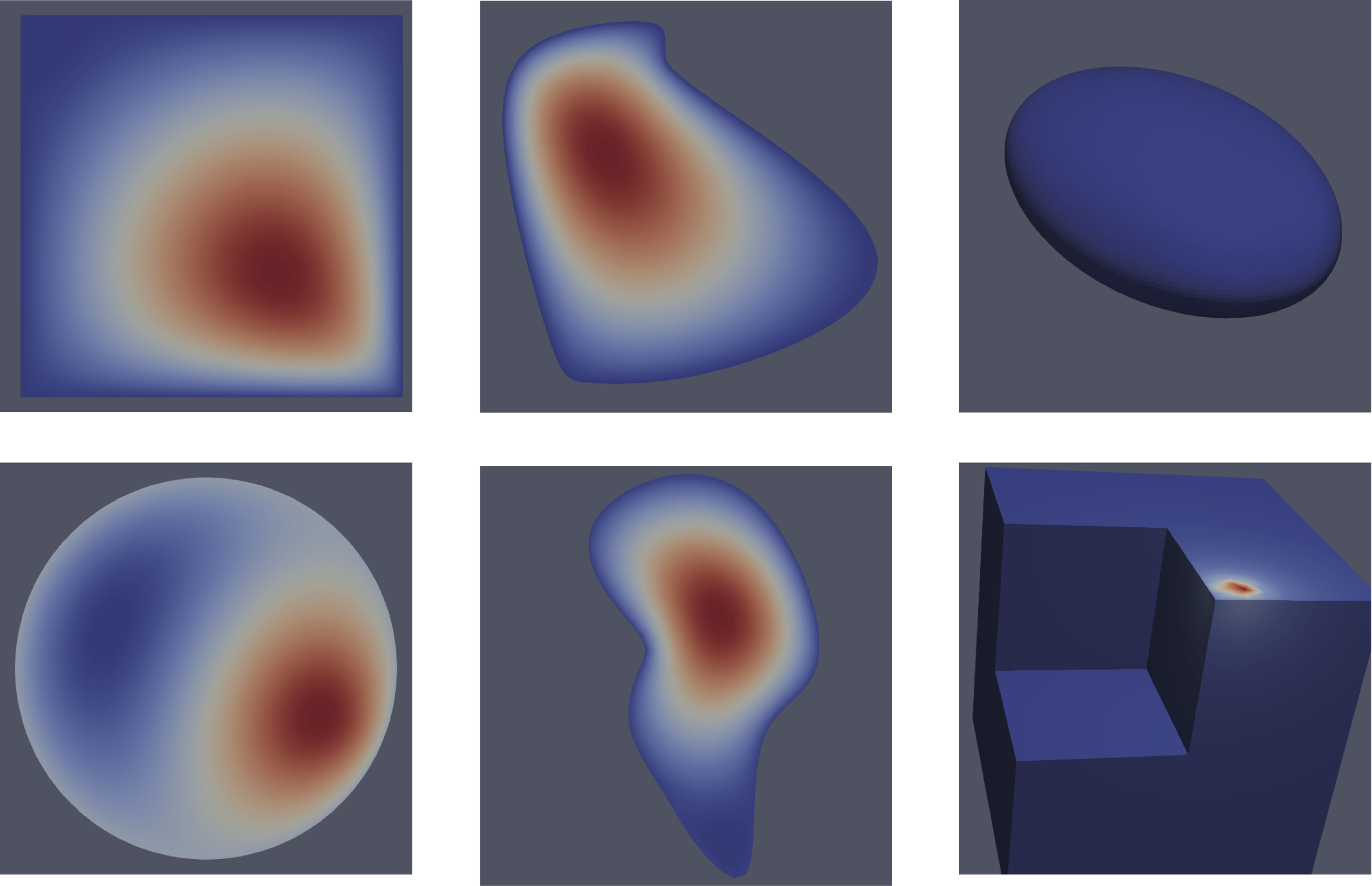
- 本手法は、Poisson、Helmholtz、対流拡散、および波動方程式の4つの PDE カテゴリにわたり、形状や境界条件が異なる2次元および3次元ドメインにおいてもスケーラブルかつ有効である。
- アブレーションスタディにより、$ G^t $ 成分のみを学習しても安定的かつ高精度な結果が得られ、2段階学習戦略および一般化定式化の堅牢性が裏付けられた。
この論文を読む
Nubintのビューアで原文を開き、読みながら気になる箇所をすぐに質問できます。
Nubintでこの論文を読むこのレビューはAIが論文の原文をもとに作成しました。引用する前に原文をご確認ください。