
[論文レビュー] Deep Reinforcement Learning for Traffic Light Control in Intelligent Transportation Systems
この論文は単一の交差点とグリッドネットワークにおけるDRLベースの信号制御を研究し、DQNは単一交差点で最適な制御をもたらす一方、DDPGはグリッドでグリーンウェーブの挙動を生み出すことを示し、指定モデル下でのスケーラビリティとポリシー最適性を立証する。
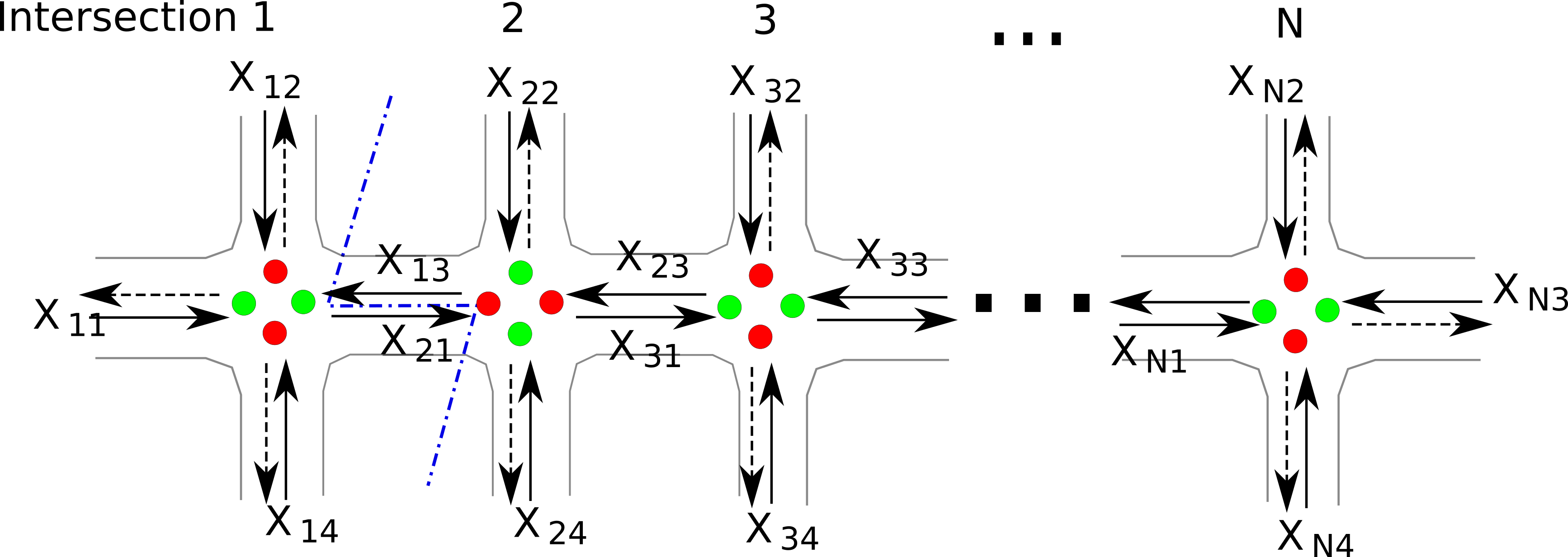
Smart traffic lights in intelligent transportation systems (ITSs) are envisioned to greatly increase traffic efficiency and reduce congestion. Deep reinforcement learning (DRL) is a promising approach to adaptively control traffic lights based on the real-time traffic situation in a road network. However, conventional methods may suffer from poor scalability. In this paper, we investigate deep reinforcement learning to control traffic lights, and both theoretical analysis and numerical experiments show that the intelligent behavior ``greenwave" (i.e., a vehicle will see a progressive cascade of green lights, and not have to brake at any intersection) emerges naturally a grid road network, which is proved to be the optimal policy in an avenue with multiple cross streets. As a first step, we use two DRL algorithms for the traffic light control problems in two scenarios. In a single road intersection, we verify that the deep Q-network (DQN) algorithm delivers a thresholding policy; and in a grid road network, we adopt the deep deterministic policy gradient (DDPG) algorithm. Secondly, numerical experiments show that the DQN algorithm delivers the optimal control, and the DDPG algorithm with passive observations has the capability to produce on its own a high-level intelligent behavior in a grid road network, namely, the ``greenwave" policy emerges. We also verify the ``greenwave" patterns in a $5 imes 10$ grid road network. Thirdly, the ``greenwave" patterns demonstrate that DRL algorithms produce favorable solutions since the ``greenwave" policy shown in experiment results is proved to be optimal in a specified traffic model (an avenue with multiple cross streets). The delivered policies both in a single road intersection and a grid road network demonstrate the scalability of DRL algorithms.
研究の動機と目的
- ITSにおける適応的信号制御のためのDRLの活用を動機づけ、効率を改善し渋滞を低減する。
- 2つのシナリオ:単一の交差点とグリッド道路網でDRL手法を評価する。
- より大規模なネットワークに対するDRLアプローチのスケーラビリティを示す。
- 指定モデルの下で、グリッド網においてグリーンウェーブのような知的行動がDRLから生じることを示す。
提案手法
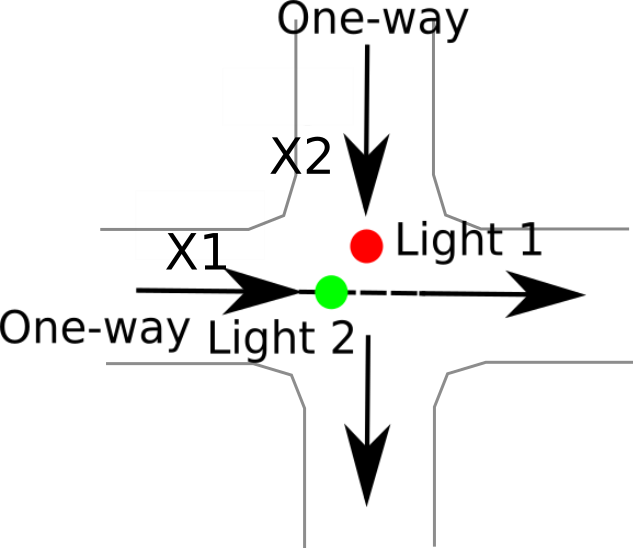
- キュー動力学と離散時間ステップを用いて交通信号制御をMDPとしてモデル化する。
- 単一交差点にDQNを適用し、最適な従来MDP結果と一致するしきい値制御を実証する。
- グリッド網にDDPGを適用して連続的に近い制御を扱い、出力を交通信号用に離散化する。
- エピソードごとの長期渋滞コストZ(X)と割引を用いてポリシーを最適化する。
- 離散アクションを生み出すよう変更したシグモイド活性化を備えた離散化DDPG変種を導入する。
- 指定モデル下でグリッド設定においてグリーンウェーブパターンが最適ポリシーとして現れることを示す。
実験結果
リサーチクエスチョン
- RQ1DRL(DQN)は単一交差点で従来のMDP手法と比較して最適またはほぼ最適な信号制御を達成できるか?
- RQ2DRL(DDPG)はグリッド道路網でグリーンウェーブのような高レベルの知的挙動を生み出せるか?
- RQ3単一交差点からグリッド網へとDRLアプローチのポリシー品質と計算実現性はどうスケールするか?
- RQ4グリーンウェーブポリシーは複数の Cross Streetを持つアベニューの交通モデル下で最適か?
主な発見
- DQNは単一の道路交差点で最適な制御を提供し、従来のMDPの最適ポリシーと一致する。
- グリッド道路網でDDPGはグリーンウェーブのエマージェントパターンを生み出し、明示的なプログラミングなしに高レベルの知的挙動を示す。
- 5×10グリッドでグリーンウェーブパターンが出現し、DRLが大規模ネットワークでスケーラブルで有利な解を生み出せることを示す。
- グリーンウェーブポリシーは、複数の横断通りを持つアベニューの指定された交通モデル内で最適であることが示される。
- 本研究は単一交差点からグリッド網へのDRLアルゴリズムのスケーラビリティを示し、渋滞対策の有利な成果を得る。
この論文を読む
Nubintのビューアで原文を開き、読みながら気になる箇所をすぐに質問できます。
Nubintでこの論文を読むこのレビューはAIが論文の原文をもとに作成しました。引用する前に原文をご確認ください。