
[論文レビュー] DeMamba: AI-Generated Video Detection on Million-Scale GenVideo Benchmark
本稿では、AI生成動画検出のための初のミリオンスケールデータセットGenVideoと、構造的状態空間モデルを用いて空間的・時間的不一致をモデル化するプレグ・アンド・プレイモジュールDeMambaを紹介する。DeMambaは、最先端の汎化性能と耐性を実現し、ベンチマーク上でXCLIPの精度を10.22%向上、APを12.02%向上させた。
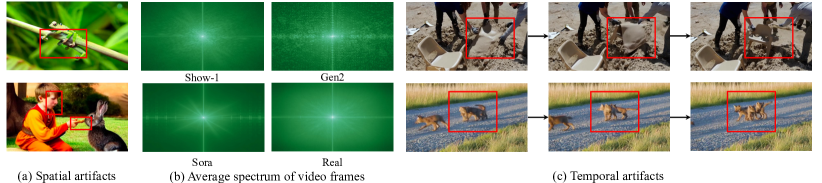
Recently, video generation techniques have advanced rapidly. Given the popularity of video content on social media platforms, these models intensify concerns about the spread of fake information. Therefore, there is a growing demand for detectors capable of distinguishing between fake AI-generated videos and mitigating the potential harm caused by fake information. However, the lack of large-scale datasets from the most advanced video generators poses a barrier to the development of such detectors. To address this gap, we introduce the first AI-generated video detection dataset, GenVideo. It features the following characteristics: (1) a large volume of videos, including over one million AI-generated and real videos collected; (2) a rich diversity of generated content and methodologies, covering a broad spectrum of video categories and generation techniques. We conducted extensive studies of the dataset and proposed two evaluation methods tailored for real-world-like scenarios to assess the detectors' performance: the cross-generator video classification task assesses the generalizability of trained detectors on generators; the degraded video classification task evaluates the robustness of detectors to handle videos that have degraded in quality during dissemination. Moreover, we introduced a plug-and-play module, named Detail Mamba (DeMamba), designed to enhance the detectors by identifying AI-generated videos through the analysis of inconsistencies in temporal and spatial dimensions. Our extensive experiments demonstrate DeMamba's superior generalizability and robustness on GenVideo compared to existing detectors. We believe that the GenVideo dataset and the DeMamba module will significantly advance the field of AI-generated video detection. Our code and dataset will be aviliable at \url{https://github.com/chenhaoxing/DeMamba}.
研究の動機と目的
- AI生成動画検出のための大規模かつ多様なデータセットが不足している問題に対処すること。
- 未観測の動画生成モデルに対しても汎化可能であり、実世界の動画劣化に対しても耐性を示す検出手法を開発すること。
- AI生成動画における微細な空間的・時間的不一致を同定できる検出モジュールを設計すること。
- 実世界の検出課題を模擬するベンチマークタスクを確立すること:生成モデル間の汎化性と劣化した動画分類。
提案手法
- 著者らは、多様なソースと生成モデルから成る1,078,838本のAI生成動画と1,223,511本の実動画を含むGenVideoというデータセットを構築した。
- 2つの評価タスクを導入した:未観測の生成モデル間での汎化性をテストするクロスジェネレータ分類、および品質劣化下での耐性を評価する劣化動画分類。
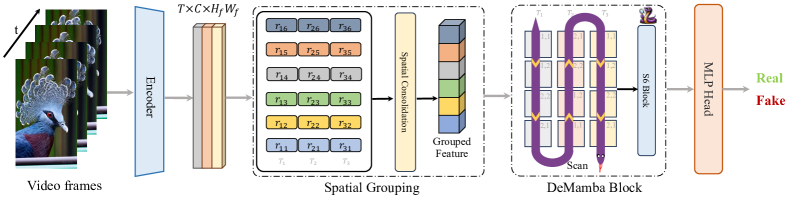
- DeMambaは、空間的・時間的不一致を分析する構造的状態空間モデルに基づくプレグ・アンド・プレイモジュールである。
- モジュールは動画クリップを空間的領域に分割し、順次走査することで時間的・空間的全域にわたる異常を検出する。
- DeMambaは既存の特徴抽出器(例:XCLIP)と統合され、エンドツーエンドで微調整されて検出性能が向上した。
- 局所的不一致のモデリングを向上させるために、領域ベースの特徴集約と連続走査を採用した。
実験結果
リサーチクエスチョン
- RQ1GenVideoのような大規模かつ多様なデータセットは、より強固で汎化性の高いAI生成動画検出を可能にするか?
- RQ2多様な生成モデルのセットで学習した検出器は、未観測の動画生成モデルに対し、どの程度汎化できるか?
- RQ3H.264圧縮、JPEG圧縮、ガウスノイズ、画像透かしなどの実世界の動画劣化(例:圧縮やぼやけ)に直面した場合、検出モデルはどの程度性能を維持できるか?
- RQ4空間的・時間的不一致をモデル化するプレグ・アンド・プレイモジュールは、検出精度と耐性を顕著に向上させることができるか?
主な発見
- DeMamba-XCLIP-FTはGenVideoベンチマーク上で平均94.42%の精度と平均97.10%のAPを達成し、元のXCLIPモデル比で精度が10.22%向上、APが12.02%向上した。
- モデルは、多数対多数および1対多数のクロスジェネレータ分類タスクにおいて優れた汎化性能を示し、未観測の生成モデルに対しても高い適応性を示した。
- 劣化動画分類において、DeMamba-XCLIP-FTはH.264圧縮、JPEG圧縮、ガウスノイズ、画像透かしなどの8種類の摂動に対して、すべてのベースラインを上回った。
- アブレーションスタディの結果、DeMambaは検出性能を顕著に向上させ、融合特徴と領域サイズ2を用いた際が最適な結果をもたらした。
- DeMambaにおける連続走査順序は、従来の走査方法を上回り、不一致モデリングにおける順次処理の重要性を示した。
- 本研究では、Mambaベースのアーキテクチャ固有の計算コストが原因で、DeMambaの学習非効率性が主な制約要因であると特定した。
この論文を読む
Nubintのビューアで原文を開き、読みながら気になる箇所をすぐに質問できます。
Nubintでこの論文を読むこのレビューはAIが論文の原文をもとに作成しました。引用する前に原文をご確認ください。