
[論文レビュー] DERA: Enhancing Large Language Model Completions with Dialog-Enabled Resolving Agents
DERA は臨床タスク向けに出力を反復的に洗練させる二-agent ダイアログフレームワークを導入し、ベースライン GPT-4 より医療会話の要約とケアプラン生成で改善を示す一方、オープンエンドの医療QAでは混合した成果を得た。
Large language models (LLMs) have emerged as valuable tools for many natural language understanding tasks. In safety-critical applications such as healthcare, the utility of these models is governed by their ability to generate outputs that are factually accurate and complete. In this work, we present dialog-enabled resolving agents (DERA). DERA is a paradigm made possible by the increased conversational abilities of LLMs, namely GPT-4. It provides a simple, interpretable forum for models to communicate feedback and iteratively improve output. We frame our dialog as a discussion between two agent types - a Researcher, who processes information and identifies crucial problem components, and a Decider, who has the autonomy to integrate the Researcher's information and makes judgments on the final output. We test DERA against three clinically-focused tasks. For medical conversation summarization and care plan generation, DERA shows significant improvement over the base GPT-4 performance in both human expert preference evaluations and quantitative metrics. In a new finding, we also show that GPT-4's performance (70%) on an open-ended version of the MedQA question-answering (QA) dataset (Jin et al. 2021, USMLE) is well above the passing level (60%), with DERA showing similar performance. We release the open-ended MEDQA dataset at https://github.com/curai/curai-research/tree/main/DERA.
研究の動機と目的
- 臨床NLP出力の事実性と網羅性を向上させるために、ダイアログ対応の解決エージェントの活用を動機づける。
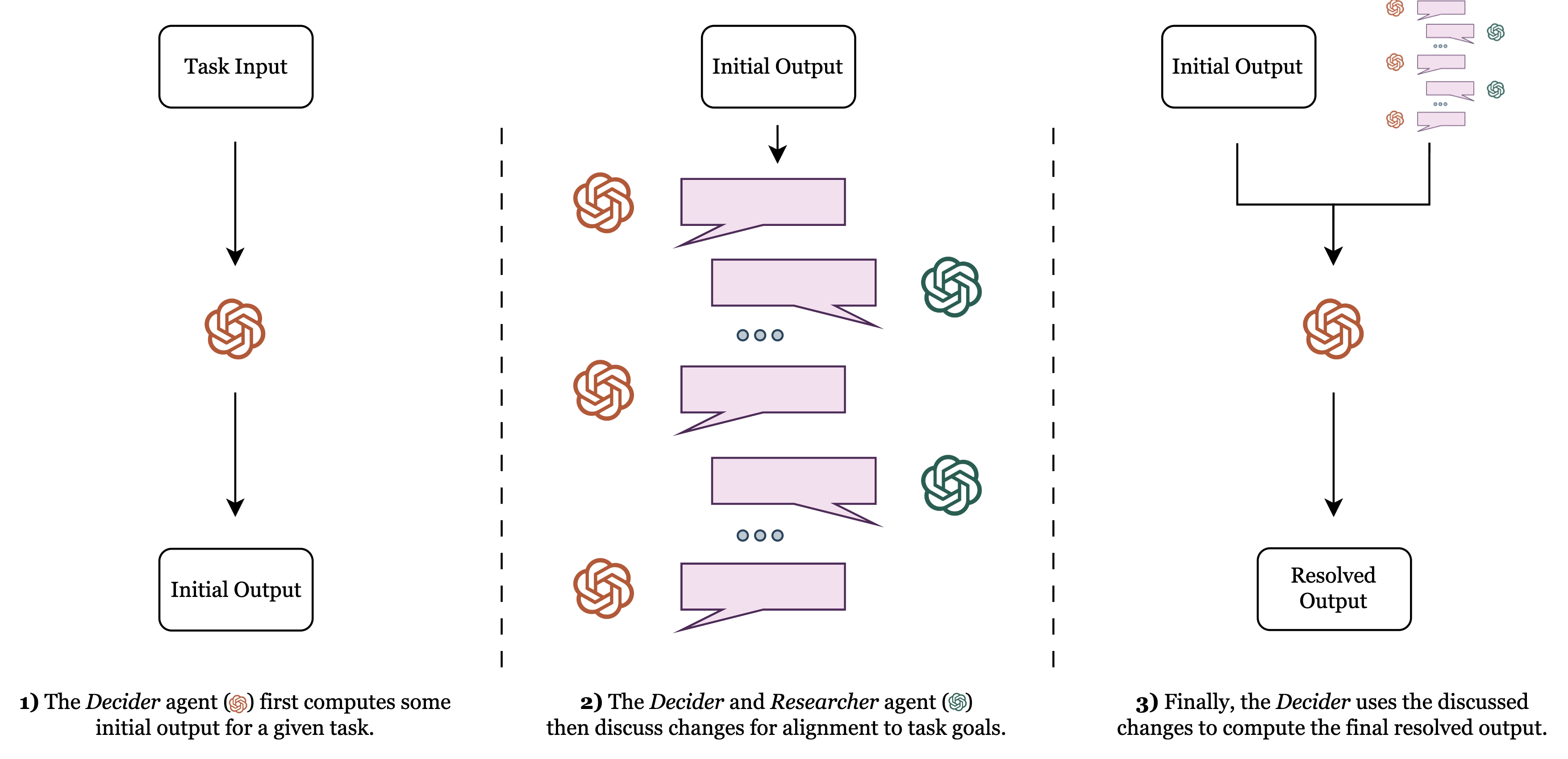
- 構造化された対話を介して出力を反復的に洗練させる二-agent(Researcherと Decider)フレームワークを導入する。
- DERAを医療会話の要約、ケアプラン生成、オープンエンド医療質問応答の評価に用いる。
- 長文生成タスクにおける専門家合意品質の改善を示し、オープンエンドのMedQAデータセットの公開を提供する。
提案手法
- 研究者が重要な問題要素を特定し、デシーダーが情報を統合して最終出力を作成する二-agentダイアログフレームワークを提案する。
- デシーダー生成の初期出力を用い、その後、研究者が不整合を指摘し、デシーダーが共有のスクラッチパッドを更新する反復対話を行う。
- デシーダーが最終判断を下すことを許容し、研究者に全てを委ねず、役割定義された反復的な精錬を可能にする。
- DERAを三つのタスク、医療会話の要約、ケアプラン生成、オープンエンド医療質問応答に適用する。
- タスク固有のプロンプトと制限された対話長を用いて、反復的な修正を引き出すGPT-4を活用する(例示プロンプトとプロンプトの改良が記述されている)。
- 欠損・破損した要約の訂正と計画の完全性を評価するために、医師評価者などの人間専門家評価と定量的指標(GPT-F1)を提供する。
実験結果
リサーチクエスチョン
- RQ1二-agentダイアログ(ResearcherとDecider)は、ベースラインのGPT-4プロンプトと比較して、医療LLM出力の事実性の網羅性を改善し、幻覚を減らすことができるか?
- RQ2DERAは臨床環境で長文出力(要約とケアプラン)を、短文のオープンエンドQAより一貫して向上させるか?
- RQ3対話による反復的な誤り訂正は、医療要約における人工的な破損をどの程度修正できるか?
- RQ4非選択式に再構成された質問で、オープンエンド医療QAデータセットに対するDERAの性能はどうなるか?
- RQ5著者はDERAを用いた医療QA研究を促進するため、オープンエンドのMEDQAデータセットを公開する可能性はどの程度か?
主な発見
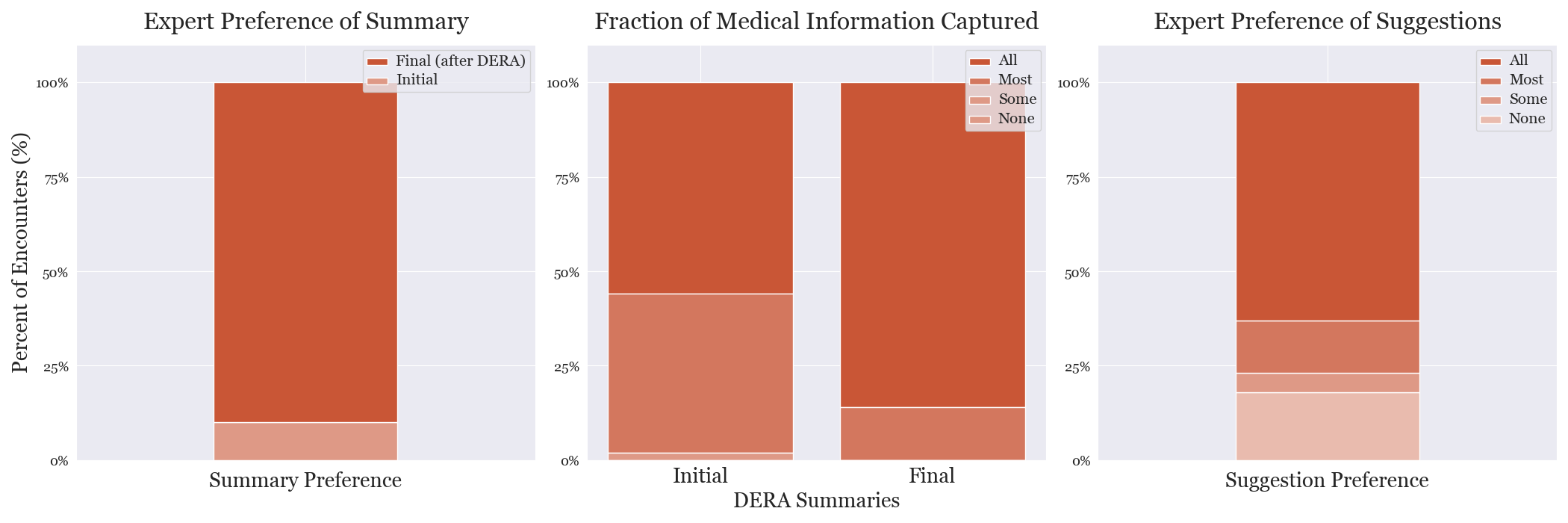
- DERAは医師の専門家の好みによると、医療会話の要約でベースのGPT-4を上回る。
- DERAは初期のGPT-4出力よりも、医師が関連する医療情報をより多く捉えていると評価する要約を生み出す。
- DERAはケアプラン生成を改善し、医師は最終的なDERAプランを初期のGPT-4プランより好み、完全性を高く評価する。
- 欠損要約を用いた定量評価は、低・中・高の破損レベルを横断してDERAがGPT-F1スコアを大幅に改善することを示している。
- DERAはオープンエンドのMedQA様のQAで準専門家レベルの性能を達成し、対話ベースの洗練が知識推論タスクにも拡張可能であることを示している。
- 著者らはDERAを用いた医療QA研究を促進するため、オープンエンドのMEDQAデータセットを公開する。
この論文を読む
Nubintのビューアで原文を開き、読みながら気になる箇所をすぐに質問できます。
Nubintでこの論文を読むこのレビューはAIが論文の原文をもとに作成しました。引用する前に原文をご確認ください。