
[論文レビュー] Detecting Unknown Encrypted Malicious Traffic in Real Time via Flow Interaction Graph Analysis
HyperVision は、コン pact なメモリ内グラフを通じてフローパターンの相互作用を分析することにより、ラベルなしデータや攻撃パターンの事前知識が不要なリアルタイムで非教師あり機械学習システムであり、未知の暗号化された悪意あるトラフィックを検出する。高い検出精度(AUC ≥ 0.92、F1 ≥ 0.86)とスループット(>80.6 Gb/s)を達成している。
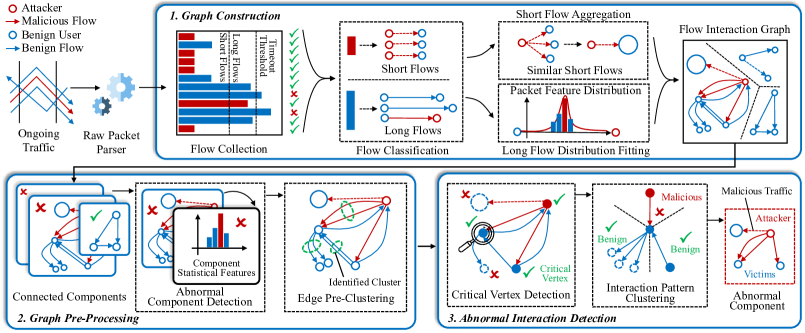
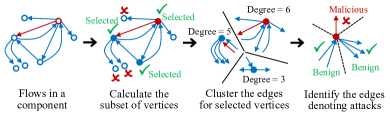
In this paper, we propose HyperVision, a realtime unsupervised machine learning (ML) based malicious traffic detection system. Particularly, HyperVision is able to detect unknown patterns of encrypted malicious traffic by utilizing a compact inmemory graph built upon the traffic patterns. The graph captures flow interaction patterns represented by the graph structural features, instead of the features of specific known attacks. We develop an unsupervised graph learning method to detect abnormal interaction patterns by analyzing the connectivity, sparsity, and statistical features of the graph, which allows HyperVision to detect various encrypted attack traffic without requiring any labeled datasets of known attacks. Moreover, we establish an information theory model to demonstrate that the information preserved by the graph approaches the ideal theoretical bound. We show the performance of HyperVision by real-world experiments with 92 datasets including 48 attacks with encrypted malicious traffic. The experimental results illustrate that HyperVision achieves at least 0.92 AUC and 0.86 F1, which significantly outperform the state-of-the-art methods. In particular, more than 50% attacks in our experiments can evade all these methods. Moreover, HyperVision achieves at least 80.6 Gb/s detection throughput with the average detection latency of 0.83s.
研究の動機と目的
- 従来のシグネチャーや教師あり機械学習ベースの手法が回避する未知の暗号化された悪意あるトラフィックを検出する課題に対処すること。
- 攻撃パターンやラベル付きデータの事前知識が不要な状態で、暗号化攻撃のリアルタイム検出を可能にすること。
- 単一フロー特徴ではなく、複数のネットワークフロー間の相互作用パターンを通じて、複雑な攻撃行動をモデル化すること。
- 攻撃シグネチャの事前知識が不要なタスクに特化しない検出システムを構築すること。
提案手法
- ネットワークフローの接続性、スパarsity、統計的特徴を捉えるコン pact なメモリ内フローアクセスグラフを構築する。
- 短いフローと長いフローからの相互作用パターンを2つの戦略で表現し、多様なトラフィック行動の統合的分析を可能にする。
- グラフ内の構造的および統計的逸脱に基づいて異常を検出する非教師ありグラフ学習手法を適用する。
- グラフが検出に必要な近似的最適情報量を保持していることを示す情報理論モデルを活用する。
- 離散時間マルコフ連鎖(DTMC)を用いて、グラフ表現の情報保持効率を定量的に評価する。
- リアルタイム処理パイプラインを統合し、平均遅延 0.83 秒、スループット >80.6 Gb/s の低遅延検出を実現する。
実験結果
リサーチクエスチョン
- RQ1暗号化トラフィックにおけるフローパターンの相互作用は、ラベルなしデータが不要な状態で、未知の攻撃を効果的にモデル化できるか?
- RQ2コン pact なメモリ内グラフは、暗号化トラフィックにおける悪意ある行動検出に必要な情報をどれほど効果的に保持しているか?
- RQ3非教師ありグラフ学習は、単一フロー分析では検出できない暗号化トラフィックの異常を検出できるか?
- RQ4情報理論的限界としてのグラフベース表現の悪意あるトラフィック検出における理論的上限は何か?
- RQ5実世界の暗号化攻撃を検出する際、HyperVision は最先端の手法と比較してどの程度の性能を示すか?
主な発見
- HyperVision は 92 個の実世界の攻撃データセットにおいて、AUC が 0.92 以上、F1 が 0.86 以上を達成し、最先端の手法を著しく上回っている。
- テストした 48 個の攻撃の 50% 以上(24 個)が、5 つの既存の最先端検出システムすべてを回避していた。
- 平均遅延 0.83 秒で 80.6 Gb/s 以上の検出スループットを維持している。
- フローアクセスグラフが保持する情報量は、理論的な情報理論的上限に近い。
- HyperVision は、暗号化トラフィックに依存する複雑でマルチステージの攻撃を効果的に検出でき、単一フロー分析では検出不能な攻撃も検出可能である。
- 攻撃シグネチャの事前知識が不要な状態で、C2 採掘、マルウェアキャンペーン、データ漏洩など多様な攻撃タイプに効果的に対応できる。
この論文を読む
Nubintのビューアで原文を開き、読みながら気になる箇所をすぐに質問できます。
Nubintでこの論文を読むこのレビューはAIが論文の原文をもとに作成しました。引用する前に原文をご確認ください。