
[論文レビュー] Diffusion Model-Augmented Behavioral Cloning
本稿では、行動乗法(BC)と拡散モデルを組み合わせることで、専門家のデモンストレーションの条件付き分布 $p(a|s)$ と連合分布 $p(s,a)$ を同時に学習する、新しい模倣学習フレームワークである拡散モデル拡張行動乗法(DBC)を提案する。BCと専門家データに一致するように行動を促進する拡散モデル損失を最適化することで、ナビゲーション、操作、歩行の環境において、限られた専門家データでも、従来手法(Diffusion Policy や BC を含む)を上回る最先端の性能を達成する。
Imitation learning addresses the challenge of learning by observing an expert's demonstrations without access to reward signals from environments. Most existing imitation learning methods that do not require interacting with environments either model the expert distribution as the conditional probability p(a|s) (e.g., behavioral cloning, BC) or the joint probability p(s, a). Despite the simplicity of modeling the conditional probability with BC, it usually struggles with generalization. While modeling the joint probability can improve generalization performance, the inference procedure is often time-consuming, and the model can suffer from manifold overfitting. This work proposes an imitation learning framework that benefits from modeling both the conditional and joint probability of the expert distribution. Our proposed Diffusion Model-Augmented Behavioral Cloning (DBC) employs a diffusion model trained to model expert behaviors and learns a policy to optimize both the BC loss (conditional) and our proposed diffusion model loss (joint). DBC outperforms baselines in various continuous control tasks in navigation, robot arm manipulation, dexterous manipulation, and locomotion. We design additional experiments to verify the limitations of modeling either the conditional probability or the joint probability of the expert distribution, as well as compare different generative models. Ablation studies justify the effectiveness of our design choices.
研究の動機と目的
- 行動乗法(BC)の一般化の限界、特に訓練安定性は保たれるが分布外の状態で困難をきたす問題に対処する。
- 模倣学習における連合確率モデル化の非効率性と多様体への過適合問題を克服する。
- 条件付きモデル化($p(a|s)$)の効率性と連合モデル化($p(s,a)$)の一般化の利点を統合したフレームワークを構築する。
- 環境との相互作用なしに、拡散モデルを活用してポリシー学習を改善する手法を開発する。
- 連合モデル化による拡散モデルの有効性を実験的に検証する。
提案手法
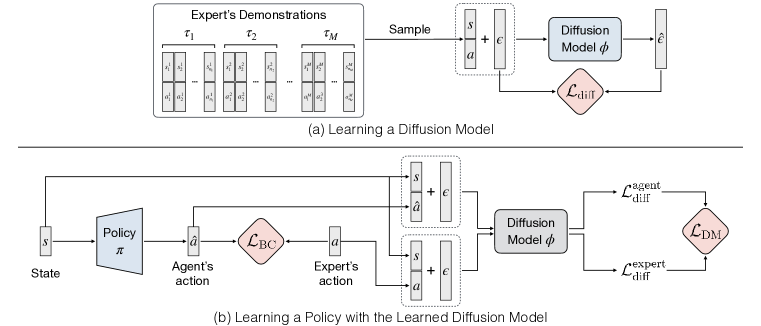
- フレームワークは、標準的な BC 損失に加え、予測された行動が専門家分布に一致するよう促進する新しい拡散モデル損失を最小化するようにポリシーを訓練する。
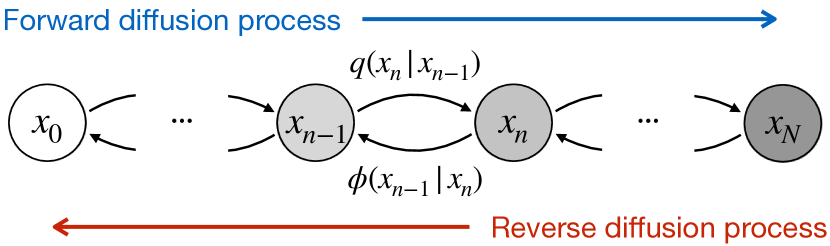
- 拡散モデルは、専門家デモンストレーションの連合分布 $p(s,a)$ をモデル化するように訓練される。
- 拡散損失 $\mathcal{L}_{\text{diff}}$ は、専門家データ $(s,a)$ と予測された行動 $(s,\hat{a})$ の両方に対して計算され、コントラストIVEな目的関数として定式化される:$\mathcal{L}_{\text{DM}} = \mathbb{E}_{(s,a)\sim D,\hat{a}\sim\pi(s)}[\max(\mathcal{L}_{\text{diff}}^{\text{agent}} - \mathcal{L}_{\text{diff}}^{\text{expert}}, 0)]$。
- 最終的な目的関数は、ハイパーパramータ $\lambda$ を用いて BC 損失と拡散損失を組み合わせる。
- 本手法は、ナビゲーション、ロボットアームの操作、歩行を含む連続制御タスクで評価され、完全なデータセットと縮小されたデータセットサイズの両方を用いる。
- アブレーションスタディでは、さまざまな生成モデルの比較と、ハイパーパramータおよびデータスパarsityの影響の分析が行われる。
実験結果
リサーチクエスチョン
- RQ1環境との相互作用なしに、専門家デモンストレーションの条件付き分布と連合分布を同時にモデル化することで、模倣学習の一般化性能が向上するか?
- RQ2限られたデータ環境下で、提案された拡散モデル拡張 BC フレームワークは、標準的な BC や Diffusion Policy のベースラインと比べてどのように性能を発揮するか?
- RQ3連合分布 $p(s,a)$ をモデル化するために拡散モデルを用いることで、ポリシーの一般化性能とデータサイズの変動に対するロバストネスにどのような影響を与えるか?
- RQ4拡散損失やハイパーパramータ $\lambda$ などのフレームワークの異なる構成要素が、性能に与える影響は何か?
- RQ5本手法は、BC や連合モデル化アプローチで一般的に見られる多様体への過適合と誤差の累積問題を緩和するか?
主な発見
- DBC は、ナビゲーション、ロボットアームの操作、歩行の全タスクにおいて、BC や Implicit BC、Diffusion Policy をすべて上回り、最高の成功確率を達成した。
- Maze 環境では、データセットの 100% を使用した場合、DBC は 95.4% ± 1.7% の成功率を達成し、Diffusion Policy(95.5% ± 1.9%)をわずかに上回り、BC(92.1% ± 3.6%)を顕著に上回った。
- データセットの 25% のみを用いた場合、DBC は 71.2% ± 3.9% の成功率を達成し、Diffusion Policy(72.7% ± 9.2%)を上回り、データ不足に対するロバストネスが顕著に優れていた。
- アブレーションスタディの結果、拡散損失が性能に不可欠であることが確認され、異なる設定でもハイパーパramータ $\lambda$ に対してロバストであることが示された。
- 特にデータが少ない環境下で、DBC は優れた一般化性能を示し、BC や Implicit BC は顕著な性能低下を示した。
- 結果は、拡散モデルによる条件付きと連合モデル化の統合が、サンプル効率性とポリシー性能の両方を向上させることを裏付けた。
この論文を読む
Nubintのビューアで原文を開き、読みながら気になる箇所をすぐに質問できます。
Nubintでこの論文を読むこのレビューはAIが論文の原文をもとに作成しました。引用する前に原文をご確認ください。