
[論文レビュー] DiffusionInst: Diffusion Model for Instance Segmentation
DiffusionInstはインスタンス分割をノイズからフィルタへデノイズするプロセスとして扱い、マスクをインスタンス認識フィルタとダイナミックマスクヘッドで表現し、さまざまなバックボーンでCOCOとLVISで競争力のある結果を達成。
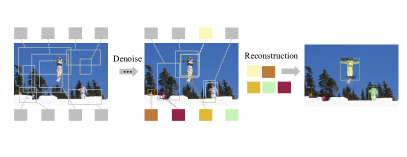
Diffusion frameworks have achieved comparable performance with previous state-of-the-art image generation models. Researchers are curious about its variants in discriminative tasks because of its powerful noise-to-image denoising pipeline. This paper proposes DiffusionInst, a novel framework that represents instances as instance-aware filters and formulates instance segmentation as a noise-to-filter denoising process. The model is trained to reverse the noisy groundtruth without any inductive bias from RPN. During inference, it takes a randomly generated filter as input and outputs mask in one-step or multi-step denoising. Extensive experimental results on COCO and LVIS show that DiffusionInst achieves competitive performance compared to existing instance segmentation models with various backbones, such as ResNet and Swin Transformers. We hope our work could serve as a strong baseline, which could inspire designing more efficient diffusion frameworks for challenging discriminative tasks. Our code is available in https://github.com/chenhaoxing/DiffusionInst.
研究の動機と目的
- インスタンス分割のための拡散モデルベースのフレームワークの動機づけと探究。
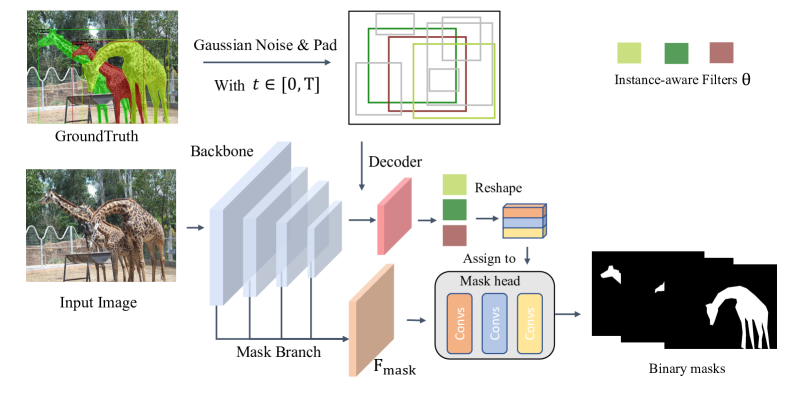
- ノイズからフィルタへのデノイズを可能にするため、インスタンス認識フィルタとグローバルマスク特徴量を用いてインスタンスマスクを表現する。
- RPN帰納的バイアスを持たず、グランドトゥルースボックスとフィルタ上でノイズ対ノイズの拡 diffusion 過程で訓練する。
- ResNetやSwin Transformerなどのバックボーンに跨って、COCOとLVISで競争力のある性能を示す。
提案手法
- 各インスタンスマスクを、インスタンス認識フィルタに条件付けられたダイナミックマスクヘッドとして表現し、FPNからのマルチスケールマスク特徴と組み合わせる。
- インスタンス分割を、ノイズのある真偽ボックスとノイズのあるフィルタをデノイズしてマスクを生成するデノイジング拡散過程として定式化する。
- マスク分岐を用いてマルチスケール情報を保持し、デノイズされたフィルタによって与えられた畳み込み重みを持つダイナミックマスクヘッドを介してグローバルなマスク再構成を可能にする。
- マスクに対してダイス損失を用い、検出損失を組み合わせ、DiffusionDetに似た複数の監督段階で学習する。
- 推論時には、初期のノイズ入力(ボックスとフィルタ)をガウス分布からサンプリングして1段階または多段階のデノイズを行い、DDIMベースの反復で精練する。
実験結果
リサーチクエスチョン
- RQ1拡散モデルを、RPNのバイアスを避けつつ、インスタンス分割のような識別的タスクに効果的に適用できるか?
- RQ2拡散デノイズを活用しつつグローバルな文脈を維持するために、インスタンスマスクをどのように表現すべきか?
- RQ3多段階デノイズとバックボーンの選択が、拡散ベースのインスタンス分割におけるCOCO/LVISの性能に与える影響は何か?
- RQ4従来法やクエリベース手法と比較した際のDiffusionInstの速度と精度のトレードオフは何か?
主な発見
- DiffusionInstはCOCO検証データでResNet-50と1ステップデノイズで37.3 APを達成し、同じバックボーン下でMask R-CNN、SOLO、CondInstを上回る。
- より大きなバックボーン(Swin-L)と5xスケジュールで、DiffusionInstはSwin-LでCOCOの47.8 APに到達し、いくつかのベースラインを上回る。
- COCO test-devでは、Swin-L 5xのDiffusionInstは47.8 AP(1-step)と、4-step variantでAP Lが51.9 APを達成し、バックボーンの影響を示す。
- DiffusionInstはLVISでSwin-Base/Swin-Lと競合する性能を示し、特に長尾カテゴリでMask R-CNNのいくつかのベースラインを上回り改善。
- 1-step拡散設定は強力な結果を提供し、多段階デノイズは通常約0.3%の小さな増分利得で推論が遅い。
- DiffusionInstの訓練には相当な計算資源を要し(例:ResNet-50構成で8 A100 GPU上で26時間)、RPNベースの帰納的バイアスを欠くため、拡散ベースの識別タスクの競争力のあるベースラインとなる。
この論文を読む
Nubintのビューアで原文を開き、読みながら気になる箇所をすぐに質問できます。
Nubintでこの論文を読むこのレビューはAIが論文の原文をもとに作成しました。引用する前に原文をご確認ください。