
[論文レビュー] Disentangling the Faraday rotation sky
本稿では、外部銀河系のフレイデー回折測定値、パルサー分散測定値、および熱電子トレーサー(Hα、ブレムストラールーニング)を統合的に分析することで、情報場理論を用いて、初の全天磁気場の線路上平均のマップを提示する。この手法により、$B_\parallel$ と電子密度 $n_{\mathrm{th}}$ が分離され、全天空で1.1 μGのRMS磁場強度が得られ、高緯度ではモデルと整合的だが、銀河平面の系統的誤差に影響を受ける分散測定マップが得られた。
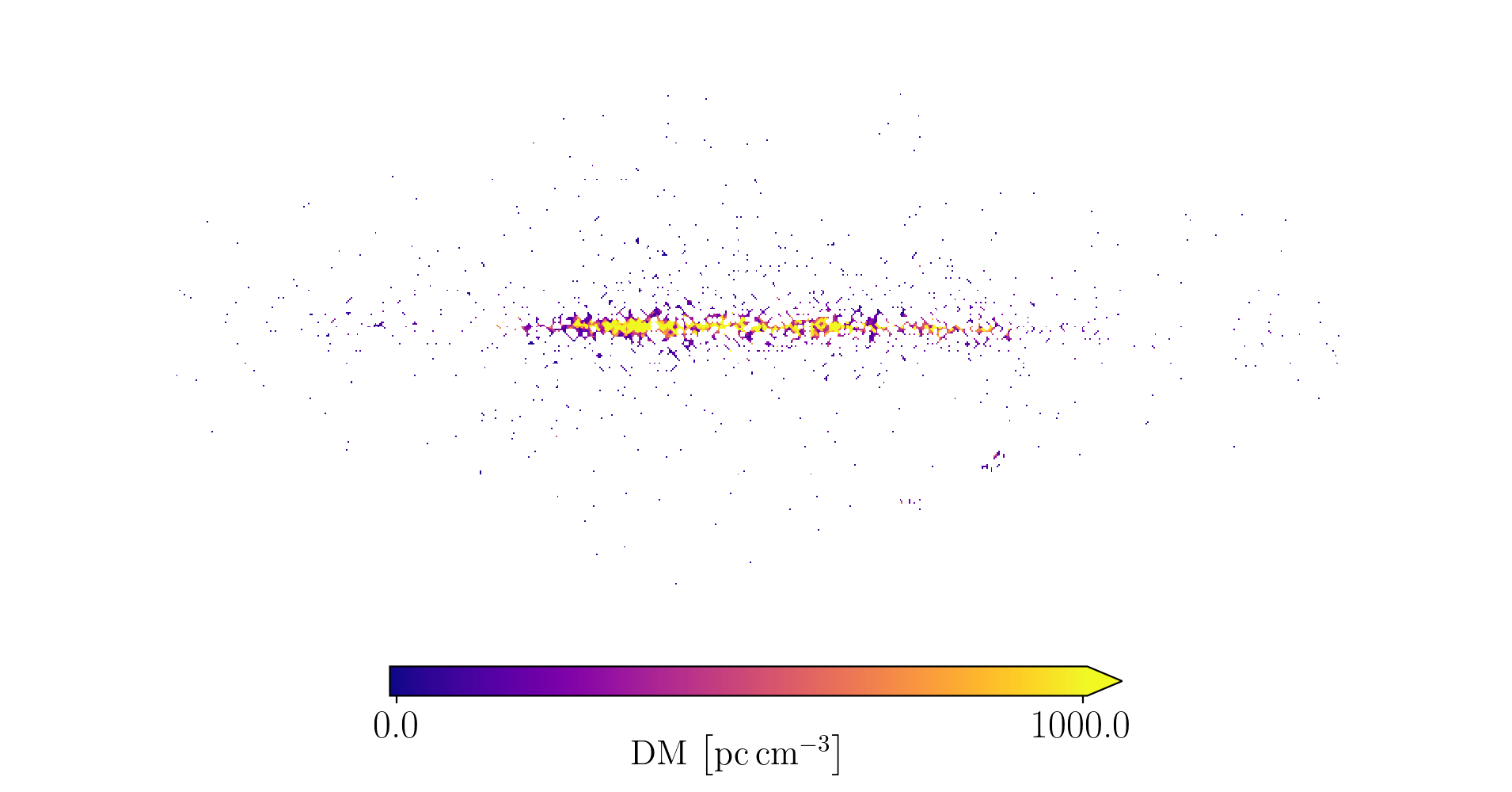
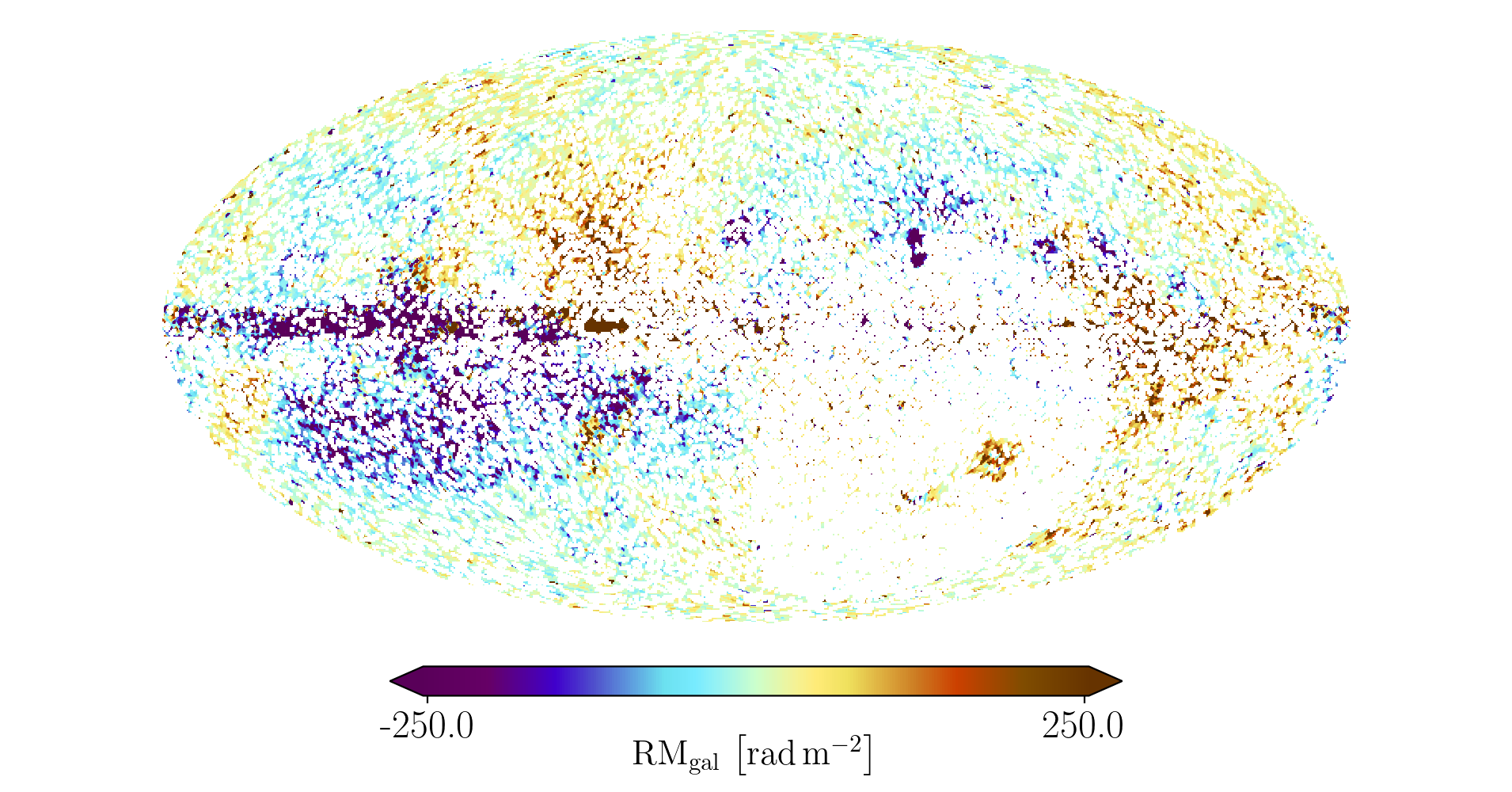
Magnetic fields permeate the diffuse interstellar medium (ISM) of the Milky Way, and are essential to explain the dynamical evolution and current shape of the Galaxy. Magnetic fields reveal themselves via their influence on the surrounding matter, and as such are notoriously hard to measure independently of other tracers. In this work, we attempt to disentangle an all sky map of the line-of-sight parallel component of the Galactic magnetic field from the Faraday effect, utilizing several tracers of the Galactic thermal electron density. Additionally, we aim to produce a Galactic electron dispersion measure map and quantify several tracers of the structure of the ionized medium of the Milky Way. We rely on compiled catalogs of extragalactic Faraday rotation measures and Galactic pulsar dispersion measures, a well as data on bremsstrahlung and the hydrogen $α$ spectral line to trace the ionized medium of the Milky Way. We present the first full sky map of the line-of-sight averaged Galactic magnetic field. Within this map, we find LoS parallel and LoS-averaged magnetic field strengths of up to 4 $μ$G, with an all-sky root-mean-square of 1.1 $μ$G, which is consistent with previous local measurements and global magnetic field models. Additionally, we produce a detailed electron dispersion measure map, which agrees with already existing parametric models at high latitudes, but suffers from systematic effects in the disk. Further analysis of our results with regard to the 3D structure of $n_{th}$ reveals that it follows a Kolmogorov-type turbulence for most of the sky. From the reconstructed dispersion measure and emission measure maps we construct several tracers of variability of $n_{th}$ along the LoS.
研究の動機と目的
- 複数の天体物理学的トレーサーを統合的に分析することで、フレイデー効果から銀河磁場を分離すること。
- 高精度で全天にわたる線路上平均磁場強度 $B_\parallel$ のマップを作成すること。
- 詳細な電子分散測定値(DM)マップを構築し、既存のモデルと的一致を評価すること。
- 熱電子密度 $n_{\mathrm{th}}$ の3次元構造とその乱流特性を定量すること。
- 銀河磁場およびイオン化済みISMEの将来の3次元再構築のためのロードマップを策定すること。
提案手法
- ノイズ多きく不完全で高次元なデータを扱うために、ベイズ推論フレームワークである情報場理論を採用する。
- 外部銀河系のフレイデー回折測定値(RM)、パルサー分散測定値(DM)、熱電子トレーサー(Hα、ブレムストラールーニング)を入力データとして用いる。
- 統合統計的推論を適用し、混在するフレイデー深さ $\phi$ から $B_\parallel$ と $n_{\mathrm{th}}$ を分離する。
- 角スペクトルと変換係数 $\mathrm{L_{DM^{2}/EM}}$ および $\varrho_{\mathrm{EM/DM}}$ を導出し、電子密度構造を調査する。
- 観測されたべき乗則的挙動と系統的誤差を解釈するため、$n_{\mathrm{th}}$ のモック3次元モデルを構築する。
- 特定の領域(例:Sh 2-27、スミス高速雲)における詳細なカットアウトを実施し、局所的な一貫性を検証する。
実験結果
リサーチクエスチョン
- RQ1線路上平均の銀河磁場 $B_\parallel$ の真の全天分布は何か?
- RQ2両者ともデータに混在する $B_\parallel$ と $n_{\mathrm{th}}$ を、フレイデー深さからどのように分離できるか?
- RQ3の熱電子密度 $n_{\mathrm{th}}$ の3次元構造は何か? また、これはコルモゴロフ型の乱流に従うか?
- RQ4推定された分散測定値マップと放射測定値マップは、既存のパラメトリックモデルとどのように一致するか?
- RQ5再構築に影響を及ぼす系統的バイアスは何か? 今後のデータとモデリングによってどのように緩和できるか?
主な発見
- 線路上平均の銀河磁場の初の全天マップが得られ、全天空で1.1 μGの平均二乗強度を示した。
- 局所的領域では磁場強度が最大4 μGに達し、局所的測定値およびグローバルモデルと整合的であった。
- 分散測定値マップは高緯度で既存のパラメトリックモデルと一致するが、パルサーのサンプリングが疎なため銀河平面で系統的誤差を示した。
- DM天球の角スペクトルは、コルモゴロフ型の乱流行動を示し、「空に広がる大きなべき乗則」と整合的であった。
- 変換係数 $\mathrm{L_{DM^{2}/EM}}$ は、DMとEMに寄与する有効なパス長を示し、均一媒体近似において文献値と一致した。
- 係数 $\varrho_{\mathrm{EM/DM}}$ は、線路上の平均的熱電子密度の推定値を提供し、銀河系の期待値と一致した。
この論文を読む
Nubintのビューアで原文を開き、読みながら気になる箇所をすぐに質問できます。
Nubintでこの論文を読むこのレビューはAIが論文の原文をもとに作成しました。引用する前に原文をご確認ください。