
[論文レビュー] Distance-distributed design for Gaussian process surrogates
本稿では、ガウス過程(GP)の代理モデルにおける新しい距離分布設計を提案する。この手法は、特に長尺度(lengthscales)の推定を改善するために、ペアワイズ距離の分布を最適化することで、従来の空間均等設計(例:最大最小距離法やラテン超立体設計)よりも優れた予測精度と逐次最適化性能を達成する。ランダム設計が示す好ましい距離構造を逆設計することで、従来の空間均等設計に比べて顕著な性能向上を実現する。
A common challenge in computer experiments and related fields is to efficiently explore the input space using a small number of samples, i.e., the experimental design problem. Much of the recent focus in the computer experiment literature, where modeling is often via Gaussian process (GP) surrogates, has been on space-filling designs, via maximin distance, Latin hypercube, etc. However, it is easy to demonstrate empirically that such designs disappoint when the model hyperparameterization is unknown, and must be estimated from data observed at the chosen design sites. This is true even when the performance metric is prediction-based, or when the target of interest is inherently or eventually sequential in nature, such as in blackbox (Bayesian) optimization. Here we expose such inefficiencies, showing that in many cases purely random design is superior to higher-powered alternatives. We then propose a family of new schemes by reverse engineering the qualities of the random designs which give the best estimates of GP lengthscales. Specifically, we study the distribution of pairwise distances between design elements, and develop a numerical scheme to optimize those distances for a given sample size and dimension. We illustrate how our distance-based designs, and their hybrids with more conventional space-filling schemes, outperform in both static (one-shot design) and sequential settings.
研究の動機と目的
- 従来の空間均等設計(例:最大最小距離法やラテン超立体設計)が、特に長尺度の推定において非効率である問題を解決すること。
- 空間均等性の明示的特徴を欠くにもかかわらず、しばしば従来の空間均等設計を上回る性能を示すランダム一様設計の理由を解明すること。
- GPハイパーパramータ推定の向上を目的として、好ましいペアワイズ距離分布を明示的にターゲットにする新しい実験設計のクラスを開発すること。
- 静的1回限りの設計および逐次設計の両設定において、距離分布設計の優位性を示すこと、特にベイズ最適化と予測の文脈で。
- 所望の距離分布を持つ設計を生成するための計算的に実行可能な最適化フレームワークを提供すること。ここでは、柔軟なパラメトリックモデルとしてベータ分布族を用いる。
提案手法
- 正確なGP長尺度推定をもたらすランダム一様設計のペアワイズ距離分布を逆設計する。
- 形状母数αとβを用いて定義されるベータ分布族を用いて、一様的かつ滑らかな距離プロファイルをモデル化する目的の距離分布をパrameter化する。
- 与えられた設計サイズnと次元dのもとで、予測誤差を最小化し、ハイパーパramータ推定の精度を向上させるために、数値探索によりベータ分布のパラメータ(α, β)を最適化する。
- 距離分布設計と従来の空間均等設計(例:LHS)を組み合わせたハイブリッド設計戦略を導入し、グローバルカバレッジとハイパーパラメータ推定の質の両立を図る。
- 設計の収束を向上させるために、ランダムスワップアルゴリズムを用いて設計を精緻化する。
- 合成データおよび実世界のコンピュータ実験ベンチマークを用いて、最大最小距離法、LHS、ランダム設計と比較して、静的および逐次設定の両方で手法の有効性を検証する。
実験結果
リサーチクエスチョン
- RQ1空間均等性の明示的特徴を欠くにもかかわらず、なぜランダム一様設計が最大最小距離法やラテン超立体設計よりもGP長尺度推定において優れているのか?
- RQ2好ましいペアワイズ距離分布を明示的にターゲットにする、体系的な設計戦略を開発できるか?
- RQ3距離分布設計は、従来の空間均等設計と比較して、予測精度および逐次ベイズ最適化における性能でどのように差をつけるか?
- RQ4異なる設計サイズおよび入力次元で、正確かつ安定したGPハイパーパラメータ推定を支援する最適な距離分布のパラメトリック族(例:ベータ分布)は何か?
- RQ5距離分布設計と空間均等性の両方の特性を組み合わせたハイブリッド設計は、良好なグローバルカバレッジと頑健なハイパーパラメータ推定を両立できるか?
主な発見
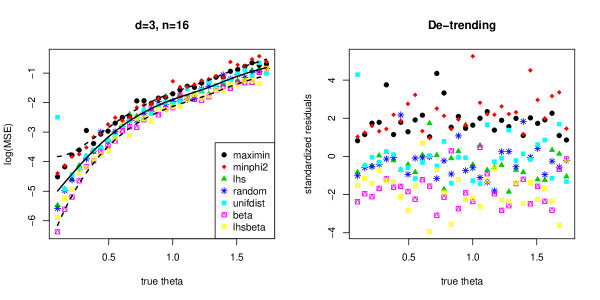
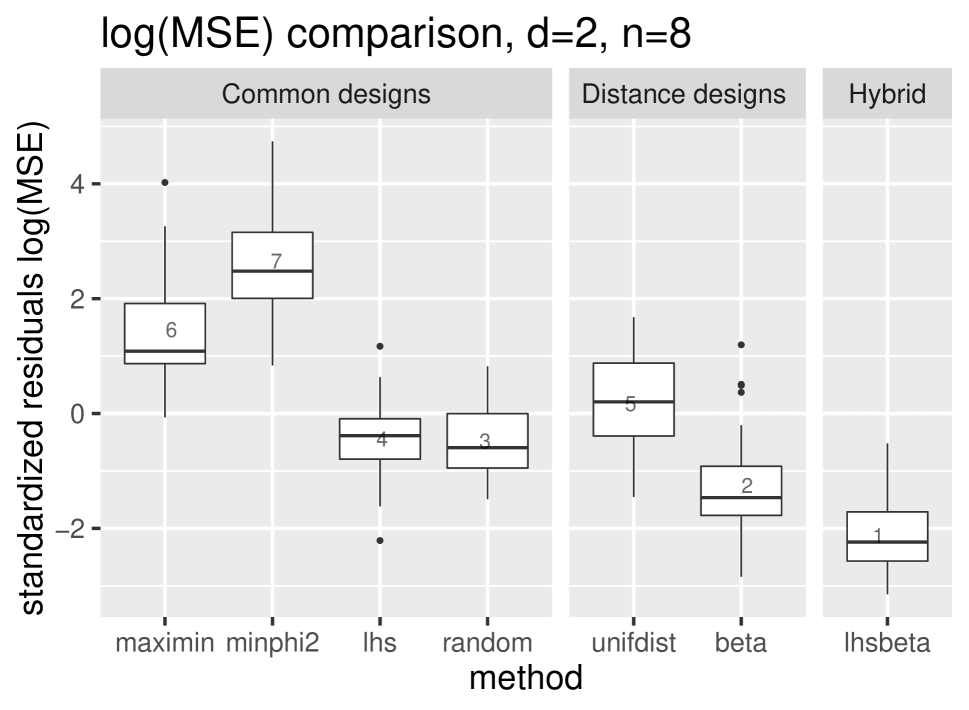
- ランダム一様設計は、特に低サンプル数の状況において、常に最大最小距離法やラテン超立体設計を上回ってGP長尺度を推定する。
- ベータ分布族を用いて最適化された本稿で提案する距離分布設計は、静的および逐次設定の両方で、最大最小距離法やLHS設計よりも顕著に低い予測誤差を達成する。
- 距離分布設計とLHS成分を組み合わせたハイブリッド設計は、純粋なLHSや最大最小距離法の設計よりも優れた性能を示す。特に高次元問題において顕著である。
- 本手法は、従来の空間均等設計で見られる多峰性や不規則なペアワイズ距離分布が原因で生じるハイパーパラメータ推定の悪化を効果的に緩和する。
- 最適な距離分布は一様的で、中間的な距離に集中しており、これはランダム設計の好ましい性質と整合する。
- 本手法はさまざまなカーネル族に対して頑健であり、分離可能またはノイズインフレート型GPモデルへの応用も可能であるが、最適化の複雑性が増す。
この論文を読む
Nubintのビューアで原文を開き、読みながら気になる箇所をすぐに質問できます。
Nubintでこの論文を読むこのレビューはAIが論文の原文をもとに作成しました。引用する前に原文をご確認ください。