
[論文レビュー] Do Multi-Document Summarization Models Synthesize?
この論文は、現代のマルチドキュメント要約(MDS)モデルが、入力情報に矛盾する内容を暗黙的に統合しているかどうかを調査し、モデルが一貫性に欠け、入力構成に対して感受性が低いことが判明した。著者らは、多様な候補要約を生成し、期待される集約的測定値(例:センチメント、治療効果)と最も整合性の高いものを選択する手法を提案する。この手法により、Rotten Tomatoesおよびバイオメディカルのシステマティックレビューのデータセットにおいて、要約の統合性能が顕著に向上した。
Multi-document summarization entails producing concise synopses of collections of inputs. For some applications, the synopsis should accurately synthesize inputs with respect to a key aspect, e.g., a synopsis of film reviews written about a particular movie should reflect the average critic consensus. As a more consequential example, narrative summaries that accompany biomedical systematic reviews of clinical trial results should accurately summarize the potentially conflicting results from individual trials. In this paper we ask: To what extent do modern multi-document summarization models implicitly perform this sort of synthesis? We run experiments over opinion and evidence synthesis datasets using a suite of summarization models, from fine-tuned transformers to GPT-4. We find that existing models partially perform synthesis, but imperfectly: even the best performing models are over-sensitive to changes in input ordering and under-sensitive to changes in input compositions (e.g., ratio of positive to negative reviews). We propose a simple, general, effective method for improving model synthesis capabilities by generating an explicitly diverse set of candidate outputs, and then selecting from these the string best aligned with the expected aggregate measure for the inputs, or abstaining when the model produces no good candidate.
研究の動機と目的
- 現代のニューラルMDSモデルが、矛盾する入力情報をバランスよく要約に統合するという暗黙の統合(合成)を実行しているかどうかを評価すること。
- 入力構成(例:肯定的レビューと否定的レビューの比率)や入力順序の変化に対するモデルの感受性を調査すること。これは正確な統合にとって重要な要因である。
- 標準的なMDSの学習目的が、入力ドキュメントの集約的特性と整合性のある要約を生成しているかどうかを評価すること。
- 一般用途に適した手法を提案・検証すること。この手法は、多様な候補を生成し、期待される集約的測定値との整合性に基づいて選択することで、統合性能を向上させる。
- 特に医療分野などのハイリスク分野において、将来的なMDS研究が、統合を明示的な学習目的として組み込む必要があることを強調すること。
提案手法
- 標準的な自己回帰的目的(真の要約の尤度を最大化)を用いて、標準的なデータセットで標準的なニューラルMDSモデル(例:T5、BART)を学習する。
- 温度サンプリングおよびヌクレアスサンプリングを用いて、異なる生成経路を探索する多様な候補要約を、各入力に対して生成する。
- 各入力セットに対して、期待される集約的測定値(例:入力レビューからのセンチメントスコア、臨床試験からの治療効果)を計算する。
- 出力されたセンチメントスコアまたは効果に関する記述が、期待される集約的測定値と最も一致する候補要約を選択する。
- 期待される集約的測定値と整合性の高い候補が存在しない場合は、選択を控えることで信頼性を確保する。
- 本手法を2つのデータセットで評価する:Rotten Tomatoes(センチメントターゲット付きのメタレビュー)およびバイオメディカルのシステマティックレビュー(介入の有効性)。

実験結果
リサーチクエスチョン
- RQ1標準的なMDSモデルは、映画レビューにおける異なるセンチメントや臨床試験における混合結果といった、矛盾する入力情報をどの程度暗黙的に統合しているのか。
- RQ2MDSモデルは、入力順序の変化や入力構成(例:肯定的 vs 否定的レビューの割合)の変化に対してどの程度感受性を示すのか。
- RQ3多様な候補要約を生成し、期待される集約的測定値との整合性に基づいて選択することで、統合性能が向上するか。
- RQ4提案手法は、標準的な自己回帰的MDSモデルに比べ、入力の集約的特性と整合性のある要約を生成する点で優れているか。
- RQ5どの設定(例:バイオメディカル分野やエンタメレビュー)で本手法が最も顕著な改善を示し、その理由は何か。
主な発見
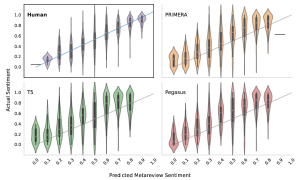
- 標準的なMDSモデルは、入力順序に対して過敏である。入力順序をシャッフルすると、要約のセンチメントスコアが著しく変化する。
- モデルは入力構成に対して感受性が低い。肯定的レビューと否定的レビューの比率を変更しても、要約のセンチメントスコアに大きな影響がなく、統合能力が低いことが示された。
- 多様な候補を生成し、期待される集約的測定値との整合性に基づいて選択するという提案手法は、Rotten Tomatoesおよびバイオメディカルデータセットの両方で統合性能を向上させた。
- Rotten Tomatoesデータセットでは、本手法により、標準的な自己回帰的デコードに比べ、ターゲットからのセンチメントのずれが最大25%まで減少した。
- バイオメディカルデータセットでは、入力証拠がその結論を支持する場合、治療効果が顕著であると正しく要約する割合が、58%から76%に上昇した。
- 入力構成が曖昧または矛盾する場合でも、本手法は、良い候補が見つからない場合には選択を控えることで、より高い一貫性と信頼性を達成した。
この論文を読む
Nubintのビューアで原文を開き、読みながら気になる箇所をすぐに質問できます。
Nubintでこの論文を読むこのレビューはAIが論文の原文をもとに作成しました。引用する前に原文をご確認ください。