
[論文レビュー] Does Localization Inform Editing? Surprising Differences in Causality-Based Localization vs. Knowledge Editing in Language Models
研究は、言語モデル内で事実がどこに局所化されるか(Causal Tracing を介して)が、事実を書き換えるために編集すべき層を予測するかどうかを示しておらず; 局所化領域外でも編集が成功する可能性があり、いくつかの編集問題のバリアントが検討されている。
Language models learn a great quantity of factual information during pretraining, and recent work localizes this information to specific model weights like mid-layer MLP weights. In this paper, we find that we can change how a fact is stored in a model by editing weights that are in a different location than where existing methods suggest that the fact is stored. This is surprising because we would expect that localizing facts to specific model parameters would tell us where to manipulate knowledge in models, and this assumption has motivated past work on model editing methods. Specifically, we show that localization conclusions from representation denoising (also known as Causal Tracing) do not provide any insight into which model MLP layer would be best to edit in order to override an existing stored fact with a new one. This finding raises questions about how past work relies on Causal Tracing to select which model layers to edit. Next, we consider several variants of the editing problem, including erasing and amplifying facts. For one of our editing problems, editing performance does relate to localization results from representation denoising, but we find that which layer we edit is a far better predictor of performance. Our results suggest, counterintuitively, that better mechanistic understanding of how pretrained language models work may not always translate to insights about how to best change their behavior. Our code is available at https://github.com/google/belief-localization
研究の動機と目的
- Causal Tracing を介した因果的局所化点が、保存された事実を書き換えるために編集すべきモデルの層を予測するかを理解する。
- 局所化結果と複数の編集手法・データセットにまたがる編集成功の関係を評価する。
- 局所化の洞察と編集性能を結びつける代替の編集問題の定式化を調査する。
提案手法
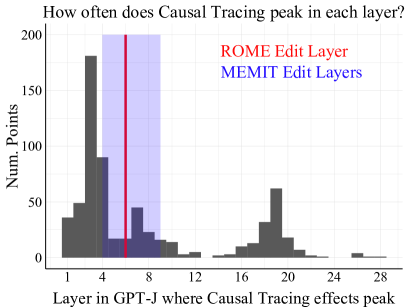
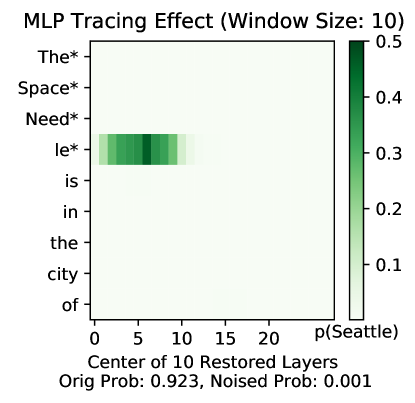
- CounterFact データを GPT-J とともに用い、MLP 層全体で Causal Tracing によって事実がどこに保存されているかを測定する。
- 編集手法(ROME、MEMIT、constrained finetuning)を適用し、さまざまな層で事実を注入、消去、増幅、または変更する。
- 正規化された書き換え、言い換え、および隣接度スコアで編集の成功を定量化する。
- 層とバリアント全体で回帰分析を用いて、局所化信号(tracing 効果)と編集結果を比較する。
- localization-editing の関係を探索するため、編集問題のバリアント(Error Injection、Tracing Reversal、Fact Erasure、Fact Amplification、Fact Forcing)を導入してテストする。
実験結果
リサーチクエスチョン
- RQ1最も強い tracing 効果を持つ層は、事実を書き換えた際の編集成功を高く予測するか?
- RQ2異なる編集手法間で、編集層の位置と編集性能のばらつきはどのようになるか?
- RQ3局所化信号は、複数の編集シナリオにおける編集成功のばらつきを意味のある程度説明できるか?
- RQ4代替の編集定式化は、局所化と編集の間に何らかの整合性を示すかを明らかにするか?
- RQ5モデルとデータセットをまたいだ、局所化と編集結果を結びつける頑健なパターンは存在するか?
主な発見
- 編集成功は、Causal Tracing によって層ごとに測定された事実情報の保存場所とは本質的に相関しない。
- 編集層の選択は書き換え成功の分散の大半を説明し、tracing 効果はほとんど追加の説明力を提供しない。
- 局所化が別の場所に保存されることを示唆していても、初期〜中間層での編集は事実を正常に上書きできる。
- Fact Forcing は、テストされたバリアントの中で、局所化信号と編集成功の最も強い(ただし控えめな)関連を示す。
- 頑健性チェックを通じても、多くの手法とデータセットで局所化の洞察が編集性能を信頼性高く予測することはなかった。
この論文を読む
Nubintのビューアで原文を開き、読みながら気になる箇所をすぐに質問できます。
Nubintでこの論文を読むこのレビューはAIが論文の原文をもとに作成しました。引用する前に原文をご確認ください。