
[論文レビュー] Domain-Agnostic Mutual Prompting for Unsupervised Domain Adaptation
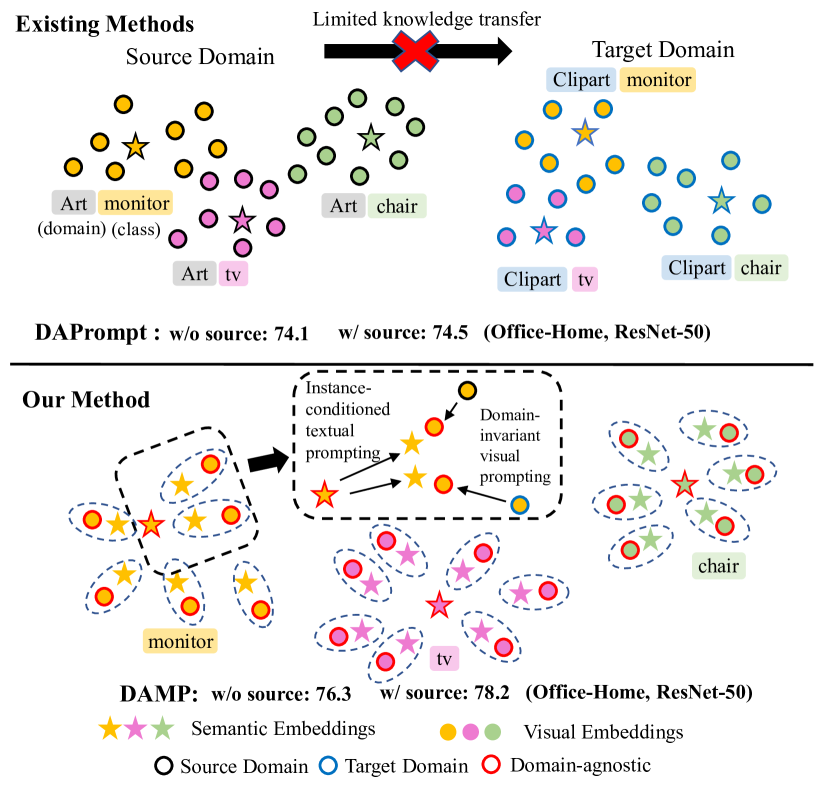
本稿では、ドメインに依存しない相互プロンプト(DAMP)を提案する。これは、クロスアテンションを用いてドメイン間の埋め込みを整合化する、ドメインに依存しないテキスト的および視覚的プロンプトを同時に最適化する、新しい教師なしドメイン適応フレームワークである。CLIPの事前学習済み知識を活用し、意味的一致性とインスタンス識別性を強制することで、DAMPは3つのUDAベンチマークで最先端の性能を達成し、複雑なドメインシフトに対しても優れたクロスドメイン知識転送性と頑健性を示した。
Conventional Unsupervised Domain Adaptation (UDA) strives to minimize distribution discrepancy between domains, which neglects to harness rich semantics from data and struggles to handle complex domain shifts. A promising technique is to leverage the knowledge of large-scale pre-trained vision-language models for more guided adaptation. Despite some endeavors, current methods often learn textual prompts to embed domain semantics for source and target domains separately and perform classification within each domain, limiting cross-domain knowledge transfer. Moreover, prompting only the language branch lacks flexibility to adapt both modalities dynamically. To bridge this gap, we propose Domain-Agnostic Mutual Prompting (DAMP) to exploit domain-invariant semantics by mutually aligning visual and textual embeddings. Specifically, the image contextual information is utilized to prompt the language branch in a domain-agnostic and instance-conditioned way. Meanwhile, visual prompts are imposed based on the domain-agnostic textual prompt to elicit domain-invariant visual embeddings. These two branches of prompts are learned mutually with a cross-attention module and regularized with a semantic-consistency loss and an instance-discrimination contrastive loss. Experiments on three UDA benchmarks demonstrate the superiority of DAMP over state-of-the-art approaches.
研究の動機と目的
- 既存の教師なしドメイン適応(UDA)手法が、ドメイン固有のプロンプトとモダリティ間連携の欠如により、ソース知識を効果的に転送できないという制限を解消すること。
- UDAにおける事前学習済み視覚言語モデル(VLM)の不適切な使用を是正し、ソースと事前学習済み知識を統合する、転送可能なドメインに依存しないプロンプトを学習すること。
- クロスアテンションを用いて視覚的および言語的ブランチを同時にプロンプト化することで、一方向または独立したプロンプト化ではなく、柔軟で双方向の適応を可能にすること。
- 意味的一致性とインスタンス識別性の対照的損失を正則化することで、特徴の識別性とドメイン不変性を向上させること。
- モダリティ間で相互作用する、インスタンスに条件づけられたプロンプト化が、モダリティ固有または独立したプロンプト化戦略よりも優れた一般化性と頑健性をもたらすことを示すこと。
提案手法
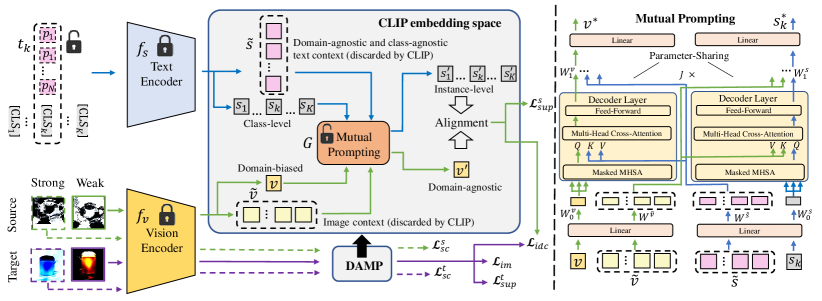
- DAMPは、トランスフォーマーのデコーダーにインspiredされたクロスアテンションモジュールを用いて、ドメインに依存しないテキスト的および視覚的プロンプトを同時に学習する相互プロンプトフレームワークを導入し、視覚と言語ブランチ間の双方向的相互作用を可能にする。
- 視覚ブランチは、インスタンスに条件づけられた画像コンテキスト埋め込みを用いてドメイン不変の視覚的特徴を生成する。一方、言語ブランチはドメインに依存しないテキストプロンプトを用いて意味的整合性をガイドする。
- 意味的一致性正則化損失により、プロンプト最適化済み埋め込みがドメイン間で共有される意味を保持し、ドメイン固有のバイアスを低減する。
- インスタンス識別性の対照的損失により、同じインスタンスのペア(ポジティブペア)が埋め込み空間で近づき、異なるインスタンスのペア(ネガティブペア)が遠ざかるように特徴の識別性が向上する。
- 視覚的および言語的プロンプトのそれぞれに、可学習スケーリング重みγvとγsを導入し、摂動の大きさを動的に制御し、モダリティ固有の分布ギャップに適応する。
- フレームワークは、ソースデータに対する教師あり損失、信頼度の高いターゲットサンプルに対する疑似ラベル化、および2つの正則化損失を組み合わせて、エンドツーエンドで訓練され、頑健で一般化可能なプロンプト学習を保証する。
実験結果
リサーチクエスチョン
- RQ1視覚と言語ブランチ間の相互プロンプト化は、教師なしドメイン適応におけるドメイン不変の表現学習を改善できるか?
- RQ2ドメイン固有のプロンプトではなくドメインに依存しないプロンプトを学習することで、ソース知識がターゲットドメインに効果的に転送されるか?
- RQ3クロスアテンションベースの視覚的および言語的プロンプト間の相互作用は、一方向または独立したプロンプト化と比較して、特徴の整合性をどのように向上させるか?
- RQ4意味的一致性とインスタンス識別性正則化が、学習済みプロンプトの頑健性と識別性をどの程度向上させるか?
- RQ5複雑なドメインシフト下で、提案された相互プロンプトフレームワークは、DAPrompt や CoOp などの既存のプロンプトベースの UDA 手法よりも効果的か?
主な発見
- DAMPは3つのUDAベンチマークで最先端の性能を達成し、Office-Homeでは平均正解率78.2%、VisDA-17では88.4%を記録し、以前のSOTA手法を上回った。
- アブレーションスタディの結果、テキスト的および視覚的プロンプトを併用した相互プロンプト化は、VisDA-17におけるベースラインCoOpに比べて2.9%の絶対的向上を示し、モダリティ間連携の有効性を裏付けた。
- 意味的一致性損失(Lsc)とインスタンス識別性対照的損失(Lidc)を追加することで一貫した向上が得られ、フルメソッドではOffice-Homeで78.2%、VisDA-17で88.4%の正解率を達成した。
- ハイパーパramータの選択に頑健である:信頼度しきい値T ∈ [0.5, 1.0] の範囲で性能が安定しており、豊富な意味的符号化に十分な最適なプロンプト長N ≈ 32が十分であることが示された。
- 可学習スケーリング重みγvとγsは、それぞれ0.1および0.5に収束し、視覚的プロンプトは言語的プロンプトよりも小さな摂動を必要としており、CLIPにおけるモダリティギャップを反映している。
- クロスアテンションを用いた相互プロンプトフレームワークは、一方向プロンプト化ベースライン(例:MaPLeスタイルのプロジェクション)を上回り、プロンプト学習における双方向的相互作用の利点を実証した。
この論文を読む
Nubintのビューアで原文を開き、読みながら気になる箇所をすぐに質問できます。
Nubintでこの論文を読むこのレビューはAIが論文の原文をもとに作成しました。引用する前に原文をご確認ください。