
[論文レビュー] Don't Play Favorites: Minority Guidance for Diffusion Models
本稿では、特徴の独自性を人間の知覚に近い再構成誤差で定量化する新しい指標「マイノリティスコア」を用いて、低密度領域に位置するマイノリティサンプルへ生成を再配分する、拡散モデル向けの新規サンプリング手法「マイノリティガイドランス」を提案する。実験では、標準的な拡散サンプラーと比較して、特に長尾分布を示すデータセットにおいて、希少で新しい特徴の生成が顕著に向上することを示しており、分類器ガイドランスを用いることで制御性を維持している。
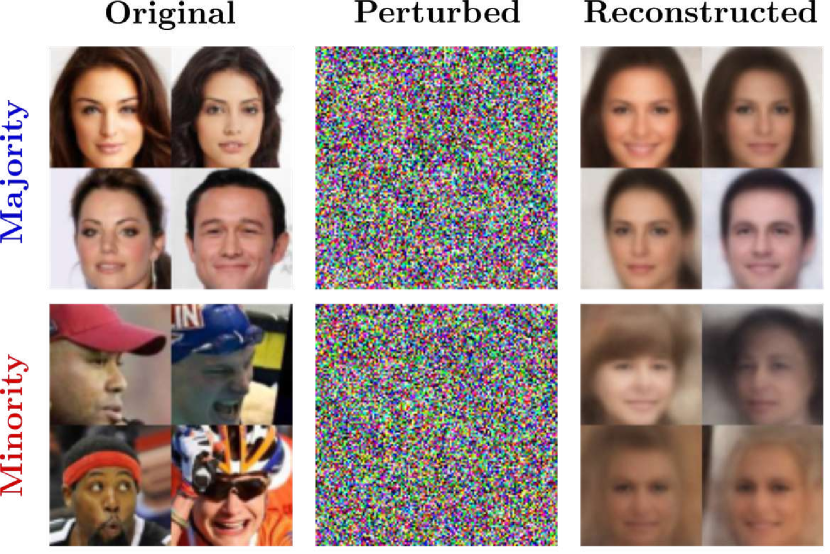
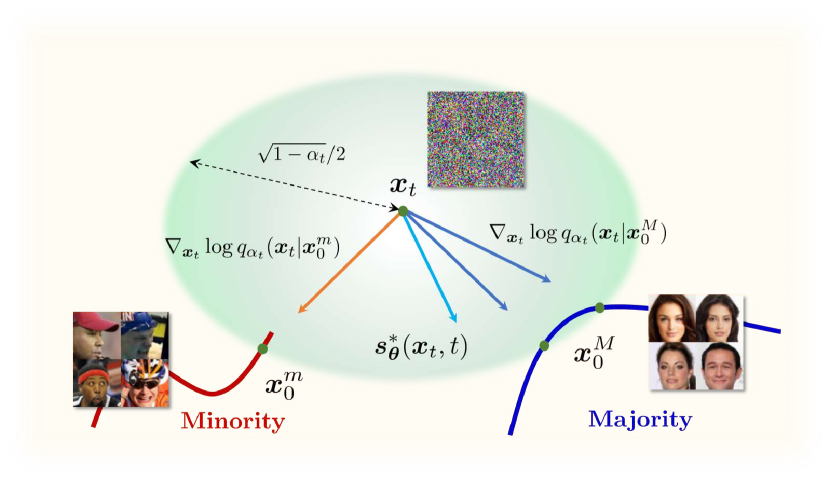
We explore the problem of generating minority samples using diffusion models. The minority samples are instances that lie on low-density regions of a data manifold. Generating a sufficient number of such minority instances is important, since they often contain some unique attributes of the data. However, the conventional generation process of the diffusion models mostly yields majority samples (that lie on high-density regions of the manifold) due to their high likelihoods, making themselves ineffective and time-consuming for the minority generating task. In this work, we present a novel framework that can make the generation process of the diffusion models focus on the minority samples. We first highlight that Tweedie's denoising formula yields favorable results for majority samples. The observation motivates us to introduce a metric that describes the uniqueness of a given sample. To address the inherent preference of the diffusion models w.r.t. the majority samples, we further develop minority guidance, a sampling technique that can guide the generation process toward regions with desired likelihood levels. Experiments on benchmark real datasets demonstrate that our minority guidance can greatly improve the capability of generating high-quality minority samples over existing generative samplers. We showcase that the performance benefit of our framework persists even in demanding real-world scenarios such as medical imaging, further underscoring the practical significance of our work. Code is available at https://github.com/soobin-um/minority-guidance.
研究の動機と目的
- 拡散モデルに内在するバイアス、特に高尤度で多数派のサンプルを優先して生成する傾向を是正すること。
- データ多様体の低密度領域に位置する特徴の独自性を定量化する指標を開発すること。
- 望ましい特徴の独自性レベルに条件づけて、マイノリティサンプルの制御的生成を可能にするサンプリングフレームワークを設計すること。
- 希少で新しい属性の低代表化を是正することで、生成モデルにおける公平性と表現の多様性を向上させること。
提案手法
- クリーンなサンプルとTweedieの公式による再構成との間の知覚的距離(例:LPIPS)として定義される新しい指標「マイノリティスコア」を提案し、特徴の独自性を定量化する。
- 事前学習済み分類器を用いて、ノイズを含む入力に対する離散化されたマイノリティスコアを予測し、既存の拡散サンプラーとの統合を可能にする。
- 分類器ガイドランスを用いて、アーリー・サンプリングにマイノリティスコア分類器を統合し、生成サンプルの尤度レベルを制御可能にする。
- ターゲットとなるマイノリティスコアレベル(例:希少な特徴を生成するには高い値)に条件づけてサンプリングプロセスを制御し、独自なサンプルの標的生成を実現する。
- ワンショット再構成が効率的に行えるようにTweedieの公式を活用し、マイノリティスコア計算のスケーラビリティと実用性を確保する。
- CIFAR-10、CelebA、LSUN-Bedroomsなどのベンチマークデータセットを対象に、クラス条件付きおよび非条件付きの両設定に本手法を適用する。
実験結果
リサーチクエスチョン
- RQ1拡散モデルは、分布カバレッジが優れているにもかかわらず、なぜマイノリティサンプルを生成できないのか?
- RQ2データ多様体における希少性を反映する知覚的メトリクスを用いて、サンプル内の特徴の独自性を定量化できるか?
- RQ3モデルの再訓練なしに、低尤度で高独自性のサンプルを優遇するように拡散サンプリングプロセスを変更できるか?
- RQ4標準的な拡散サンプラーと比較して、マイノリティガイドランスは希少で新しい特徴の生成をどの程度向上できるか?
- RQ5マイノリティサンプルを生成する際、独自性と忠実度のトレードオフはどのようなものか?
主な発見
- マイノリティガイドランスは、局所的外れ値要因(LOF)や平均k近傍距離(k-NN密度)といった外れ値検出指標の値が高くなることから、低密度領域のマイノリティサンプルの生成が顕著に向上することが実証された。
- LSUN-Bedroomsでは、高マイノリティスコアに条件づけたマイノリティガイドランスがLOF密度スコア0.5935を達成したのに対し、標準的なDDPMベースラインは0.7686であった。
- CIFAR-10では、希少な特徴に注目したマイノリティガイドランスは精度0.7581を達成したが、標準DDPMは0.8795であった。これは独自性と忠実度のトレードオフを示している。
- 本手法は、追加のランプや一風変わったオブジェクトといった、通常のサンプラーが見逃しがちな新しい属性を効果的に生成できており、特に単調で一般的なシーンにおいて顕著であった。
- 分類器ガイドランスのスケール$w$とターゲットマイノリティスコア$\tilde{l}$は効果的な制御ノブとして機能する:$\tilde{l}$を大きくすると生成が低密度領域へシフトし、$w$を大きくすると高尤度の多数派特徴が優先される。
- マイノリティスコアは他の外れ値測定指標と強く相関しており、実データセットにおいて希少で新しい特徴を特定する有効な代理指標であることが裏付けられた。
この論文を読む
Nubintのビューアで原文を開き、読みながら気になる箇所をすぐに質問できます。
Nubintでこの論文を読むこのレビューはAIが論文の原文をもとに作成しました。引用する前に原文をご確認ください。