
[論文レビュー] Double-Ended Synthesis Planning with Goal-Constrained Bidirectional Search
本稿では、出発物質制約下での合成計画を高速化する二重エンド合成計画(DESP)を提案する。DESPは、標的物質(逆合成)と指定された出発物質(前向き合成)から同時に展開する双方向探索アルゴリズムであり、熟練者の反応経路を学習したゴール条件付き合成距離ネットワークを用いて探索を誘導する。本手法は、制約付きベンチマークにおいて、先行手法に比べ高い解決率と少ないノード展開数を達成した。
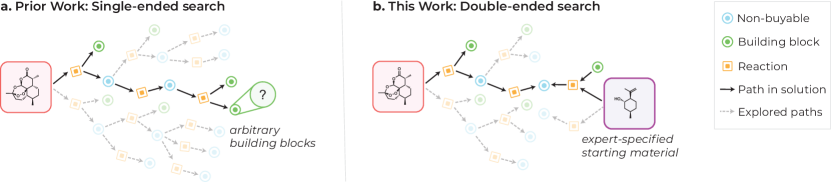
Computer-aided synthesis planning (CASP) algorithms have demonstrated expert-level abilities in planning retrosynthetic routes to molecules of low to moderate complexity. However, current search methods assume the sufficiency of reaching arbitrary building blocks, failing to address the common real-world constraint where using specific molecules is desired. To this end, we present a formulation of synthesis planning with starting material constraints. Under this formulation, we propose Double-Ended Synthesis Planning (DESP), a novel CASP algorithm under a bidirectional graph search scheme that interleaves expansions from the target and from the goal starting materials to ensure constraint satisfiability. The search algorithm is guided by a goal-conditioned cost network learned offline from a partially observed hypergraph of valid chemical reactions. We demonstrate the utility of DESP in improving solve rates and reducing the number of search expansions by biasing synthesis planning towards expert goals on multiple new benchmarks. DESP can make use of existing one-step retrosynthesis models, and we anticipate its performance to scale as these one-step model capabilities improve.
研究の動機と目的
- 既存のアルゴリズムが特定の出発物質を必要とする現実世界の制約を適切に扱えない点に起因する、コンピュータ支援合成計画(CASP)分野におけるギャップを解消すること。
- 出発物質制約付きの合成計画を、実用的ユースケース(例:部分合成や持続可能なフィードストック利用)を反映する二重エンド探索問題として定式化すること。
- 逆合成と前向き合成の展開を交互に実行する双方向探索アルゴリズムを設計し、制約の整合性を保証すること。
- 強化学習を用いずに、反応データから事前学習したゴール条件付きコストネットワーク(合成距離ネットワーク)を構築し、熟練者が指定したゴールに向けた探索を誘導すること。
- 実世界のデータ(Pistachioデータベース由来)を活用した新たなベンチマークを公開し、既存データセットに見られる重複を是正すること。
提案手法
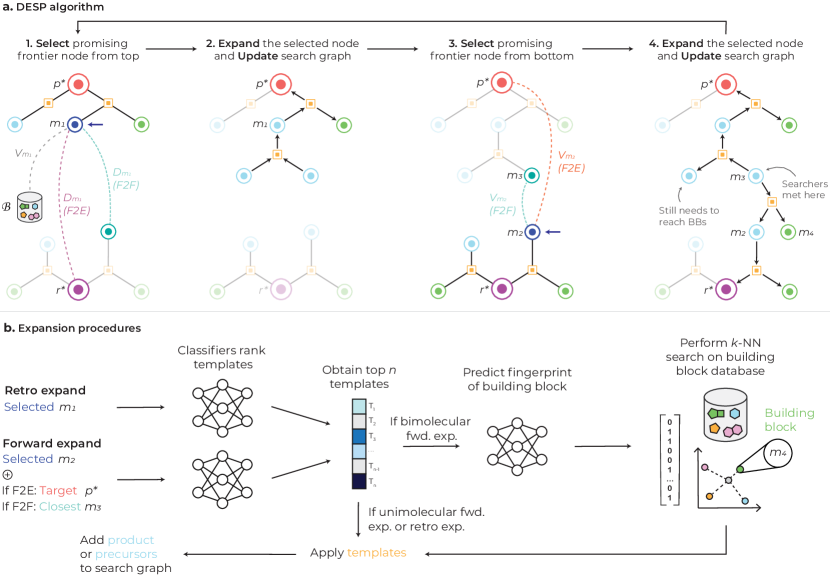
- DESPは、標的分子(逆合成)と指定された出発物質(前向き合成)から展開する双方向AND-ORグラフ探索を採用し、両方の探索を交互に実行する。
- 2つの変種を提案する:F2E(フロントツーエンド)では、各探索が相手のグラフのルートに条件付けられる。F2F(フロントツーフロント)では、ノードが相手のグラフに近い順に選択される。
- 合成距離ネットワークは、熟練者の反応経路データを用いて事前学習され、任意の分子から指定されたゴール分子までの距離を推定する。強化学習を必要とせず、自己対戦RLの代替となる。
- 正例ペア(既知の反応経路で接続された分子)と負例ペア(既知の経路で接続されていない分子)を用い、コントラスト型損失関数を最適化して学習を行う。
- 前向き展開には、2300万の構築ブロックをFaissを用いて256次元のMorganフィンガープintでk-NN検索し、高速かつメモリ効率の良い処理を実現する。
- アルゴリズムは、既存の1ステップ逆合成モデルと統合可能であり、それらの妥当性スコアを用いて行動コストを$-\log p$として計算する。
実験結果
リサーチクエスチョン
- RQ1特定の出発物質を制約として課した場合、双方向探索戦略が解決率を向上させるとともに、探索の負荷を軽減できるか?
- RQ2熟練者の反応データから学習したゴール条件付き合成距離ネットワークは、強化学習を用いずに、望ましい出発物質に向けた探索を効果的に誘導できるか?
- RQ3出発物質制約下において、二重エンド探索は単一エンドまたは一方向探索に比べ、ノード展開数と解の質の点で優れているか?
- RQ4実世界のデータから導出した本研究のベンチマークは、制約付き条件下で既存のCASPアルゴリズムの限界をどれほど明確に示せるか?
- RQ5事前学習済み1ステップモデルを双方向探索フレームワークに統合することで、より効率的かつ正確な合成計画が可能になるか?
主な発見
- DESPは、Pistachioベースの新データセット(USPTO-190テストセットの重複を是正)も含め、制約付きベンチマークにおいて、先行手法に比して高い解決率を達成した。
- DESPは、解に至るまでのノード展開数を削減し、Retro* や GRASP といったベースライン手法に比べ、探索効率が向上していることを示した。
- F2EバージョンのDESPは、F2Fに比べ平均的に短い経路を発見しており、相手のグラフのルートに条件付けられることでルート品質が向上することが示唆された。
- 強化学習を用いずに学習した合成距離ネットワークは、熟練者が指定した出発物質に向けた探索を効果的に誘導し、制約の整合性を高めた。
- GPU加速を活用した2300万の構築ブロックに対するk-NN検索により、前向き展開が高速化され、テンプレートの逆転可能性チェックのため、前向きステップは逆合成ステップに比べ約50%長時間かかった。
- 前向き探索が一方向であるため収束経路の処理に限界があるものの、DESPは強力な実験的性能と、より優れた1ステップモデルと統合した際のスケーラビリティを示した。
この論文を読む
Nubintのビューアで原文を開き、読みながら気になる箇所をすぐに質問できます。
Nubintでこの論文を読むこのレビューはAIが論文の原文をもとに作成しました。引用する前に原文をご確認ください。