
[論文レビュー] Edge Directionality Improves Learning on Heterophilic Graphs
Dir-GNN は、入出力エッジの集約を分離することで任意の MPNN を有向グラフに拡張し、異種同質性(heterophily)グラフでの性能を向上させつつ、同質性(homophily)グラフでの結果を損なわない。Directed Weisfeiler-Lehman の表現力に匹敵し、いくつかの directed heterophilic ベンチマークで最先端を達成する。
Graph Neural Networks (GNNs) have become the de-facto standard tool for modeling relational data. However, while many real-world graphs are directed, the majority of today's GNN models discard this information altogether by simply making the graph undirected. The reasons for this are historical: 1) many early variants of spectral GNNs explicitly required undirected graphs, and 2) the first benchmarks on homophilic graphs did not find significant gain from using direction. In this paper, we show that in heterophilic settings, treating the graph as directed increases the effective homophily of the graph, suggesting a potential gain from the correct use of directionality information. To this end, we introduce Directed Graph Neural Network (Dir-GNN), a novel general framework for deep learning on directed graphs. Dir-GNN can be used to extend any Message Passing Neural Network (MPNN) to account for edge directionality information by performing separate aggregations of the incoming and outgoing edges. We prove that Dir-GNN matches the expressivity of the Directed Weisfeiler-Lehman test, exceeding that of conventional MPNNs. In extensive experiments, we validate that while our framework leaves performance unchanged on homophilic datasets, it leads to large gains over base models such as GCN, GAT and GraphSage on heterophilic benchmarks, outperforming much more complex methods and achieving new state-of-the-art results.
研究の動機と目的
- グラフにおけるエッジの向き情報の活用が特に異種同質性設定で必要である理由を動機づける。
- 二重の in- および out- 集約によって任意のMPNNを有向グラフへ拡張する汎用フレームワークとして Dir-GNN を導入する。
- Dir-GNN の表現力を理論的に分析し、 directed WL テストと比較する。
- 異種同質性および同質性データセット上で Dir-GNN を実証的に検証し、異種同質性ベンチマークでの改善と同質性ベンチマークでの安定性を示す。
提案手法
- 入側隣接ノードおよび出側隣接ノードに対して別々の集約を行い、独立したパラメータを用いることで MPNNs を有向グラフに拡張する。
- 正規化を用いた2つのメッセージパッシング行列 S_→ および S_← を用い、S_→ = D_→^{-1/2} A D_←^{-1/2} および S_← = S_→^T。
- 二方向の寄与を重み付けする学習可能な α を組み込む。
- Dir-GNN は注入性条件の下で Directed WL テストと同等の表現力を持つことを示し、MPNN-U や MPNN-D より厳密に表現力が高い。
- Dir-GCN、Dir-SAGE、Dir-GAT は別々の方向重みによってパラメータ数が増加する一方で、層あたりの計算量は類似のままであることを示す。
実験結果
リサーチクエスチョン
- RQ1エッジの向き情報はグラフの実効的な同質性を高めるのか、特に異種同質性設定において?
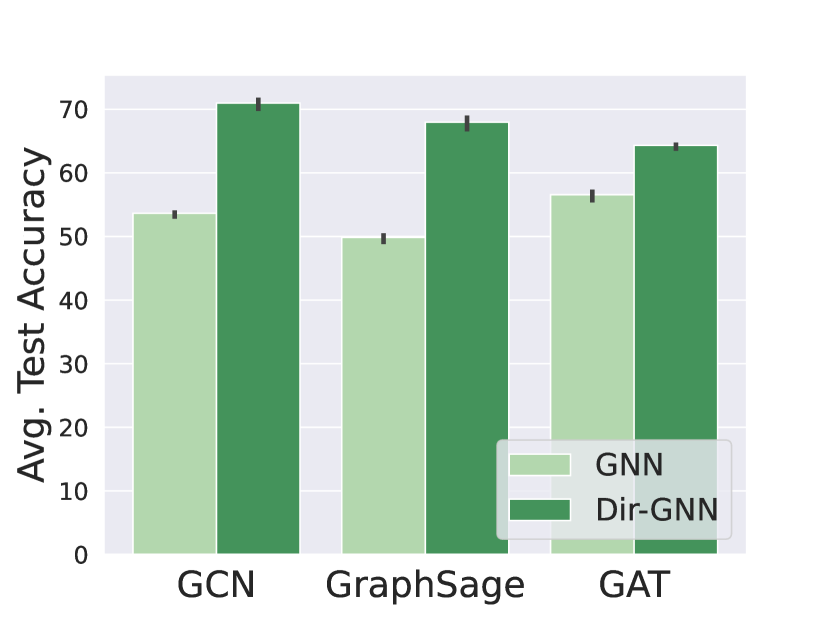
- RQ2一般的な Dir-GNN フレームワークは任意の MPNN を有向グラフへ拡張し、性能を向上させることができるのか?
- RQ3Dir-GNN は directed Weisfeiler-Lehman テストと同等の表現力を持ち、従来の MPNN よりも表現力が高いのか?
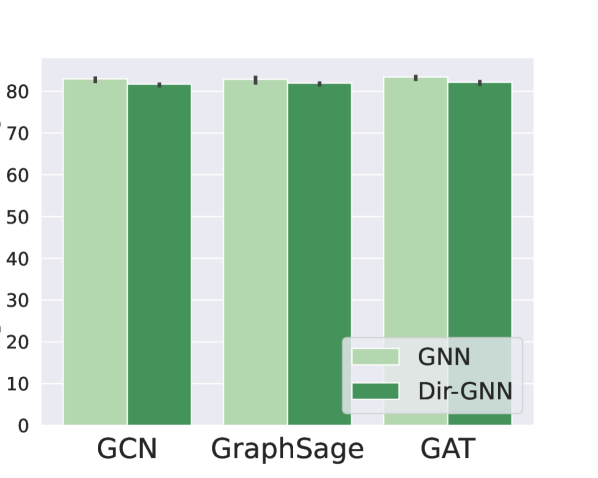
- RQ4Dir-GNN の拡張は異種同質性ベンチマークの精度を改善しつつ、同質性ベンチマークを損なわないのか?
主な発見
- 有向グラフを用いると、異種同質性グラフにおける実効的な同質性が高まり、同質性グラフへの影響はほとんどない。
- Dir-GNN は二重の In- および Out- 集約によって MPNN を拡張し、実践的にはより同質的な集約をもたらす。
- Dir-GNN は5つの directed heterophilic ベンチマーク(Chameleon、Squirrel、Arxiv-Year、Snap-Patents、Roman-Empire)で最先端の結果を達成。
- Dir-GNN は directed heterophilic データセットでより複雑な異質性特化法を上回り、同質性データセットでも性能を維持。
- このフレームワークは理論的に Directed Weisfeiler-Lehman テストと同等の表現力を持ち、標準の MPNN よりも厳密に表現力が高い。
この論文を読む
Nubintのビューアで原文を開き、読みながら気になる箇所をすぐに質問できます。
Nubintでこの論文を読むこのレビューはAIが論文の原文をもとに作成しました。引用する前に原文をご確認ください。