
[論文レビュー] EMO: Emote Portrait Alive -- Generating Expressive Portrait Videos with Audio2Video Diffusion Model under Weak Conditions
EMOは、3Dモデルやランドマークを経由せずに音声を顔の動きに直接変換する拡散ベースの音声から動画生成フレームワークを提案する。速度制御子、顔領域制御子、FrameEncodingを統合することで、リアリズム、アイデンティティ保持、表現力の面で最先端の性能を達成し、特に歌唱や動的な頭部運動において優れた結果を示す。FID、FVD、E-FIDの指標において、SOTA手法を上回っている。
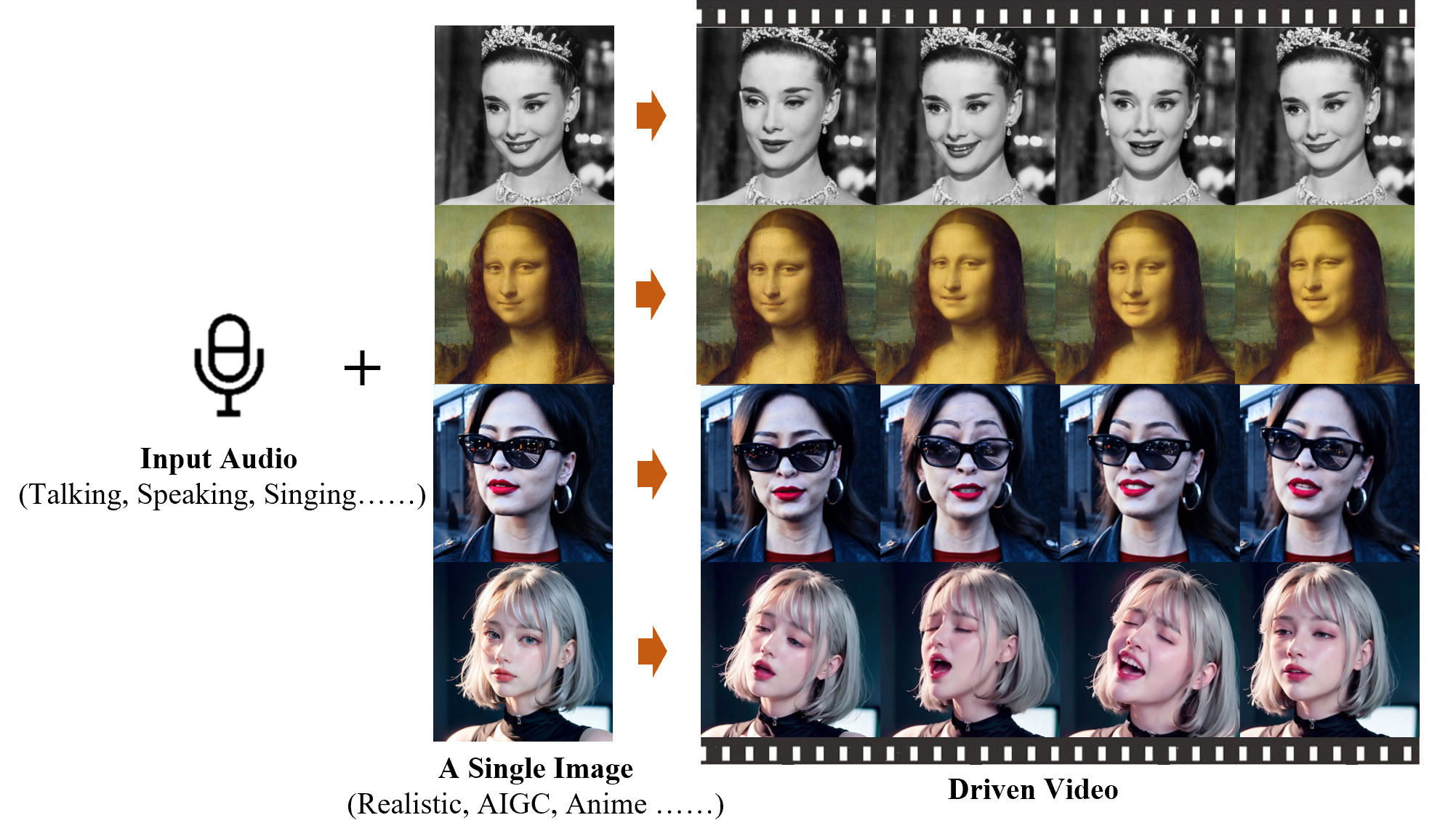
In this work, we tackle the challenge of enhancing the realism and expressiveness in talking head video generation by focusing on the dynamic and nuanced relationship between audio cues and facial movements. We identify the limitations of traditional techniques that often fail to capture the full spectrum of human expressions and the uniqueness of individual facial styles. To address these issues, we propose EMO, a novel framework that utilizes a direct audio-to-video synthesis approach, bypassing the need for intermediate 3D models or facial landmarks. Our method ensures seamless frame transitions and consistent identity preservation throughout the video, resulting in highly expressive and lifelike animations. Experimental results demonsrate that EMO is able to produce not only convincing speaking videos but also singing videos in various styles, significantly outperforming existing state-of-the-art methodologies in terms of expressiveness and realism.
研究の動機と目的
- 既存の会話ヘッドモデルが3Dモデルや顔のランドマークに依存するという制限を解消し、表現の多様性と自然な動きを向上させること。
- 中間表現を経由せずに、音声と1枚の参照画像から高精細で表現力のある動画を直接生成すること。
- 音声駆動生成中に発生するジタリングや顔の歪みなどのアーチファクトを低減し、動画の安定性を向上させること。
- 多様なポートレートスタイル(リアリスティック、アニメ、3Dなど)と長時間の音声入力に対しても、アイデンティティとスタイルの一貫性を維持すること。
- 最先端の手法と比較して、表現力、リアリズム、同期性の面で優れた性能を達成すること。
提案手法
- 音声と1枚の参照画像から直接動画フレームを生成する音声2動画の拡散モデルを採用し、3Dモデルやランドマークに基づく中間表現を回避する。
- 拡散サンプリング中にフレームレベルのジタリングや顔の歪みを抑制するため、安定なハイパーパrameterとして速度制御子と顔領域制御子を導入する。
- 参照エンコーディングモジュールであるFrameEncodingを設計。ReferenceNetをインspiredしたもので、動画全体にわたるアイデンティティとスタイルの一貫性を維持する。
- 複数言語のスピーチ、映画、歌唱を含む250時間を超える多様な音声・動画コンテンツから構成される大規模データセットを用いてモデルを学習する。
- 動きフレームを用いて、初期シーケンスを超えて動画生成を拡張し、入力音声長に合わせた長時間出力を可能にする。
- 話し言葉と歌唱の両方の動画を、豊かな顔の表情と多様な頭部ポーズを伴って生成可能である。
実験結果
リサーチクエスチョン
- RQ13Dモデルや顔のキーポoint監視に依存せずに、拡散ベースの音声から動画生成モデルが表現力豊かでリアルな会話ヘッド動画を生成できるか?
- RQ2拡散サンプリング中に顔のジタリングや歪みを防ぐために、音声から動画生成をどのように安定化できるか?
- RQ31枚の参照画像のみを用いて、多様な視覚的スタイル(例:リアリスティック、アニメ、3D)において、アイデンティティとポートレートスタイルをどの程度維持できるか?
- RQ4長時間の音声、たとえば歌唱のようなものに対しても、同期性と表現的なダイナミクスを維持しながら一般化できるか?
- RQ5定量的・定性的に、既存のSOTAアプローチと比較して、リアリズム、アイデンティティの忠実度、表現力の面で本手法はどの程度優れているか?
主な発見
- EMOはFIDスコア8.76という新たなSOTAを達成し、Wav2Lip(9.38)、SadTalker(10.31)、DreamTalk(58.80)を大きく上回った。
- FVDスコア67.66を達成し、ベースラインと比較して優れた動画品質と時間的整合性を示した。
- E-FIDスコア0.116を達成し、特に微表情や動的な変化において顔の動きの表現力が優れていることを示した。
- 定性的な結果から、EMOはWav2Lip、SadTalker、DreamTalkと比較して、特に歌唱シナリオにおいてより自然な頭部の動きと豊かな顔の表情を生成した。
- 1分までの長時間動画を、アイデンティティの一貫性と同期した口元の動きを保ちながら生成でき、トーンの音声(歌唱など)に対しても効果を発揮した。
- SyncNetでは首位ではなかったが、ユーザー調査と定性的な評価により、表現力とリアリズムの面で顕著な優位性を示した。

この論文を読む
Nubintのビューアで原文を開き、読みながら気になる箇所をすぐに質問できます。
Nubintでこの論文を読むこのレビューはAIが論文の原文をもとに作成しました。引用する前に原文をご確認ください。