
[論文レビュー] Enhancing IoT Security with CNN and LSTM-Based Intrusion Detection Systems
CICIoT2023データで学習し、CICIDS2017で検証されたIoTトラフィック向けのCNN-LSTMハイブリッド侵入検知モデルは、バイナリの benign/malicious 分類で高精度と低損失を達成。
Protecting Internet of things (IoT) devices against cyber attacks is imperative owing to inherent security vulnerabilities. These vulnerabilities can include a spectrum of sophisticated attacks that pose significant damage to both individuals and organizations. Employing robust security measures like intrusion detection systems (IDSs) is essential to solve these problems and protect IoT systems from such attacks. In this context, our proposed IDS model consists on a combination of convolutional neural network (CNN) and long short-term memory (LSTM) deep learning (DL) models. This fusion facilitates the detection and classification of IoT traffic into binary categories, benign and malicious activities by leveraging the spatial feature extraction capabilities of CNN for pattern recognition and the sequential memory retention of LSTM for discerning complex temporal dependencies in achieving enhanced accuracy and efficiency. In assessing the performance of our proposed model, the authors employed the new CICIoT2023 dataset for both training and final testing, while further validating the model's performance through a conclusive testing phase utilizing the CICIDS2017 dataset. Our proposed model achieves an accuracy rate of 98.42%, accompanied by a minimal loss of 0.0275. False positive rate(FPR) is equally important, reaching 9.17% with an F1-score of 98.57%. These results demonstrate the effectiveness of our proposed CNN-LSTM IDS model in fortifying IoT environments against potential cyber threats.
研究の動機と目的
- 多様なサイバー攻撃に対する堅牢なIoTセキュリティの動機付けと、IoT環境で効果的なIDSの必要性。
- 空間的特徴と時間的特徴を活用して検知を向上させるCNN-LSTMハイブリッドIDSを開発。
- 性能と一般化能力を評価するため、CICIoT2023とCICIDS2017データセットでモデルを評価。
- 標準的な指標(accuracy、loss、precision、recall、F1-score、FPR)を用いて性能を示す。
提案手法
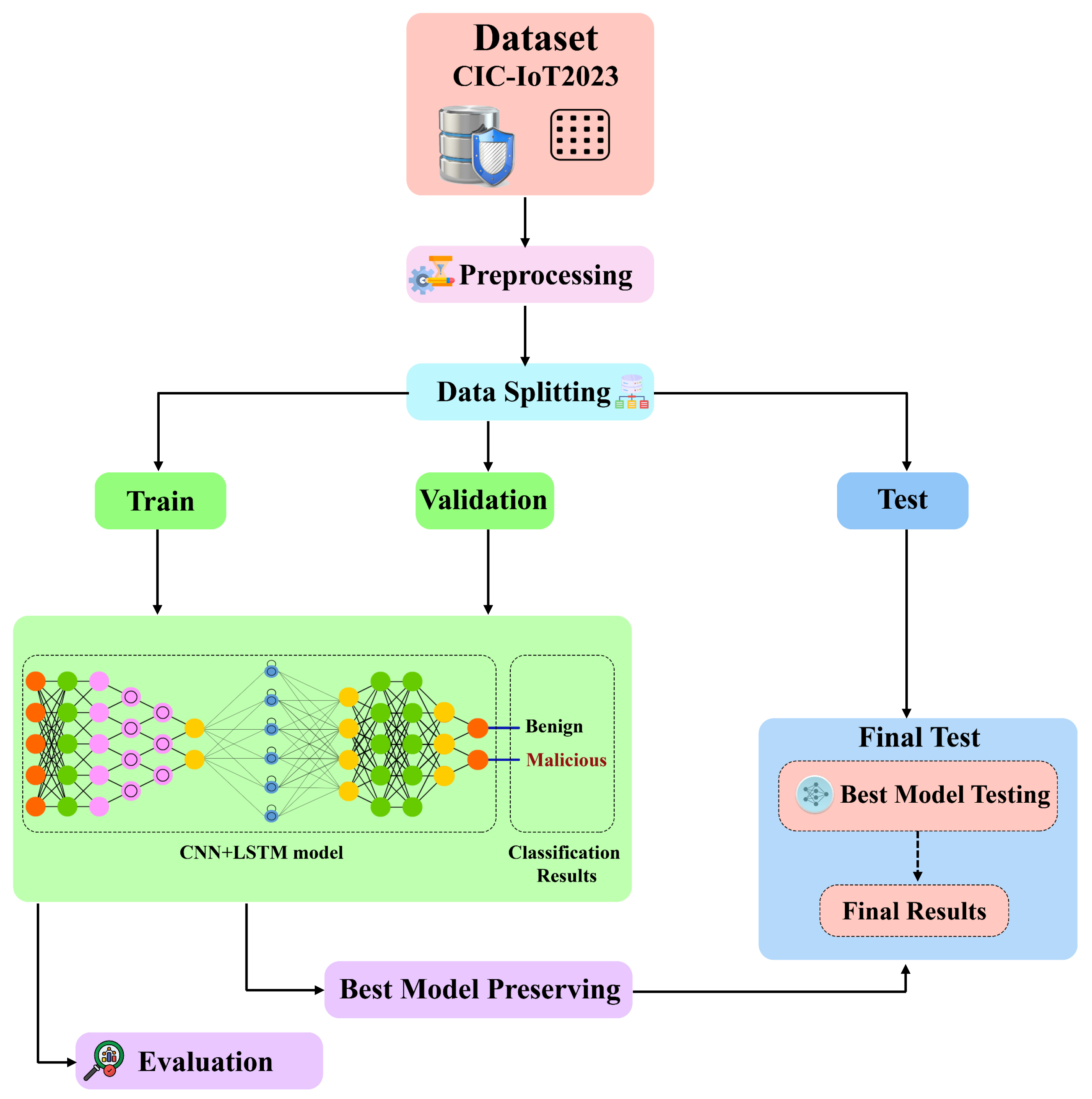
- IoTトラフィックデータを45特徴ベクトルに前処理し、ラベルをバイナリ形式に変換。
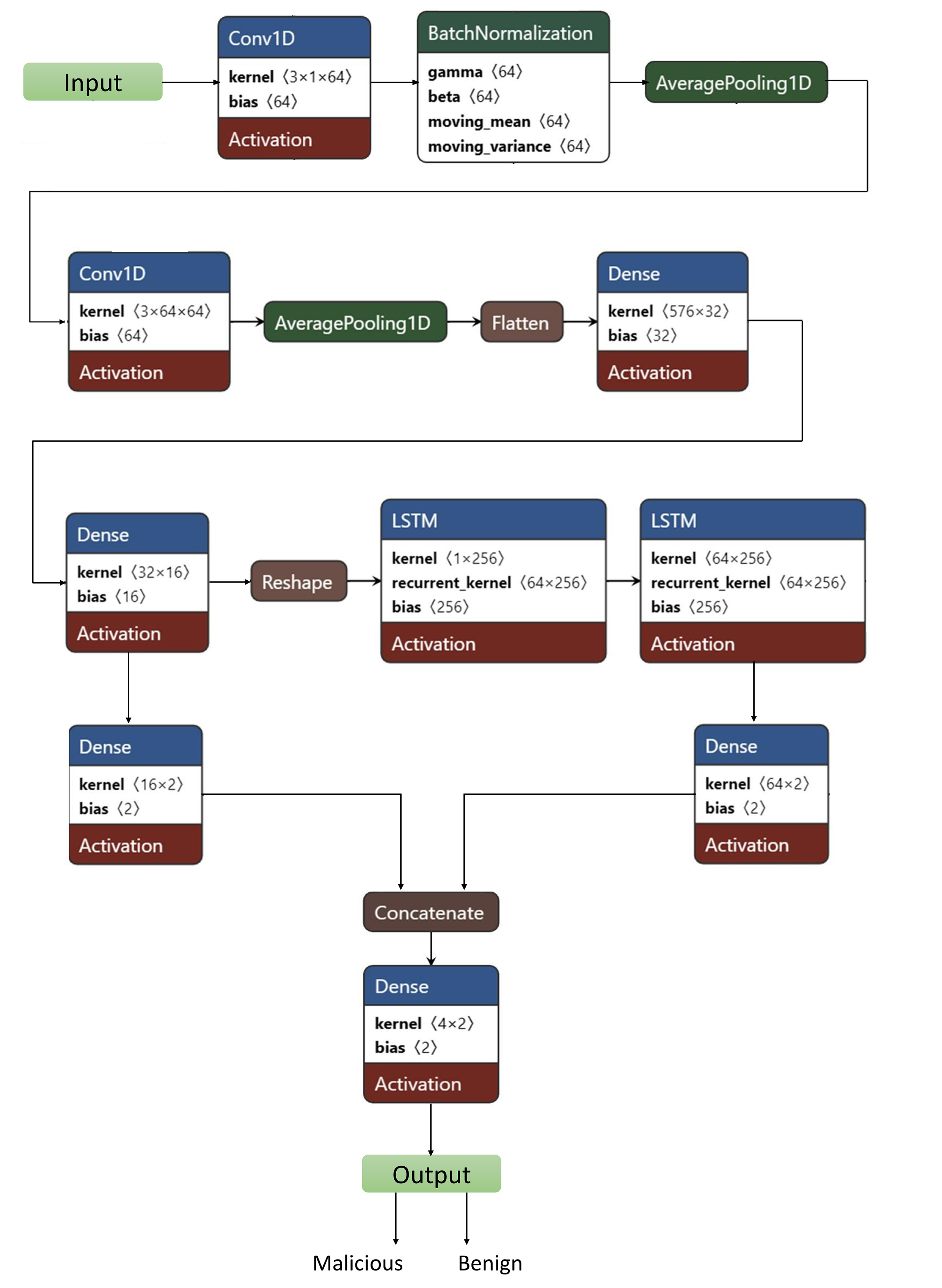
- バッチ正規化と平均プーリングを用いたCNN-1D特徴抽出器を設計し、空間的パターンを捉える。
- CNN出力をLSTM層と組み合わせて逐次依存性をモデル化し、バイナリのbenign/malicious判定を生成。
- CICIoT2023サブセット上で80/20の訓練/検証分割、Adam最適化子で25エポック訓練。追加のCICIoT2023サブセットおよびCICIDS2017で一般化を評価。
- accuracy、loss、precision、recall、F1-score、FPRを用いて性能を評価。ROC/混同行列の分析を報告。
実験結果
リサーチクエスチョン
- RQ1CNN-LSTMハイブリッドモデルは、IoT侵入検知のバイナリ分類タスクにおいて単一モデル手法を上回ることができるか。
- RQ2CNN-LSTM IDSは、異なるIoTトラフィックデータセット(CICIoT2023サブセットおよびCICIDS2017)でどの程度一般化できるか。
- RQ3提案手法における検知精度と偽陽性率のトレードオフは何か。
- RQ4モデルは空間-時間的特徴を有効に活用して、正常なIoTトラフィックと悪意のあるトラフィックを区別できているか。
主な発見
- CNN-LSTM IDSはCICIoT2023第一サブセットで98.42%の精度、損失0.0275を達成。
- CICIoT2023第二サブセットでの一般化テストは98.43%の精度、0.0275の損失、9.17%のFPRを示した。
- CICIDS2017では、97.45%の精度、0.06の損失、97.17%のprecision、97.15%のrecall、97.07%のF1-score、2.08%のFPRを達成。
- 混同行列は正常トラフィックで約90%の精度、攻撃で約99%の精度を示す。
- ROC分析は高いTrue Positive Rateと低いFalse Positive Rateを示し、クラス間の強い識別を示す。
- 最新手法と比較して、CICIoT2023およびCICIDS2017でのCNN-LSTMアプローチは、報告された指標全体で優れた性能を示す。
この論文を読む
Nubintのビューアで原文を開き、読みながら気になる箇所をすぐに質問できます。
Nubintでこの論文を読むこのレビューはAIが論文の原文をもとに作成しました。引用する前に原文をご確認ください。