
[論文レビュー] Enhancing Multivariate Time Series-based Solar Flare Prediction with Multifaceted Preprocessing and Contrastive Learning
本論文は、多変量時系列に基づくソーラーフレア予測を向上させるために、多面的な前処理パイプラインと、対照的学習に基づく新しいGRU分類器(ContReg)を提案する。欠損値補完、正規化、SMOTE-RUSサンプリング、近接意思決定境界付近のサンプル除去、特徴選択、二重損失GRUアーキテクチャを統合することで、平均真のスキル統計量(TSS)が0.846に達し、先行研究を著しく上回る性能を達成した。
Accurate solar flare prediction is crucial due to the significant risks that intense solar flares pose to astronauts, space equipment, and satellite communication systems. Our research enhances solar flare prediction by utilizing advanced data preprocessing and classification methods on a multivariate time series-based dataset of photospheric magnetic field parameters. First, our study employs a novel preprocessing pipeline that includes missing value imputation, normalization, balanced sampling, near decision boundary sample removal, and feature selection to significantly boost prediction accuracy. Second, we integrate contrastive learning with a GRU regression model to develop a novel classifier, termed ContReg, which employs dual learning methodologies, thereby further enhancing prediction performance. To validate the effectiveness of our preprocessing pipeline, we compare and demonstrate the performance gain of each step, and to demonstrate the efficacy of the ContReg classifier, we compare its performance to that of sequence-based deep learning architectures, machine learning models, and findings from previous studies. Our results illustrate exceptional True Skill Statistic (TSS) scores, surpassing previous methods and highlighting the critical role of precise data preprocessing and classifier development in time series-based solar flare prediction.
研究の動機と目的
- 宇宙機器や宇宙飛行士へのリスクを軽減するため、正確な太陽フレア予測の実現を目的とする。
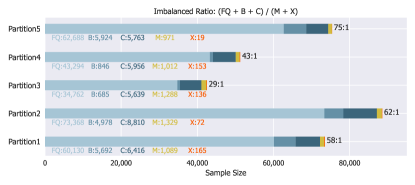
- SWAN-SF多変量時系列データセットに内在する欠損値、クラス不均衡、特徴の冗長性といったデータ品質の問題を克服する。
- 不均衡でノイズの多い太陽フレアデータに対して、一般化性能を向上させる体系的な前処理パイプラインの構築を目的とする。
- 分類の強度とピーク軟X線放射線量の両方を向上させるために、対照的学習と回帰学習を統合した新しい深層学習分類器ContRegの設計を目的とする。
- SWAN-SFデータセットの複数のトレイン・テスト分割において、既存の機械学習および深層学習モデルを上回る優れた性能を示すことを目的とする。
提案手法
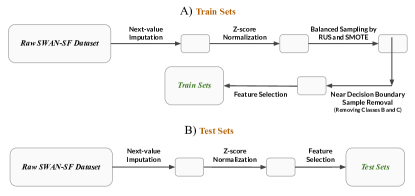
- 時系列の連続性を保つために、次値補完と前値補完を組み合わせたハイブリッド欠損値補完戦略を実装する。
- 全般的なzスコア正規化を適用して、時系列全体における多変量磁場パラメータを標準化する。
- クラス不均衡を緩和するために、SMOTEとランダムアンダーサンプリング(RUS)を併用したバランスサンプリングを実施する。
- 意思決定境界付近の曇りのない訓練サンプルを除去するため、近接意思決定境界付近のサンプル除去(NDBSR)を導入する。
- GRUを用いた特徴重要度分析を実施し、情報に基づいた特徴選択を実現することで、ノイズを低減し、モデルの効率を向上させる。
- 三重損失を用いた対照的学習と平均二乗誤差損失を用いた回帰学習を統合した二重ブランチGRUモデルContRegを開発し、フレア分類とピーク放射線量予測を同時に最適化する統合損失関数を構築する。
実験結果
リサーチクエスチョン
- RQ1包括的な前処理パイプラインは、SWAN-SFデータセットにおける太陽フレア予測性能をどの程度向上させるか?
- RQ2前処理パイプラインの各構成要素(補完、正規化、サンプリング、NDBSR、特徴選択)がTSSスコアにどのように段階的に寄与するか?
- RQ3対照的学習に基づくGRU分類器(ContReg)は、標準的な深層学習および従来の機械学習モデルを上回る性能を示せるか?
- RQ4損失関数にフレア分類とピークソフトX線放射線量を統合することで、二値分類のみに比べて分類性能がどのように向上するか?
- RQ5提案手法は、SWAN-SFデータセットの異なるトレイン・テスト分割において一貫した性能を維持できるか?
主な発見
- 完全な前処理パイプラインは平均TSSが0.801に達し、 Ahmadzadehら(2021)(TSS = 0.613)およびAlshammariら(2024)(TSS = 0.693)を著しく上回った。
- 前処理パイプラインの各段階がTSSに段階的に寄与した:補完のみで0.173から完全パイプラインで0.801にまで上昇。特に正規化とバランスサンプリングが主な貢献要因であった。
- NDBSR技術はクラスの重複を低減することでTSSを向上させ、曇りのない訓練サンプルの処理においてその価値を示した。
- 完全な前処理パイプラインと組み合わせたContReg分類器は、平均TSSが0.846、平均リcallが0.975に達し、すべての先行研究およびベースラインモデルを上回った。
- すべてのトレイン・テスト組み合わせにおいて、標準RNN、LSTM、GRU、SVM、k-NN、ランダムフォレストモデルをContRegモデルが一貫して上回った。
- SMOTEとRUSの併用によるバランスサンプリングは、SMOTE単体よりも高いTSSを達成し、不均衡データ環境下での過学習の低減と一般化性能の向上を示した。
この論文を読む
Nubintのビューアで原文を開き、読みながら気になる箇所をすぐに質問できます。
Nubintでこの論文を読むこのレビューはAIが論文の原文をもとに作成しました。引用する前に原文をご確認ください。