
[論文レビュー] Enhancing Social Recommendation with Adversarial Graph Convolutional Networks
本稿では、implicitな社会的関係の共同学習と異種の社会的インパクトのモデリングにより、スパースな社会的データを補完することで、ソーシャルレコメンデーションを向上させる、深層敵対的グラフ畳み込みネットワークフレームワークESRFを提案する。GCNベースのオートエンコーダを用いてスパースな社会的データを拡張し、関係の強さを重みづけするアテンション付きGCNモジュールを導入することで、3つの実世界データセットにおいて最先端のモデルを上回る性能を示し、スパarsityとノイズに対して高いロバスト性を示した。
Social recommender systems are expected to improve recommendation quality by incorporating social information when there is little user-item interaction data. However, recent reports from industry show that social recommender systems consistently fail in practice. According to the negative findings, the failure is attributed to: (1) A majority of users only have a very limited number of neighbors in social networks and can hardly benefit from social relations; (2) Social relations are noisy but they are indiscriminately used; (3) Social relations are assumed to be universally applicable to multiple scenarios while they are actually multi-faceted and show heterogeneous strengths in different scenarios. Most existing social recommendation models only consider the homophily in social networks and neglect these drawbacks. In this paper we propose a deep adversarial framework based on graph convolutional networks (GCN) to address these problems. Concretely, for (1) and (2), a GCN-based autoencoder is developed to augment the relation data by encoding high-order and complex connectivity patterns, and meanwhile is optimized subject to the constraint of reconstructing the social profile to guarantee the validity of the identified neighborhood. After obtaining enough purified social relations for each user, a GCN-based attentive social recommendation module is designed to address (3) by capturing the heterogeneous strengths of social relations. Finally, we adopt adversarial training to unify all the components by playing a Minimax game and ensure a coordinated effort to enhance recommendation performance. Extensive experiments on multiple open datasets demonstrate the superiority of our framework and the ablation study confirms the importance and effectiveness of each component.
研究の動機と目的
- スパースかつノイズの多い社会的関係のため、実用的なソーシャルレコメンデーションシステムの性能が低い問題に対処する。
- 既存のモデルがすべての社会的関係を均一に扱うという限界を克服し、文脈に応じた異種のインパクトを無視しないようにする。
- 明示的リンクを超えた信頼できるimplicitな社会的関係の発見により、低データ環境におけるレコメンデーション品質を向上させる。
- 敵対的訓練を通じて関係の拡張とレコメンデーションを統合的に調整するフレームワークを構築する。
- オートエンコーダがユーザの社会的プロフィールを再構成する制約を設けることで、拡張された関係の妥当性を保証する。
提案手法
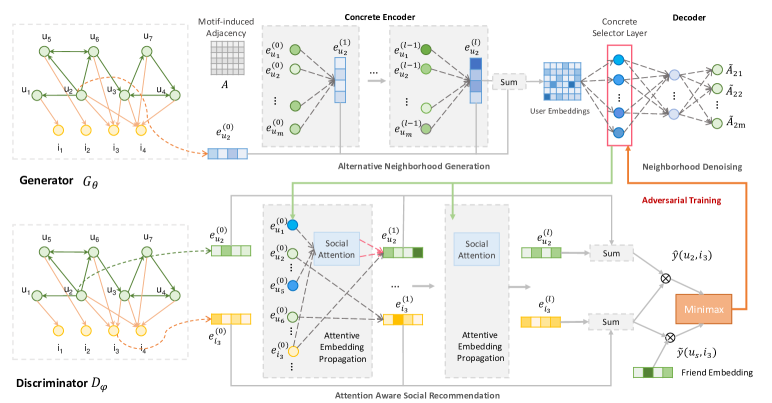
- ユーザの社会的プロフィールの再構成による制約を設けたGCNベースのオートエンコーダを用い、高次の接続パターンを学習し、validなimplicitな社会的近隣を生成する。
- 学習可能なアテンション機構を備えたグラフ畳み込みネットワークを導入し、社会的関係の異種の強度をモデリングし、関係の関連性に応じて異なる重みを近隣に割り当てる。
- 関係拡張用のジェネレータ(拡張済みGCN)とレコメンデーションに特化したディスクラミネータ(GCN)の間で敵対的訓練を実施し、ミニマックスゲームを用いて両モジュールを統合的かつ最適化する。
- オートエンコーダを最適化し、ユーザの社会的プロフィールを再構成することで、拡張された関係が意味を持つものであり、ランダムではないことを保証する。
- 2段階の訓練プロセスを採用:まずオートエンコーダとアテンションモジュールを事前学習し、次に敵対的損失を用いて全モジュールを共同で微調整する。
- 敵対的訓練の大きさを制御するハイパーパrameter βを導入し、関係拡張とレコメンデーション精度のバランスを取る。
実験結果
リサーチクエスチョン
- RQ1ノイズを導入せずに、低データ環境におけるスパースな社会的関係を効果的に拡張する方法は何か?
- RQ2高次接続パターンを介して発見されたimplicitな社会的近隣は、レコメンデーション性能をどの程度向上させるか?
- RQ3異なるレコメンデーション文脈において、社会的関係の異種インパクトをどのようにモデリングできるか?
- RQ4関係拡張モジュールとレコメンデーションモジュールの間で敵対的訓練を実施することで、独立した最適化に比べて性能が向上するか?
- RQ5ハイパーパrameter(代替近隣数k、敵対的大きさβ、GCNの深さ)に対して、このフレームワークはどの程度感度を示すか?
主な発見
- ESRFはLast.fm、Douban、Gowallaの3つのデータセットにおいて、最先端のソーシャルレコメンデーションモデルを著しく上回り、RMSEおよびMAEの両方で改善を示した。
- Last.fm、Douban、Gowallaの各データセットにおいて、k = 40、30、50のときESRFの性能がピークに達し、ノイズが支配的になる前の最適な拡張レベルであることが示された。
- 敵対的訓練は性能を向上させるが、過度な大きさ(βが大きい)では結果が劣化するため、関係の質とレコメンデーション精度の間にはトレードオフがあることが示唆された。
- Last.fm、Douban、Gowallaではそれぞれ4層、3層、4層のGCN層で最良の性能を達成し、それ以上の深さでは収益が減少する傾向を示した。
- 同定された代替近隣の32.44%が明示的な社会的関係と重複しており、拡張された近隣が意味を持ち、実際の社会的つながりと関連していることが示された。
- モデル内のアテンション重みは、各ユーザの近隣間で明確に変動しており、フレームワークが異種の社会的インパクト強度を効果的に学習していることが確認された。
より良い研究を、今すぐ始めましょう
論文の読解から最終レビューまで、研究時間を劇的に削減しましょう。
クレジットカード登録不要
このレビューはAIが作成し、人間の編集者が確認しました。