
[論文レビュー] Enhancing the Reasoning Ability of Multimodal Large Language Models via Mixed Preference Optimization
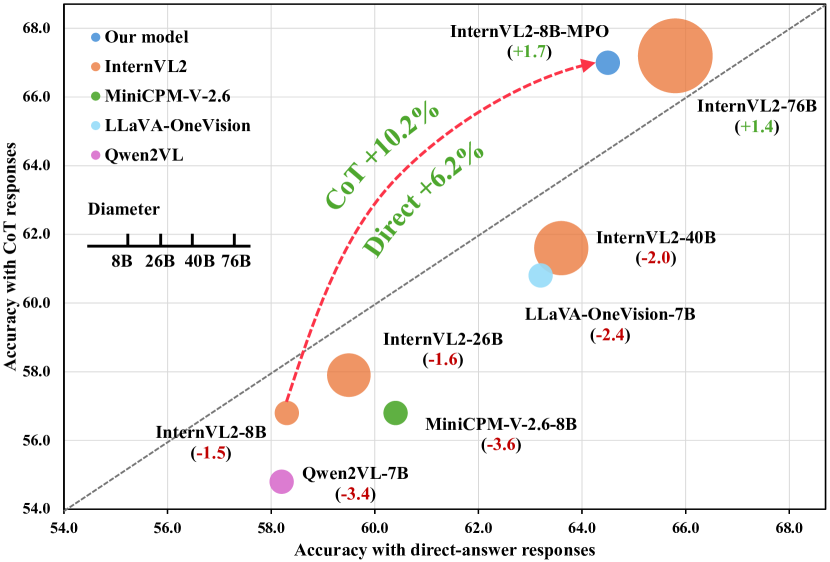
この論文では、大規模で自動化されたデータセット構築パイプラインと組み合わせた新しい手法であるミックス・プレファレンス最適化(MPO)を紹介する。MPOは、報酬モデルを必要とせず、マルチモーダル推論性能を向上させ、MathVistaで67.0のスコアを達成し、InternVL2-8B より8.7ポイント高い性能を発揮。また、10倍大きなモデルと同等の性能を示し、テキストのみの推論および指示従い能力の向上も見られた。
Existing open-source multimodal large language models (MLLMs) generally follow a training process involving pre-training and supervised fine-tuning. However, these models suffer from distribution shifts, which limit their multimodal reasoning, particularly in the Chain-of-Thought (CoT) performance. To address this, we introduce a preference optimization (PO) process to enhance the multimodal reasoning capabilities of MLLMs. Specifically, (1) on the data side, we design an automated preference data construction pipeline to create MMPR, a high-quality, large-scale multimodal reasoning preference dataset; and (2) on the model side, we explore integrating PO with MLLMs, developing a simple yet effective method, termed Mixed Preference Optimization (MPO), which boosts multimodal CoT performance. Our approach enhances the multimodal reasoning abilities of both InternVL2-8B and InternVL2-76B. Notably, our model, InternVL2-8B-MPO, achieves an accuracy of 67.0 on MathVista, outperforming InternVL2-8B by 8.7 points and achieving performance comparable to the 10$ imes$ larger InternVL2-76B. We hope this study could inspire further advancements in MLLMs. Code, data, and model are released.
研究の動機と目的
- オープンソースMLLMにおけるチェーン・オブ・ススセス(CoT)応答を用いる際のマルチモーダル推論性能の低下を是正すること。
- 訓練中にテイカー・フォースが原因で生じる分布シフトを克服し、CoT推論に悪影響を及げるSFT(教師強制)の影響を軽減すること。
- 高価な人為的アノテーションに依存せず、スケーラブルで自動化されたパイプラインを用いて、高品質なマルチモーダル推論プレファレンスデータを構築すること。
- 報酬モデルを必要とせず、推論品質と指示従い能力の両方を向上させるプレファレンス最適化手法を設計すること。
- SFTとプレファレンス最適化を組み合わせることで、特に参照モデル制約を用いることで、CoT推論性能が顕著に向上することを示すこと。
提案手法
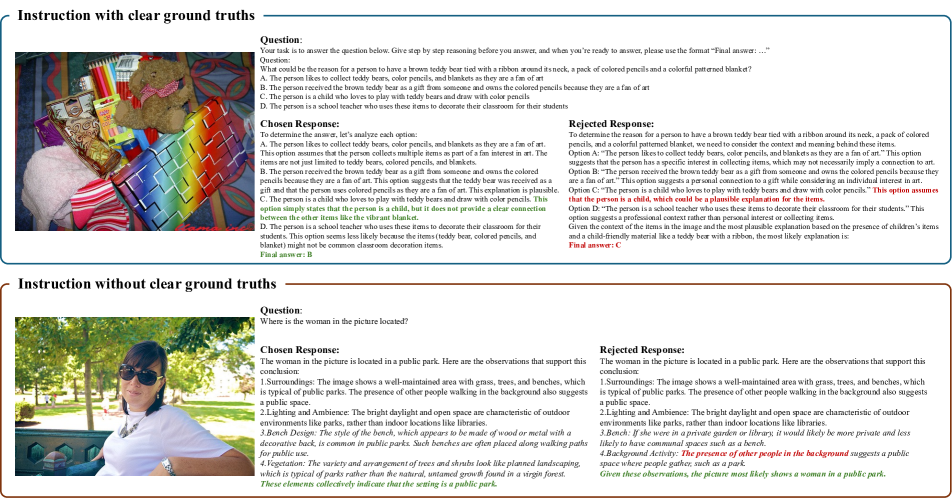
- LLMをアノテーターとして用い、高品質で大規模なマルチモーダル推論プレファレンスデータ(MMPR)を自動生成するパイプラインを提案する。
- 明確な正解がないサンプルに対しては、コントゥニエーションベースのパイプライン(DropoutNTP)を導入し、モデルが切り捨てられたCoT応答を完了することで拒否応答を形成する。
- 明確な正解があるサンプルに対しては、正解の基準に基づいて複数の解をモデルからサンプリングし、正解度で順序付けしてプレファレンスペアを形成するパイプラインを設計する。
- DPOとBCO損失を併用して、応答ペア間の相対的プレファレンスと個々の応答の絶対的品質の両方を最適化する、ミックス・プレファレンス最適化(MPO)を設計する。
- 二重損失戦略を採用:DPOでプレファレンス順序を学習し、BCOで個々の応答の品質を向上。固定された参照モデルを用いて過学習を防止する。
- すべてのPO手法にSFT損失を追加し、訓練の安定化と推論性能の向上を図る。SFTが効果的なCoT強化に不可欠であることが示された。
実験結果
リサーチクエスチョン
- RQ1SFTによる分布シフトの影響を受けるにもかかわらず、プレファレンス最適化がオープンソースMLLMにおけるマルチモーダルCoT推論を効果的に向上させられるか?
- RQ2高価な人為的アノテーションに依存せず、スケーラブルに高品質なマルチモーダル推論プレファレンスデータを構築する方法は何か?
- RQ3SFTとプレファレンス最適化を組み合わせることで、SFTまたはPO単体よりも優れたCoT推論性能が得られるか?
- RQ4DPO、BCO、それらの組み合わせといったプレファレンス最適化アルゴリズムの中で、マルチモーダル推論タスクに適用した際、どの手法が最も優れた推論性能を発揮するか?
- RQ5MPOはマルチモーダル推論にとどまらず、テキストのみの推論および指示従い能力の向上にもどの程度寄与するか?
主な発見
- InternVL2-8B-MPOはMathVistaで67.0の正答率を達成し、InternVL2-8B より8.7ポイント高い性能を示し、10倍大きなInternVL2-76B と同等の性能を発揮した。
- MPOで訓練されたモデルは、TheoremQAでSFTベースラインより5.2ポイント、IFEvalで4.1ポイント高いスコアを示し、テキストのみの推論および指示従い能力の向上が確認された。
- すべてのPO手法が直接回答およびCoT設定においてSFTを上回ったが、SFT損失を組み合わせた手法のみが顕著にCoT推論性能を向上させた。
- DPOとBCOを組み合わせたMPOが最も優れたCoT性能を発揮した。TR-DPOやODPOは、不安定な参照モデルの更新や参照モデル制約の欠如により、性能が劣った。
- 固定された参照モデルの使用は、CoT推論性能の維持に不可欠であり、適応的参照モデル(例:TR-DPO)を用いたモデルは著しく性能が低下した。
- MMPRにテキストのみのデータが含まれていないにもかかわらず、MPOモデルはテキストのみのベンチマークでも一般化可能であり、マルチモーダルプレファレンス学習がより広範な言語理解を向上させることを示した。
この論文を読む
Nubintのビューアで原文を開き、読みながら気になる箇所をすぐに質問できます。
Nubintでこの論文を読むこのレビューはAIが論文の原文をもとに作成しました。引用する前に原文をご確認ください。