
[論文レビュー] Estimate Deformation Capacity of Non-Ductile RC Shear Walls using Explainable Boosting Machine
本研究では、説明可能な勾配ブースティングマシン(EBM)を用いて、非延性RC剪断壁の変形容量を高い精度と透明性で予測する完全に説明可能な機械学習モデルを開発した。モデルはR² = 0.92および予測値/実測値比 = 1.05を達成し、物理的挙動と整合する信頼性の高い解釈可能な予測を提供し、ブラックボックスモデルに比べて精度と解釈可能性の両面で優れている。
Machine learning is becoming increasingly prevalent for tackling challenges in earthquake engineering and providing fairly reliable and accurate predictions. However, it is mostly unclear how decisions are made because machine learning models are generally highly sophisticated, resulting in opaque black-box models. Machine learning models that are naturally interpretable and provide their own decision explanation, rather than using an explanatory, are more accurate in determining what the model actually computes. With this motivation, this study aims to develop a fully explainable machine learning model to predict the deformation capacity of non-ductile reinforced concrete shear walls based on experimental data collected worldwide. The proposed Explainable Boosting Machines (EBM)-based model is an interpretable, robust, naturally explainable glass-box model, yet provides high accuracy comparable to its black-box counterparts. The model enables the user to observe the relationship between the wall properties and the deformation capacity by quantifying the individual contribution of each wall property as well as the correlations among them. The mean coefficient of determination R2 and the mean ratio of predicted to actual value based on the test dataset are 0.92 and 1.05, respectively. The proposed predictive model stands out with its overall consistency with scientific knowledge, practicality, and interpretability without sacrificing high accuracy.
研究の動機と目的
- 非延性RC剪断壁の変形容量を予測する信頼性があり解釈可能なモデルの不足に応えること。
- 地震工学分野におけるブラックボックス機械学習モデルの限界を克服し、モデルの透過性と物理的整合性を確保すること。
- 設計意思決定の根拠を理解・検証できるようにするガラスボックスモデルを構築し、変形容量予測の意思決定プロセスを解明すること。
- 過剰に安全な設計規定に代わる、データ駆動型で正確かつ説明可能な予測を用いて、耐震性能評価を向上させること。
- 解釈可能性を損なわず高精度を達成できることを実証し、設計および補強設計における実用的導入を可能にすること。
提案手法
- 個々の特徴量の寄与度を明示的に提供する内在的解釈性を持つガラスボックス型で加法的なモデル、説明可能な勾配ブースティングマシン(EBM)を採用する。
- 壁の寸法や材料特性を入力とし、極限変位を出力とする、実験的非延性RC剪断壁データのグローバルデータセットを用いてEBMモデルを学習する。
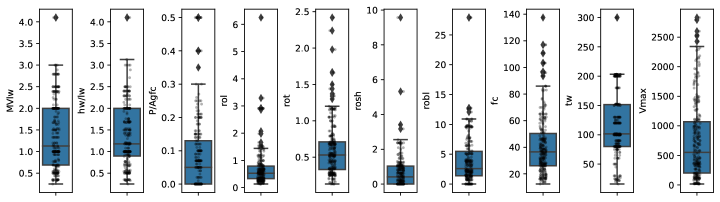
- 壁のスロープ比(M/Vl_w)、厚さ(t_w)、軸方向力比(P/A_g f_c)、最大せん断力(V_max)など、最も影響力のあるパラメータを特定するための特徴選択を実施する。
- 10回のランダムなトレイン・テスト分割を用いてモデルの性能を評価し、R²、相対誤差(RE)、予測精度(PA)を計算して妥当性を確認する。
- 標準化された指標を用いて、ブラックボックスモデル(XGBoost、Gradient Boost、Random Forest)およびガラスボックスモデル(決定木、リッジ線形回帰)と比較してEBMの性能を評価する。
- 個々の項の寄与度を分析し、物理的理解と整合するかを検証することで、モデルの解釈可能性を検証する。特に、低予測ケースにおいてV_maxが正の影響を示すなど、予期しない関係性の検出も行う。
実験結果
リサーチクエスチョン
- RQ1説明可能な機械学習モデルは、非延性RC剪断壁の変形容量予測において、完全な解釈可能性を維持しながらも高い予測精度を達成できるか?
- RQ2どの壁の特性が変形容量に最も顕著に影響を与え、それぞれが個別にまた相乗的にどのように寄与しているか?
- RQ3EBMモデルの性能は、ブラックボックスモデルおよびガラスボックスモデルと比較して、精度、頑健性、物理的挙動との整合性においてどのように差がつくか?
- RQ4予測性能を損なわず、最も関連性の高い特徴量のみに制限することで、モデルをどの程度簡略化できるか?
- RQ5透明な意思決定プロセスにより、エンジニアがモデルの予測を信頼し、後処理の説明ツール(例:SHAPやLIME)に依存せずに検証できるか?
主な発見
- EBMモデルは、テストデータセットにおいて平均決定係数(R²)が0.92、予測値/実測値比が1.05を達成し、高い精度と最小限のバイアスを示している。
- 変形容量に最も影響を与える予測変数は壁の厚さ(t_w)、曲げモーメントとせん断力比(M/Vl_w)、軸方向力比(P/A_g f_c)、最大せん断力(V_max)であり、曲げのタイプやコンクリートの圧縮強度は相対的に影響が小さい。
- 4つの主要な入力変数に限定しても、R² = 0.92、PA = 1.05を達成し、高い性能を維持している。これは実用的で計算コストが低いことを示している。
- EBMは、ブラックボックスモデル(XGBoost、Gradient Boost、Random Forest)およびガラスボックスモデル(決定木、リッジ線形回帰)の全性能指標において優れている。分散が小さく、より頑健である。
- モデルの予測は全体的に物理的整合性を有しており、V_maxが低予測ケースで正の影響を示すなど、検出可能な例外も含め、エンジニアが意味的に解釈・検証可能な内容である。
- ブラックボックスモデルとは異なり、EBMはSHAPやLIMEのような後処理の説明ツールを必要とせず、モデル意思決定の近似誤差を排除し、直接的かつ正確な理解可能性を提供する。

この論文を読む
Nubintのビューアで原文を開き、読みながら気になる箇所をすぐに質問できます。
Nubintでこの論文を読むこのレビューはAIが論文の原文をもとに作成しました。引用する前に原文をご確認ください。