
[論文レビュー] eVAE: Evolutionary Variational Autoencoder
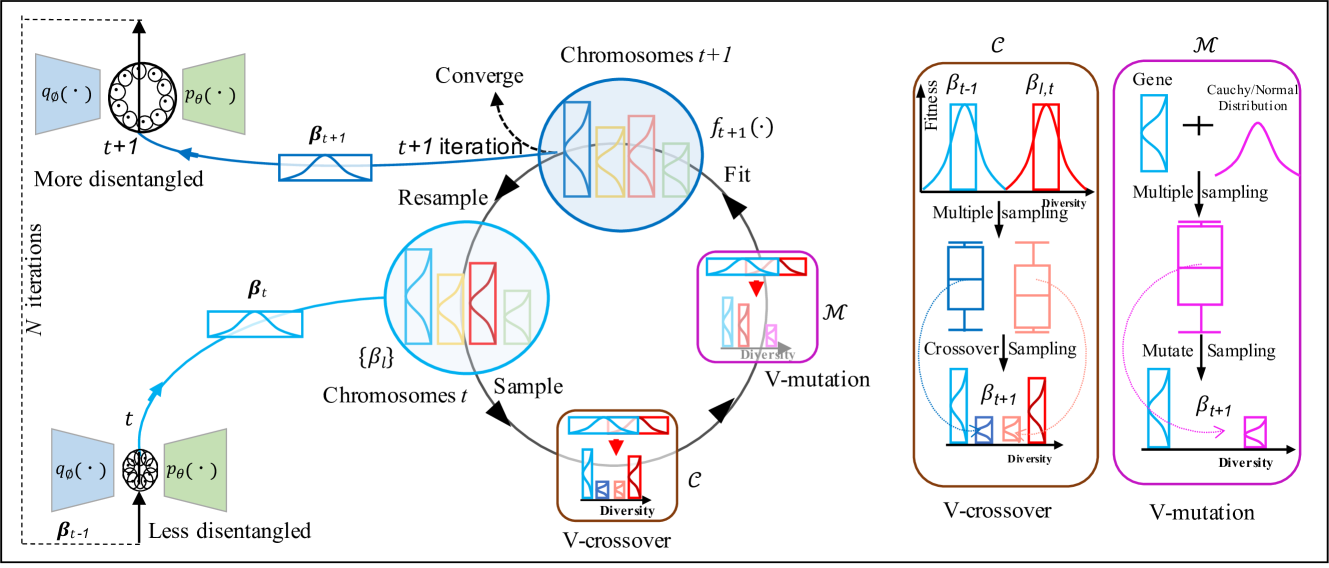
eVAE は、可変的遺伝的アルゴリズムを VAE に統合することで、ハイパーパrameterチューニングを必要とせずに再構成と表現学習の動的バランスを実現する、革新的な進化的変分オートエンコーダーを提案する。変分突然変異、シミュレーテッドバイナリクロスオーバー、およびインナーバイアス・ジョイントトレーニングを採用することで、KL 消失問題を軽減し、分離性を向上させ、最先端の手法と比較して優れた画像生成および再構成品質を達成する。
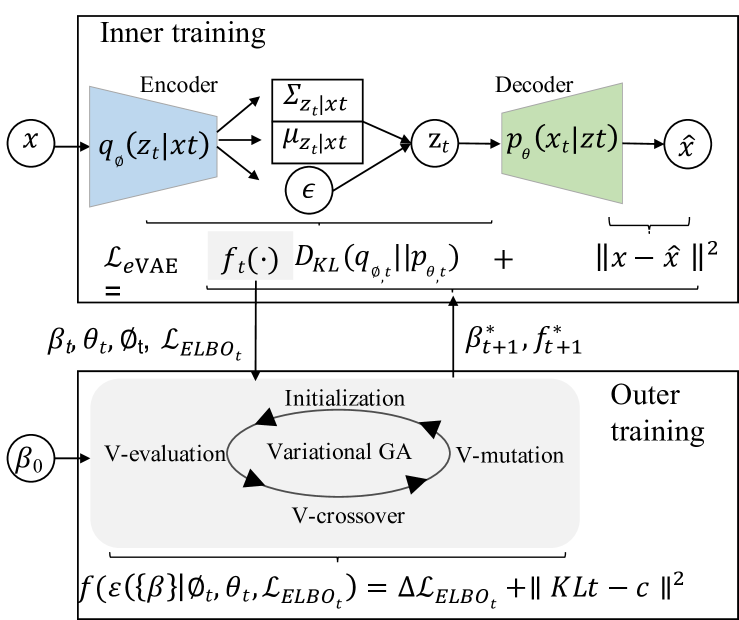
The surrogate loss of variational autoencoders (VAEs) poses various challenges to their training, inducing the imbalance between task fitting and representation inference. To avert this, the existing strategies for VAEs focus on adjusting the tradeoff by introducing hyperparameters, deriving a tighter bound under some mild assumptions, or decomposing the loss components per certain neural settings. VAEs still suffer from uncertain tradeoff learning.We propose a novel evolutionary variational autoencoder (eVAE) building on the variational information bottleneck (VIB) theory and integrative evolutionary neural learning. eVAE integrates a variational genetic algorithm into VAE with variational evolutionary operators including variational mutation, crossover, and evolution. Its inner-outer-joint training mechanism synergistically and dynamically generates and updates the uncertain tradeoff learning in the evidence lower bound (ELBO) without additional constraints. Apart from learning a lossy compression and representation of data under the VIB assumption, eVAE presents an evolutionary paradigm to tune critical factors of VAEs and deep neural networks and addresses the premature convergence and random search problem by integrating evolutionary optimization into deep learning. Experiments show that eVAE addresses the KL-vanishing problem for text generation with low reconstruction loss, generates all disentangled factors with sharp images, and improves the image generation quality,respectively. eVAE achieves better reconstruction loss, disentanglement, and generation-inference balance than its competitors.
研究の動機と目的
- データやネットワーク設定が変化する状況下でも不安定なまま残っている、VAE における表現圧縮とタスク適合の動的トレードオフを解消すること。
- 再構成と推論のバランスをとるために固定されたハイパーパrameter や制限付きアーキテクチャに依存する既存の VAE 手法の限界を克服すること。
- 進化的な演算子を用いて ELBO のトレードオフをリアルタイムで自己調整するメカニズムを構築し、手動チューニングや早期収束を回避すること。
- 変分情報ボトルネック理論と進化的学習を統合することで、深層生成モデルにおける強固で適応的な最適化を可能にすること。
- 潜在空間における確率的で進化的な探索を通じて、VAE の生成・推論のバランスと表現品質を向上させること。
提案手法
- 確率的クロモソーム表現を用いて、VAE の下界期待値(ELBO)目的関数内でハイパーパrameter を進化的に進化させる変分遺伝的アルゴリズム(VGA)を導入する。
- 不安定で非一様なハイパーパrameter空間の探索を可能にし、ランダムサーチを回避するためのカウチ分布に基づく変分突然変異演算子を設計する。
- 有望なハイパーパrameter 組み合わせを組み合わせて収束を加速するためのシミュレーテッドバイナリクロスオーバー(SBX)演算子を実装する。
- VAE の生成モデルと最適なトレードオフパラメータを求めるための進化的探索を交互に最適化するインナーバイアス・ジョイントトレーニングメカニズムを開発する。
- 潜在表現が圧縮と再構成忠実度の両方をバランスさせるように保証するため、情報ボトルネックフレームワーク下での変分推論を適用する。
- 進化的最適化中の多様性を維持し、早期収束を防ぐために確率的クロモソーム選択を用いる。
実験結果
リサーチクエスチョン
- RQ1進化的最適化は、固定されたハイパーパrameter がなくとも、VAE における再構成と表現学習のトレードオフを動的にバランスさせることができるか?
- RQ2変分遺伝的アルゴリズムを統合することで、KL 消失問題やモード崩壊に対処する際の VAE の安定性と性能がどのように向上するか?
- RQ3SBX やカウチ突然変異といった進化的な演算子は、VAE における分離性と生成品質をどの程度向上させるか?
- RQ4eVAE のインナーバイアス・ジョイントトレーニングメカニズムは、標準的な VAE 学習や既存のアニーリングまたは制御ベースの手法と比較して、再構成と分離性の観点で優れているか?
- RQ5eVAE は、アーキテクチャ的・ハイパーパラメータ的制約なしに、多様なデータタイプやアーキテクチャに一般化可能か?
主な発見
- eVAE は、複数のデータセットにおいて、β-VAE や InfoVAE、ControlVAE といったベースライン VAE と比較して顕著に低い再構成損失を達成する。
- 進化的チューニングにより KL 散乱と再構成項のバランスを効果的にとることで、よりシャープで分離性の高い画像を生成する。
- 動的調整によりテキスト生成における KL 消失問題を軽減し、尤度と生成多様性の両方が向上する。
- インナーバイアス・ジョイントトレーニングメカニズムにより、収束が安定し、早期収束を回避する。これは、複数回の学習実行において一貫した性能を示すことで裏付けられる。
- MIG や FID といった標準指標で測定したところ、eVAE は分離性と生成・推論のバランスの両面で最先端の手法を上回る。
- SBX とカウチ突然変異の統合により、ハイパーパラメータ空間における探索がより効率的になり、ランダムまたはヒューリスティックなチューニングへの依存が軽減される。
この論文を読む
Nubintのビューアで原文を開き、読みながら気になる箇所をすぐに質問できます。
Nubintでこの論文を読むこのレビューはAIが論文の原文をもとに作成しました。引用する前に原文をご確認ください。