
[論文レビュー] Evaluating Graph Neural Networks for Link Prediction: Current Pitfalls and New Benchmarking
この論文は GNN を用いたリンク予測の評価方法を検証し、重大な落とし穴を明らかにし、評価を実世界のシナリオと一致させるための hard negative sampling ベンチマークフレームワーク HeaRT を導入する。
Link prediction attempts to predict whether an unseen edge exists based on only a portion of edges of a graph. A flurry of methods have been introduced in recent years that attempt to make use of graph neural networks (GNNs) for this task. Furthermore, new and diverse datasets have also been created to better evaluate the effectiveness of these new models. However, multiple pitfalls currently exist that hinder our ability to properly evaluate these new methods. These pitfalls mainly include: (1) Lower than actual performance on multiple baselines, (2) A lack of a unified data split and evaluation metric on some datasets, and (3) An unrealistic evaluation setting that uses easy negative samples. To overcome these challenges, we first conduct a fair comparison across prominent methods and datasets, utilizing the same dataset and hyperparameter search settings. We then create a more practical evaluation setting based on a Heuristic Related Sampling Technique (HeaRT), which samples hard negative samples via multiple heuristics. The new evaluation setting helps promote new challenges and opportunities in link prediction by aligning the evaluation with real-world situations. Our implementation and data are available at https://github.com/Juanhui28/HeaRT
研究の動機と目的
- Expose inconsistencies and underreported performance in existing link prediction evaluations.
- Provide a fair, reproducible comparison of representative link prediction methods across common datasets.
- Propose and validate a new evaluation framework (HeaRT) with hard, personalized negative sampling to reflect real-world tasks.
提案手法
- Fair re-evaluation of prominent link prediction methods on Planetoid and OGB datasets using identical hyperparameters and splits.
- Assessment of existing evaluation settings (negative sampling, data splits, metrics) across multiple datasets.
- Introduction of HeaRT: a heuristic-driven sampling technique that selects K hard negatives per positive sample by constraining negatives to corruptions of the positive pair and sampling half with each node in the pair.
- Evaluation of methods under HeaRT to measure robustness and variance reduction.
実験結果
リサーチクエスチョン
- RQ1How do current link prediction methods perform under standardized hyperparameter tuning across common datasets?
- RQ2What are the effects of unified data splits and evaluation metrics on fair model comparisons in link prediction?
- RQ3Can a realistic, sample-personalized negative sampling strategy (HeaRT) provide a more challenging and informative evaluation for GNN-based link prediction methods?
- RQ4Does HeaRT reduce model performance variance and reveal differences obscured by traditional evaluation protocols?
主な発見
- Reported performance is often higher than original publications when using standardized retraining and evaluation settings (e.g., Neo-GNN on ogbl-collab).
- Unified evaluation settings reveal inconsistencies in reported results and show that some simple baselines become more competitive under rigorous tuning.
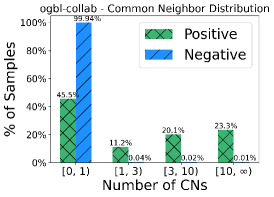
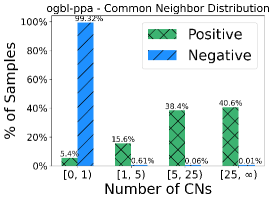
- The HeaRT evaluation substantially increases negative sample difficulty, lowers many models’ MRR/AUC, and reduces inter-model variance by up to 92% on some datasets, enabling more reliable comparisons.
- Under HeaRT, simple models frequently outperform more complex systems on ranking metrics, suggesting current advances may rely on easier negatives.
- On ogbl-collab, heuristic methods remain strong, highlighting the importance of common-neighbor information, whereas some complex models underperform under harder negatives.
- The authors provide open-source code and data at their repository for replication.
この論文を読む
Nubintのビューアで原文を開き、読みながら気になる箇所をすぐに質問できます。
Nubintでこの論文を読むこのレビューはAIが論文の原文をもとに作成しました。引用する前に原文をご確認ください。