
[論文レビュー] Experimental Study: Enhancing Voice Spoofing Detection Models with wav2vec 2.0
本稿では、事前学習済みのwav2vec 2.0モデルを微調整して特徴抽出器として用いることで、音声スプーフィング検出を向上させる手法を提案する。特に、事前学習済みモデルから特定のTransformer層を選択し、微調整する。このアプローチにより、ASVspoof 2019 LAデータセットで最先端の性能を達成し、XLS-R(1B)を用いたRawNet2で、最小t-DCFが0.0032、EERが0.12%を達成した。
Conventional spoofing detection systems have heavily relied on the use of handcrafted features derived from speech data. However, a notable shift has recently emerged towards the direct utilization of raw speech waveforms, as demonstrated by methods like SincNet filters. This shift underscores the demand for more sophisticated audio sample features. Moreover, the success of deep learning models, particularly those utilizing large pretrained wav2vec 2.0 as a featurization front-end, highlights the importance of refined feature encoders. In response, this research assessed the representational capability of wav2vec 2.0 as an audio feature extractor, modifying the size of its pretrained Transformer layers through two key adjustments: (1) selecting a subset of layers starting from the leftmost one and (2) fine-tuning a portion of the selected layers from the rightmost one. We complemented this analysis with five spoofing detection back-end models, with a primary focus on AASIST, enabling us to pinpoint the optimal configuration for the selection and fine-tuning process. In contrast to conventional handcrafted features, our investigation identified several spoofing detection systems that achieve state-of-the-art performance in the ASVspoof 2019 LA dataset. This comprehensive exploration offers valuable insights into feature selection strategies, advancing the field of spoofing detection.
研究の動機と目的
- 大規模な事前学習済みwav2vec 2.0モデルを、手作業で設計された特徴量の代わりに、深層音声特徴抽出器として活用することで、音声スプーフィング検出を向上させること。
- 一般用途の事前学習モデルとスプーフィング検出タスクとの間のドメイン不一致を、層の選択的抽出と微調整によって解消すること。
- スプーフィング対策システムに最適なwav2vec 2.0の設定を同定すること、特に選択・微調整対象となるTransformer層の数を特定すること。
- ASVspoof 2019 LAベンチマーク上で、AASISTやRawNet2を含む複数のバックエンドモデルに対して、このアプローチの有効性を評価すること。
- wav2vec 2.0を用いたトランスファー学習によって、スプーフィング検出のための新しい最先端のパフォーマンスベースラインを確立すること。
提案手法
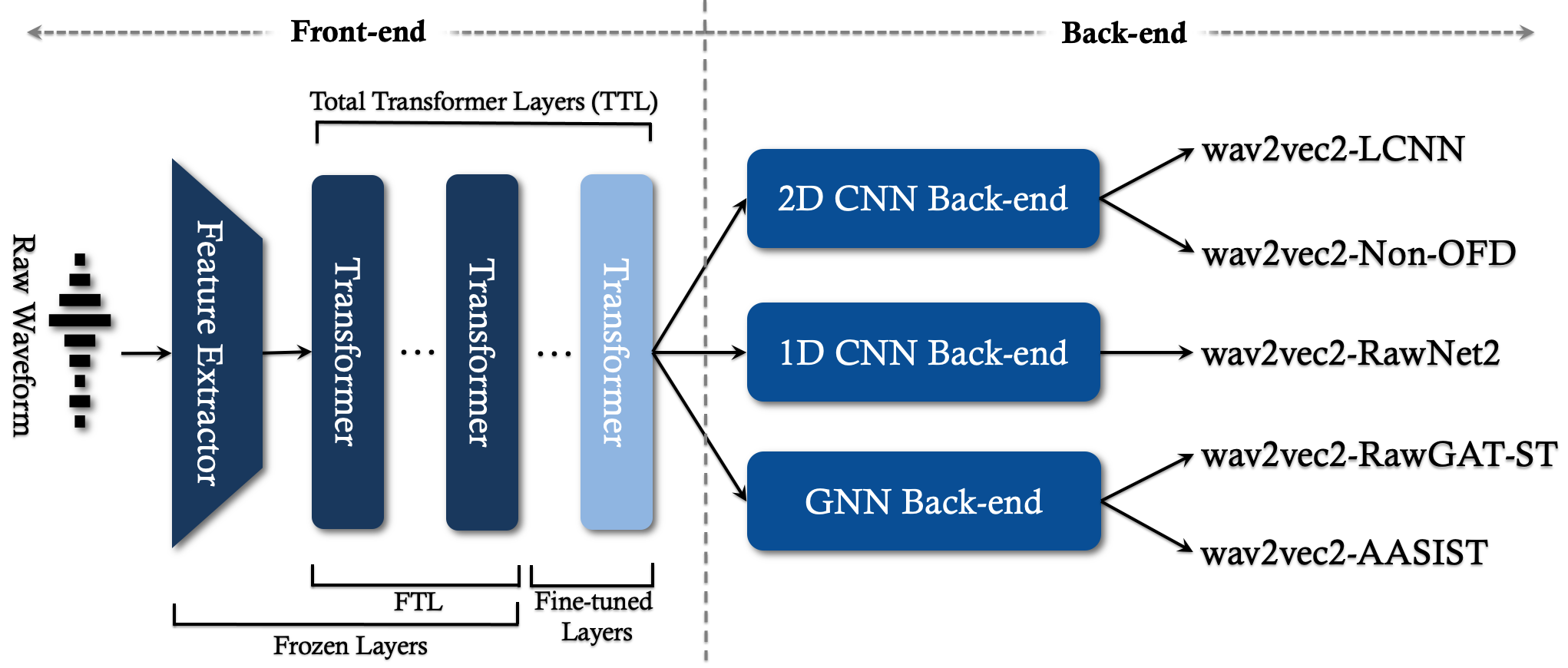
- 生の音声波形を入力として、事前学習済みのwav2vec 2.0モデル(XLS-R(1B)、XLSR-53)をフロントエンドの特徴抽出器として使用する。
- 2段階の戦略を採用する:まず、モデル全体から左端のTransformer層のサブセットを選択し、次にそのサブセット内の右端の層を微調整する。
- 2つの重要なハイパーパrameterを導入する:#TTL(選択されたTransformer層の数)と#FTL(微調整対象の層の数)、これらはグリッドサーチによって最適化される。
- 抽出された特徴量の上に、5つのスプーフィング検出バックエンド(LCNN、Non-OFD、RawNet2、RawGAT-ST、AASIST)を組み合わせ、評価を実施する。
- バックエンドモデルを抽出特徴量に対してエンドツーエンドで訓練し、特にAASISTを用いて詳細なアブレーションと設定分析を実施する。
- 一般用途のwav2vec 2.0表現を、スプーフィング検出という特定のドメインに適応させるトランスファー学習の原則を活用する。
実験結果
リサーチクエスチョン
- RQ1事前学習済みwav2vec 2.0モデルから、音声スプーフィング検出に最適なTransformer層の数は何か?
- RQ2選択した層のサブセットのうち、右端の層を微調整することで、ドメイン適合性と検出性能がどのように向上するか?
- RQ3ASVspoof 2019 LAデータセットで、最も優れたスプーフィング検出性能を達成するwav2vec 2.0バージョンとバックエンドモデルの組み合わせは何か?
- RQ4慎重に選択され、微調整されたwav2vec 2.0フロントエンドは、従来の手作業特徴量や既存の最先端システムを上回る性能を発揮できるか?
- RQ5異なるバックエンドアーキテクチャと組み合わせた場合、モデルスケール(例:XLS-R(1B) 対 XLSR-53)がスプーフィング検出性能に与える影響は何か?
主な発見
- XLS-R(1B)をバックエンドにRawNet2を用いた本手法は、ASVspoof 2019 LAデータセットで最小t-DCF 0.0032、EER 0.12%という最先端の性能を達成した。
- 選択されたwav2vec 2.0のTransformer層のうち、右端の層を微調整することで、固定モデルを使用した場合に比べて性能が顕著に向上した。
- ASVspoof 2019 LAデータセットにおけるスプーフィング検出に最適な選択層数(#TTL)は、{12, 15, 18}の範囲にあった。
- wav2vec 2.0 + AASISTシステムは、EER 0.22%、t-DCF 0.0063を達成し、複数の指標で優れた性能を示した。
- XLS-R(1B)モデルは、XLSR-53 や BASE などの小規模なバージョンを上回り、適切に微調整された大規模でパrameter数の多いモデルの利点を示した。
- 本手法は、wav2vec 2.0 + VIB や wav2vec 2.0 + ASP といった先行の最先端システムを顕著に上回り、提案された層選択と微調整戦略の有効性を確認した。
この論文を読む
Nubintのビューアで原文を開き、読みながら気になる箇所をすぐに質問できます。
Nubintでこの論文を読むこのレビューはAIが論文の原文をもとに作成しました。引用する前に原文をご確認ください。