
[論文レビュー] Explanations of Black-Box Models based on Directional Feature Interactions
本論文は一変量の除去ベースの説明を、Shapley値マップから有向の説明グラフを構築することにより二変量・非対称の相互作用へ拡張し、方向性と相互冗長性の検出を可能にし、対称的手法より多様なデータセットで優れた性能を発揮する。
As machine learning algorithms are deployed ubiquitously to a variety of domains, it is imperative to make these often black-box models transparent. Several recent works explain black-box models by capturing the most influential features for prediction per instance; such explanation methods are univariate, as they characterize importance per feature. We extend univariate explanation to a higher-order; this enhances explainability, as bivariate methods can capture feature interactions in black-box models, represented as a directed graph. Analyzing this graph enables us to discover groups of features that are equally important (i.e., interchangeable), while the notion of directionality allows us to identify the most influential features. We apply our bivariate method on Shapley value explanations, and experimentally demonstrate the ability of directional explanations to discover feature interactions. We show the superiority of our method against state-of-the-art on CIFAR10, IMDB, Census, Divorce, Drug, and gene data.
研究の動機と目的
- 特徴間相互作用を捉える説明の必要性を動機づける。
- 任意の一変量除去ベースの説明を二変量・非対称の説明マップへ一般化する方法を提案する。
- 相互作用を有向グラフとして表現し、方向性・相互冗長性・影響力特徴を特定できるようにする。
- SHAPの文脈で有向の説明グラフを分析する理論的基盤と実践的アルゴリズムを提供する。
提案手法
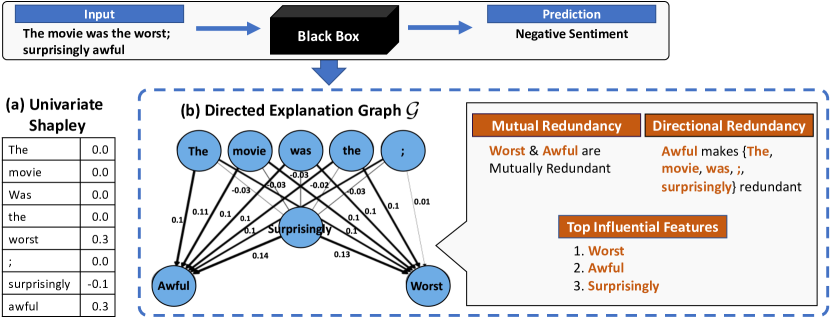
- 一変量の効用ベースの説明を、サブセット内で特徴iを固定する制限的な効用u_iに適用して二変量の説明マップE^2を定義する。
- 二変量マップをSHAPフレームワークに特化させ、非対称性を持つE^2(u)を得る(すなわちE^2(u)_{ij} ≠ E^2(u)_{ji})。
- E^2を有向グラフGとして表現し、重みW_G(i,j) = E^2(u)_{ji}とする。これを有向説明グラフと呼ぶ。
- 冗長性の概念として方向性冗長性(i -> j の重みが0)、相互冗長性(iとjが互いに影響を及ぼさない)、およびGから導かれる冗長性グラフHにおける推移性を正式化する。
- GとHを分析するアルゴリズムと定義を提供し、PageRankベースのランキングやTarjan法による冗長グループの検出を含む。
- Shapley Sampling SとKernelSHAPの2つのSHAPベース近似法を比較し、スケーラビリティと精度を評価する。
実験結果
リサーチクエスチョン
- RQ1SHAPベースの説明から抽出された方向性(非対称)特徴相互作用は、一変量の説明だけでは捉えられない情報を明らかにするか。
- RQ2インスタンスごとの説明において、方向性および相互冗長性を正式に定義・検出する方法はどうあるべきか。
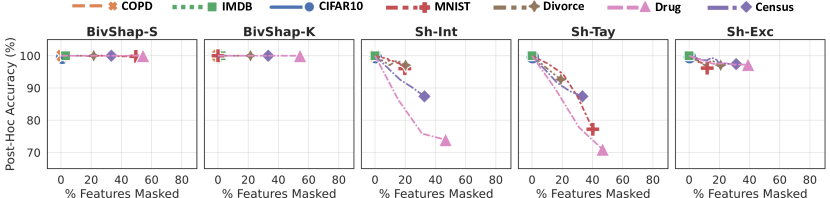
- RQ3有向説明グラフは、特徴マスキング後の後顕性精度の保持を改善し、対称的手法よりも影響力のある特徴群を明らかにするか。多様なデータモダリティで検証できるか。
主な発見
- 方向性SHAPの拡張は非対称なE^2を生み出し、有向グラフとして表現でき、対称的または一変量法では見えない相互作用構造を明らかにする。
- 有向グラフの分析により、影響力の高い特徴としてのシンクを特定でき、特徴間の方向性および相互冗長性を明らかにする。
- MNIST、CIFAR-10、IMDB、Census、Divorce、Drug、COPDGeneを対象にした実験で、KernelSHAPとShapley Samplingを用いた二変量SHAPは、対称性ベースの手法より post-hoc 精度の保持と実行時間の面で一般に改善を示す。
- 相互冗長性グループは強連結成分で検出でき、マスキング実験でその相互互換性を検証できる。GNNExplainerはこのような冗長性を明らかにしなかった。
- 理論的結果(三角形に似た境界を含む)はSHAPの下で相互冗長性の推移性を示唆し、相互に交換可能な特徴グループの堅牢なクラスタリングを可能にする。
この論文を読む
Nubintのビューアで原文を開き、読みながら気になる箇所をすぐに質問できます。
Nubintでこの論文を読むこのレビューはAIが論文の原文をもとに作成しました。引用する前に原文をご確認ください。