
[論文レビュー] Explicit Correspondence Matching for Generalizable Neural Radiance Fields
MatchNeRFはTransformer抽出特徴のグループ単位コサイン類似性によるクロ-view対応マッチングを用いて幾何学 priors を提供し、2ビューでも実現可能な一般化可能なNeRFを実現する。最少2ビューで最先端の結果を達成。
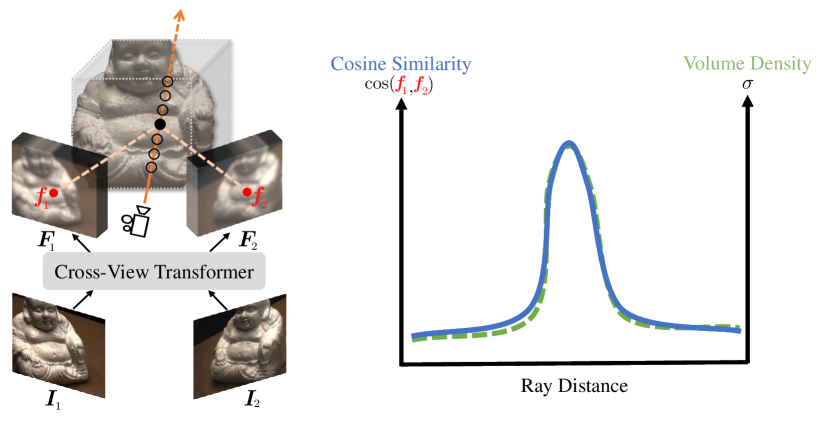
We present a new generalizable NeRF method that is able to directly generalize to new unseen scenarios and perform novel view synthesis with as few as two source views. The key to our approach lies in the explicitly modeled correspondence matching information, so as to provide the geometry prior to the prediction of NeRF color and density for volume rendering. The explicit correspondence matching is quantified with the cosine similarity between image features sampled at the 2D projections of a 3D point on different views, which is able to provide reliable cues about the surface geometry. Unlike previous methods where image features are extracted independently for each view, we consider modeling the cross-view interactions via Transformer cross-attention, which greatly improves the feature matching quality. Our method achieves state-of-the-art results on different evaluation settings, with the experiments showing a strong correlation between our learned cosine feature similarity and volume density, demonstrating the effectiveness and superiority of our proposed method. The code and model are on our project page: https://donydchen.github.io/matchnerf
研究の動機と目的
- 見たことのないシーンの novel views を少数の入力ビュー(2ビュー程度)で合成できる一般化可能なNeRFを開発する。
- クロ-view対応情報を明示的な幾何 priors としてNeRF密度予測に活用する。
- 3Dコストボリュームに依存せず、対応に基づく priors で一般化を改善する。
- DTU、Real Forward-Facing、Blender の標準ベンチマークで3ビューおよび2ビュー設定の最先端性能を示す。
提案手法
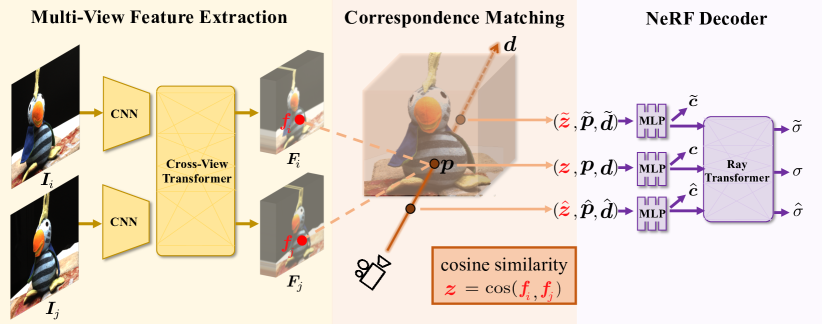
- Transformerでマルチビュー画像特徴を抽出し、ペアワイズのビュー処理を通じてクロ-view相互作用をモデリングする。
- 3D点を各ビューに射影してTransformer特徴をサンプリングし、ペアワイズのグループ単位コサイン類似度を幾何 priors z として算出する。
- 全ビュー対のコサイン類似度を集約してビュー非依存の z を得てNeRFデコーダを条件付けする。
- Ray Transformerを用いたクローポイント相互作用を含むNeRFデコーダで色と密度を予測する。
- ground-truth geometry を用いず、フォトメトリック損失でエンドツーエンド訓練する。
実験結果
リサーチクエスチョン
- RQ13Dコストボリュームなしで、Explicitなクロ-view特徴対応が一般化可能なNeRFに対して信頼できる幾何 priors を提供できるか。
- RQ2クロ-view特徴のグループ単位コサイン類似が密度予測とレンダリング品質を、単純な類似性や暗黙的類似学習より向上させるか。
- RQ3標準ベンチマークで入力ビュー数を2と3で変化させた場合の方法の性能はどうなるか。
- RQ4参照ビューの選択に対して頑健で、未知シーンへ一般化できるか。
主な発見
- MatchNeRFは3ビューおよび2ビュー設定でDTU、Real Forward-Facing、Blenderの最先端結果を達成。
- ペアワイズのTransformer特徴間の明示的なグループ単位コサイン類似が体積密度と強く相関し、幾何予測を支援。
- 1/8および1/4解像度特徴とRay Transformerの組み合わせが最良の性能を生み、エンコーダのクロスアテンションによる顕著な利得。
- 手法はビュー非依存で、コストボリュームベース手法(例: MVSNeRF)より参照ビューに対して感度が低い。
- MatchNeRFは、GPNR設定でより多くの入力ビューを使う場合(例:5–10ビュー)でもコストボリュームのベースラインを上回る。
この論文を読む
Nubintのビューアで原文を開き、読みながら気になる箇所をすぐに質問できます。
Nubintでこの論文を読むこのレビューはAIが論文の原文をもとに作成しました。引用する前に原文をご確認ください。