
[論文レビュー] Extracting Low-/High- Frequency Knowledge from Graph Neural Networks and Injecting it into MLPs: An Effective GNN-to-MLP Distillation Framework
本稿では、スペクトルドメインの因子分解を用いて事前学習済みGNNから低周波数および高周波数の知識を抽出・統合する、新しいGNNからMLPへの distillation フレームワークであるFF-G2Mを提案する。情報の飲み込み問題(高周波数知識がdistillation中に圧倒される現象)を解決することで、vanilla MLPより12.6%の性能向上を達成し、6つのデータセット平均で教師GNNを2.6%上回る。
Recent years have witnessed the great success of Graph Neural Networks (GNNs) in handling graph-related tasks. However, MLPs remain the primary workhorse for practical industrial applications due to their desirable inference efficiency and scalability. To reduce their gaps, one can directly distill knowledge from a well-designed teacher GNN to a student MLP, which is termed as GNN-to-MLP distillation. However, the process of distillation usually entails a loss of information, and ``which knowledge patterns of GNNs are more likely to be left and distilled into MLPs?" becomes an important question. In this paper, we first factorize the knowledge learned by GNNs into low- and high-frequency components in the spectral domain and then derive their correspondence in the spatial domain. Furthermore, we identified a potential information drowning problem for existing GNN-to-MLP distillation, i.e., the high-frequency knowledge of the pre-trained GNNs may be overwhelmed by the low-frequency knowledge during distillation; we have described in detail what it represents, how it arises, what impact it has, and how to deal with it. In this paper, we propose an efficient Full-Frequency GNN-to-MLP (FF-G2M) distillation framework, which extracts both low-frequency and high-frequency knowledge from GNNs and injects it into MLPs. Extensive experiments show that FF-G2M improves over the vanilla MLPs by 12.6% and outperforms its corresponding teacher GNNs by 2.6% averaged over six graph datasets and three common GNN architectures.
研究の動機と目的
- 産業応用におけるGNNの高い精度とMLPの推論効率のギャップを埋めるため。
- 既存のGNNからMLPへのdistillation手法が性能を発揮しない理由、特に高周波数知識の損失を解明するため。
- GNNから得られる低周波数および高周波数の知識パターンを保持するdistillationフレームワークを開発し、学生用MLPの性能を向上させること。
- 『情報の飲み込み』問題を形式的に特定・解決すること。この問題とは、distillation中に低周波数知識が優勢となり、高周波数知識が覆い隠される現象を指す。
提案手法
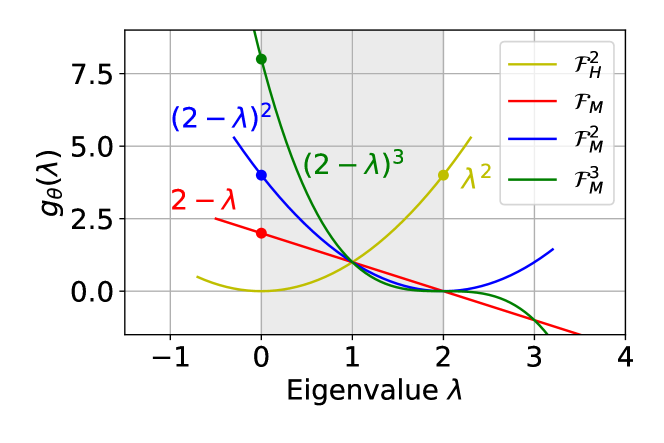
- グラフ信号処理を用いて、スペクトルドメインでGNNが学習した知識を低周波数および高周波数成分に因子分解する。
- 低周波数および高周波数成分の空間ドメインにおける対応関係を導出することで、MLPへのdistillationを可能にする。
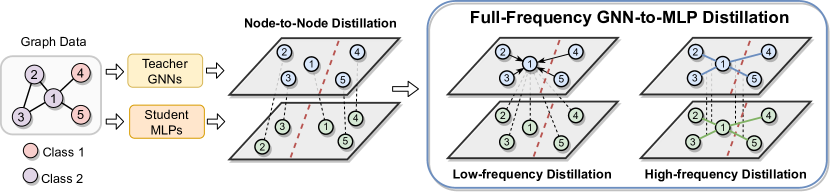
- 2種類の別々のdistillation損失を設計:低周波数distillation(LFD)は近隣ノードの滑らかさを維持し、高周波数distillation(HFD)はノード間の距離差を保持する。
- LFDとHFDを統合し、両方の知識タイプを同時に最適化する統一された全周波数GNNからMLPへの(FF-G2M)フレームワークを構築する。
- 低周波数および高周波数知識の保持度を測定するために、平均コサイン類似度とKLダイバージェンスを評価指標として用いる。
- LFDおよびHFDの両方の損失を用いて学生用MLPを訓練することで、メッセージパッシングの遅延を伴わず、全周波数の知識移行を実現する。
実験結果
リサーチクエスチョン
- RQ1GNNからMLPへのdistillation中に、どの種類の知識(低周波数対高周波数)が損失に対して最も脆弱であるか?
- RQ2『情報の飲み込み』問題とは、高周波数知識が低周波数知識に圧倒されて生じる現象であるが、その原因とdistillation性能への影響は何か?
- RQ3低周波数および高周波数の両成分を同時にdistillationすることで、従来手法よりも優れた性能を示す学生用MLPを実現できるか?
- RQ4低周波数知識と高周波数知識のどちらが、GNNからMLPへのdistillationにおける全体のモデル性能に寄与しているか?
- RQ5学生モデルに再びデータ依存性や遅延を導入せずに、両方の知識タイプを保持する方法はあるか?
主な発見
- 提案されたFF-G2Mフレームワークは、vanilla MLPより12.6%の性能向上を達成し、6つのグラフデータセット平均で対応する教師GNNを2.6%上回る。
- 標準的なdistillationでは、情報の飲み込みのため、高周波数知識が頻繁に失われる。これは、低周波数パターンがdistillationプロセスを支配するためである。
- 低周波数distillation(LFD)のみを用いても、6つのすべてのデータセットでGLNNを上回る性能を示し、グラフトポロジーに起因する滑らかさを効果的に捉えていることを示している。
- 高周波数distillation(HFD)のみを用いても、vanilla MLPを上回る性能を達成するが、LFDに比べて二次的・補助的な役割を果たす。
- LFDとHFDを併用したFF-G2Mでは、相乗効果が得られ、個々のコンponentsやベースライン手法に比べて顕著に優れた性能を発揮する。
- 可視化と指標分析により、FF-G2MはGLNNやvanilla MLPとは異なり、低周波数の近隣ノードの近接性と、高周波数の相対的なノード位置差の両方を効果的に保持していることが確認された。
この論文を読む
Nubintのビューアで原文を開き、読みながら気になる箇所をすぐに質問できます。
Nubintでこの論文を読むこのレビューはAIが論文の原文をもとに作成しました。引用する前に原文をご確認ください。