
[論文レビュー] Feature Selection using Sparse Adaptive Bottleneck Centroid-Encoder
本稿では、特徴の識別性を保ちながらクラス重心を再構築し、クラス内分散を最小化するため、ℓ₂,₁-ノルム正則化を用いたスパarsity促進層を備えた新しい深層学習ベースの特徴選択手法、Sparse Adaptive Bottleneck Centroid-Encoder (SABCE) を提案する。SABCE は 12 種類の多様なデータセットにおいて、LassoNet や Stochastic Gates、FsNet、Supervised CAE などの手法を上回る、最先端の分類精度を達成した。
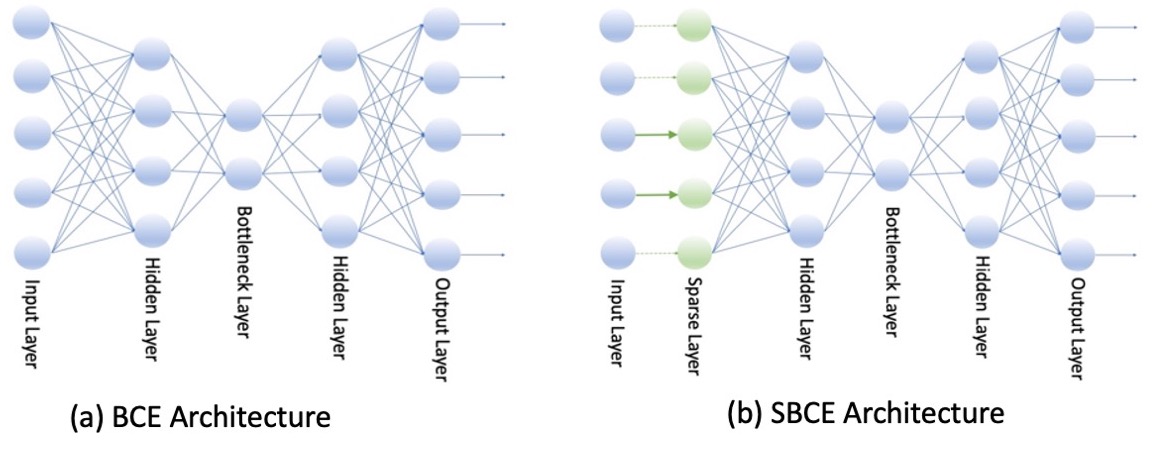
We introduce a novel nonlinear model, Sparse Adaptive Bottleneck Centroid-Encoder (SABCE), for determining the features that discriminate between two or more classes. The algorithm aims to extract discriminatory features in groups while reconstructing the class centroids in the ambient space and simultaneously use additional penalty terms in the bottleneck layer to decrease within-class scatter and increase the separation of different class centroids. The model has a sparsity-promoting layer (SPL) with a one-to-one connection to the input layer. Along with the primary objective, we minimize the $l_{2,1}$-norm of the sparse layer, which filters out unnecessary features from input data. During training, we update class centroids by taking the Hadamard product of the centroids and weights of the sparse layer, thus ignoring the irrelevant features from the target. Therefore the proposed method learns to reconstruct the critical components of class centroids rather than the whole centroids. The algorithm is applied to various real-world data sets, including high-dimensional biological, image, speech, and accelerometer sensor data. We compared our method to different state-of-the-art feature selection techniques, including supervised Concrete Autoencoders (SCAE), Feature Selection Networks (FsNet), Stochastic Gates (STG), and LassoNet. We empirically showed that SABCE features often produced better classification accuracy than other methods on the sequester test sets, setting new state-of-the-art results.
研究の動機と目的
- 高次元データにおいて、クラス重心構造を保持しつつ、識別的特徴を特定する非線形で埋め込み型の特徴選択手法を開発すること。
- LassoNet や Stochastic Gates などの L1 正則化手法の限界、特に相関のある特徴や低サンプル数・高次元の生物学的データに対する対処を改善すること。
- 適応的重心更新を通じて、クラス内分散の最小化とクラス間分散の最大化を同時に最適化することで、一般化性能を向上させること。
- 事前に特徴数や入力分布の知識がなくても、データ駆動型の特徴選択を可能にすること。
- ゲノミクス、画像、センサデータを含む多様な実世界のデータセットにおいて、最先端の手法を上回る優れた性能を示すこと。
提案手法
- SABCE は、スパarsity促進層(SPL)を入力層に直接接続した多層パーセプトロンのエンコーダ・デコーダアーキテクチャを採用し、グループスパarsityを促進するため、ℓ₂,₁-ノルム正則化を適用する。
- モデルはアンビエント空間におけるクラス重心の再構築を目的とし、再構築誤差とクラス内分散の最小化を最適化する。
- 訓練中に、元の重心とスパース層の重みのハダマード積を用いて、クラス重心を適応的に更新することで、関係のない特徴を無視する。
- 損失関数には、重心再構築損失、クラス内分散最小化、およびスパース層への ℓ₂,₁-ノルムペナルティの 3 つの成分が含まれ、特徴選択を促進する。
- バックプロパゲーションを用いて、ネットワーク重み、スパース層、適応的重心更新を同時に最適化し、識別的特徴のエンドツーエンド学習を可能にする。
- ハイパーパrameter の λ₁ と λ₂ は検証セットを用いてチューニングされ、より小さい値が分類性能を向上させることが判明した。
実験結果
リサーチクエスチョン
- RQ1スパarsity促進層と適応的重心学習を備えた深層ニューラルネットワークは、高次元データにおいて、既存の最先端の特徴選択手法を上回る性能を発揮できるか?
- RQ2スパース層における ℓ₂,₁-ノルム正則化は、特に低サンプル数・高次元の生物学的データセットにおいて、すべての特徴を過剰に縮小することなく、グループスパarsityを効果的に促進できるか?
- RQ3適応的重心更新機構は、固定重心モデルと比較して、特徴選択と分類一般化性能をどのように向上させるか?
- RQ4SABCE は、ゲノミクス、画像、センサデータを含む多様なデータタイプにおいて、安定的かつ一貫性のある特徴検出をどの程度維持できるか?
- RQ5SABCE は、LassoNet、Stochastic Gates、FsNet、Supervised CAE よりも、ベンチマークデータセットで優れた分類精度を達成できるか?
主な発見
- SABCE は、高次元の生物学的、画像、加速度センサデータを含む 12 個のベンチマークデータセットのうち 10 個で、新たな最先端の分類精度を達成した。
- ALLAML データセットでは、SABCE が優れたスパarsityと特徴の安定性を示し、Venn 図分析により、複数回の実行において一貫した特徴検出が確認された。
- SABCE は、ほとんどの場合で FsNet を上回り、特に高次元の生物学的データにおいて顕著な性能向上を示した。また、サンプル数が特徴数を上回る 6 個のデータセットでは、LassoNet をすべて上回った。
- SABCE は 12 個のデータセットのうち 3 個で Stochastic Gates よりも優れた分類結果を出した。これは、複雑な特徴空間において一般化性能が向上したことを示している。
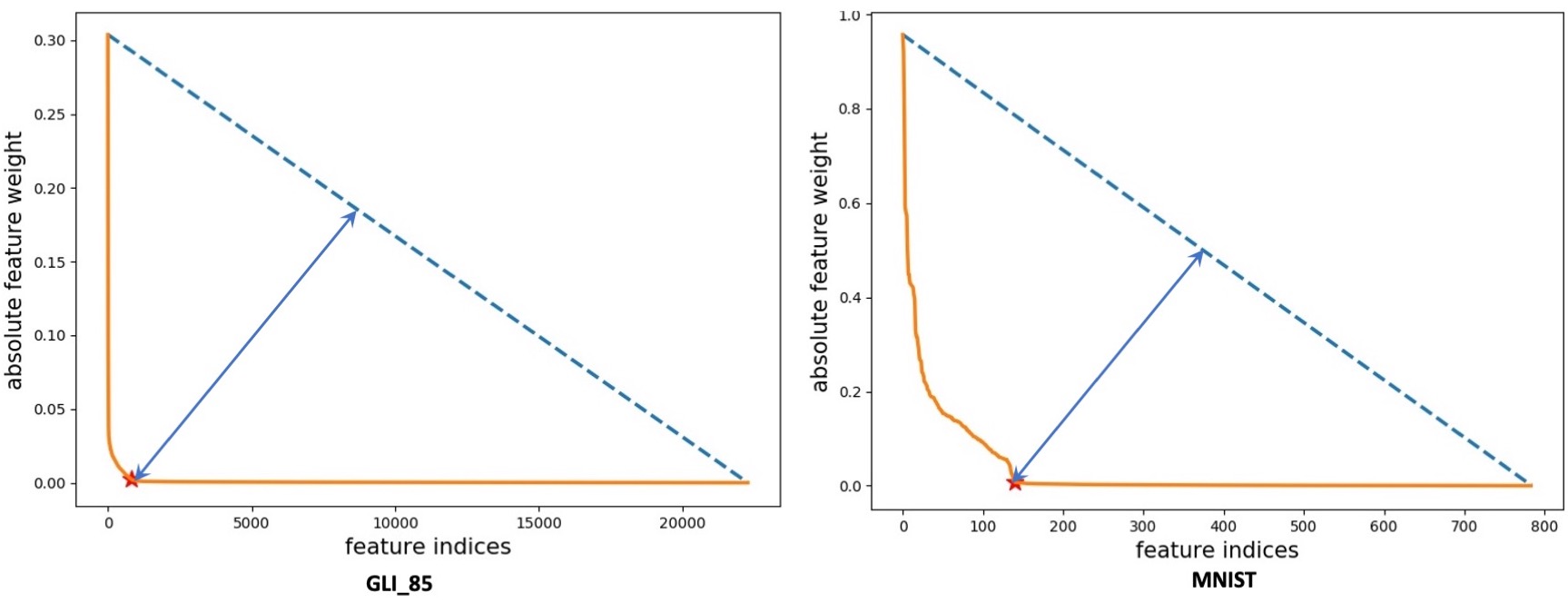
- アブレーションとスパarsity分析により、特に低サンプル数の状況下でも、ℓ₂,₁-ノルム正則化が特徴を過剰に縮小することなく、スパarsityを効果的に誘導することが確認された。
- 適応的重心更新は、元の Centroid-Encoder のような固定重心モデルとは異なり、関連する特徴に動的に焦点を当てるため、モデル性能を顕著に向上させた。
この論文を読む
Nubintのビューアで原文を開き、読みながら気になる箇所をすぐに質問できます。
Nubintでこの論文を読むこのレビューはAIが論文の原文をもとに作成しました。引用する前に原文をご確認ください。