
[論文レビュー] Federated Continual Learning via Knowledge Fusion: A Survey
本調査は、分散型でストリーミングデータ環境下における空間的・時間的災難的忘却を解決するため、知識統合を用いたフェデレーテッド継続的学習(FCL)を紹介する。2つの汎用フレームワーク(同期的および非同期的FCL)を提案し、既存の手法を知識統合メカニズムに基づいて分類することで、異種クライアント間での継続的学習を可能にしつつ、過去の知識を保持する包括的視点を提供する。
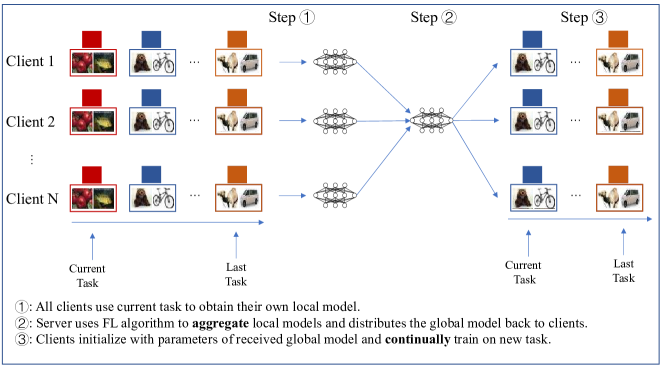
Data privacy and silos are nontrivial and greatly challenging in many real-world applications. Federated learning is a decentralized approach to training models across multiple local clients without the exchange of raw data from client devices to global servers. However, existing works focus on a static data environment and ignore continual learning from streaming data with incremental tasks. Federated Continual Learning (FCL) is an emerging paradigm to address model learning in both federated and continual learning environments. The key objective of FCL is to fuse heterogeneous knowledge from different clients and retain knowledge of previous tasks while learning on new ones. In this work, we delineate federated learning and continual learning first and then discuss their integration, i.e., FCL, and particular FCL via knowledge fusion. In summary, our motivations are four-fold: we (1) raise a fundamental problem called ''spatial-temporal catastrophic forgetting'' and evaluate its impact on the performance using a well-known method called federated averaging (FedAvg), (2) integrate most of the existing FCL methods into two generic frameworks, namely synchronous FCL and asynchronous FCL, (3) categorize a large number of methods according to the mechanism involved in knowledge fusion, and finally (4) showcase an outlook on the future work of FCL.
研究の動機と目的
- フェデレーテッド継続的学習(FCL)における空間的・時間的災難的忘却の根本的課題を特定・形式化すること。これは、クライアントでの時間的忘却と、異種クライアント間でのグローバル集約における空間的忘却を統合したものである。
- 既存のFCL手法を2つの汎用的システムフレームワーク(同期的FCLおよび非同期的FCL)に統合することで、構造的な分析と比較を可能にすること。
- パラメータ distillation、リプレイ、モデル圧縮などの知識統合メカニズムに基づいてFCLアプローチを分類し、設計原則を明確にすること。
- FCLにおける未解決の課題と今後の研究方向性について包括的な展望を提供すること。特に、合理的な協調、収束効率、および大規模モデルとの統合に関する点に焦点を当てる。
提案手法
- 二重の忘却フレームワークを提案:局所クライアントでの順次タスク学習における時間的災難的忘却と、異種クライアント間でのグローバルモデル集約における空間的災難的忘却。
- 2つの汎用的FCLシステムアーキテクチャを導入:同期的FCL(中央集権的調整)と非同期的FCL(分散型、イベント駆動型更新)を提供し、異なる通信パターンをモデル化する。
- 知識統合メカニズムに基づいてFCL手法を分類し、知識 distillation、経験リプレイ、パラメータ正則化、モデル圧縮を含む、設計の多様性を強調する。
- フェデレーテッド・アベレージ(FedAvg)をベースラインとして採用し、空間的・時間的忘却がモデル性能に与える影響を実証的に評価する。
- FCLにおけるプライバシーと効率性のトレードオフを分析し、クライアント参加における通信効率とデータ品質の重要性を強調する。
- 推薦システム、大規模言語モデル(LLMs)、ブロックチェーンベースのシステムにおけるFCLの新興応用をレビューし、実世界での実現可能性を示す。

実験結果
リサーチクエスチョン
- RQ1空間的・時間的災難的忘却はフェデレーテッド継続的学習でどのように発生し、モデル性能にどのような影響を与えるか?
- RQ2同期的FCLと非同期的FCLフレームワークの間には、どのような主なアーキテクチャ的・運用的差異があり、知識統合にどのように影響を与えるか?
- RQ3既存のFCL手法は、知識統合メカニズムを用いて時間的忘却と空間的忘却をどのように軽減しているか?
- RQ4FCLにおける合理的な協調、収束速度、データ品質の主な課題は何か。それらはモデル効率性とプライバシーにどのように影響を与えるか?
- RQ5FCLは、大規模言語モデルやその他の新興AIシステムと効果的に統合できるか。継続的かつプライバシー保護型学習を支援するにはどうすればよいか?
主な発見
- 空間的・時間的災難的忘却はFCLにおけるモデル性能を顕著に低下させる。フェデレーテッド・アベレージ(FedAvg)では、集約過程でのパラメータ上書きにより、過去のタスクに対する顕著な忘却が見られた。
- FCL手法を同期的および非同期的フレームワークに統合することで、収束速度、通信オーバーヘッド、忘却軽減効果の面で明確なトレードオフが明らかになった。
- 知識 distillation や経験リプレイなどの知識統合メカニズムは、忘却の軽減に有効であるが、非IIDデータや動的なクライアント参加下では性能にばらつきが生じる。
- データの非同一性と信頼性の低いクライアント貢献は、空間的災難的忘却を引き起こし、個々のクライアントからのタスク固有の知識がグローバルモデル集約で保持されないことがある。
- FCLにおける収束時間は依然として主要なボトルネックであり、特にリハーサルや生成的リプレイを用いる場合、複数ラウンドにわたる繰り返し通信と計算が原因で顕著に遅延する。
- LLM、推薦システム、ブロックチェーン分野における新興応用は有望であるが、大規模モデルとのFCL統合は現在の研究において未だ十分に探求されておらず、限定的である。
より良い研究を、今すぐ始めましょう
論文の読解から最終レビューまで、研究時間を劇的に削減しましょう。
クレジットカード登録不要
このレビューはAIが作成し、人間の編集者が確認しました。