
[論文レビュー] FedLoGe: Joint Local and Generic Federated Learning under Long-tailed Data
FedLoGeは、スパース等角フレーム分類器(SSE-C)を用いた表現学習と、グローバルおよびローカルの特徴の適応的再配列による、長尾データ分布下でのグローバルモデルとパーソナライズドモデルの共同最適化を実現する統合型フェデレーテッドラーニングフレームワークを提案する。神経コラプスにインspiredされた設計により、CIFAR-10/100-LT、ImageNet、iNaturalistで最先端の性能を達成し、グローバルモデルの精度とクライアント固有のパーソナライズド性能の両方を向上させる。
Federated Long-Tailed Learning (Fed-LT), a paradigm wherein data collected from decentralized local clients manifests a globally prevalent long-tailed distribution, has garnered considerable attention in recent times. In the context of Fed-LT, existing works have predominantly centered on addressing the data imbalance issue to enhance the efficacy of the generic global model while neglecting the performance at the local level. In contrast, conventional Personalized Federated Learning (pFL) techniques are primarily devised to optimize personalized local models under the presumption of a balanced global data distribution. This paper introduces an approach termed Federated Local and Generic Model Training in Fed-LT (FedLoGe), which enhances both local and generic model performance through the integration of representation learning and classifier alignment within a neural collapse framework. Our investigation reveals the feasibility of employing a shared backbone as a foundational framework for capturing overarching global trends, while concurrently employing individualized classifiers to encapsulate distinct refinements stemming from each client's local features. Building upon this discovery, we establish the Static Sparse Equiangular Tight Frame Classifier (SSE-C), inspired by neural collapse principles that naturally prune extraneous noisy features and foster the acquisition of potent data representations. Furthermore, leveraging insights from imbalance neural collapse's classifier norm patterns, we develop Global and Local Adaptive Feature Realignment (GLA-FR) via an auxiliary global classifier and personalized Euclidean norm transfer to align global features with client preferences. Extensive experimental results on CIFAR-10/100-LT, ImageNet, and iNaturalist demonstrate the advantage of our method over state-of-the-art pFL and Fed-LT approaches.
研究の動機と目的
- 既存の手法がグローバルモデルのみ最適化するか、データがバランスしていると仮定する一方で、クライアント固有のパーソナライズド性能を無視するという、長尾データ下におけるフェデレーテッドラーニングのギャップを解消すること。
- 長尾かつ異種のクライアントデータを伴うフェデレーテッドラーニングにおいて、グローバルモデルとパーソナライズドモデルの両方の性能を共同で向上させること。
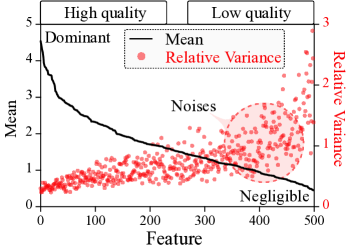
- スパースで等角フレームである分類器を用いて、ノイズの多い特徴を削除し、支配的特徴を強化することで、表現学習のメカニズムを設計すること。
- ノルムに基づく再配列を用いて、グローバルおよびローカルの特徴を素早く適応的に整列させ、クライアント固有の好みを保持すること。
- CIFAR-100-LT、ImageNet、iNaturalistを含む多様なベンチマークで、現実的な長尾設定下でのフレームワークの妥当性を検証すること。
提案手法
- スパースで構造化された分類器である静的スパース等角フレーム分類器(SSE-C)を導入し、等角性とスパarsityを強制することで、ノイズの多い特徴を抑制し、表現学習を強化する。
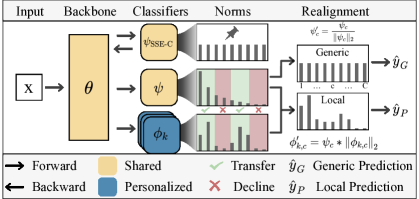
- グローバル表現学習に共通のバックボーンを採用すると同時に、クライアント固有の分類器を導入し、ローカルデータ分布に適応可能にする。
- ニューロンコラプスの原則を適用し、クラス平均と特徴プロトタイプの収束を促進することで、一般化性能と安定性を向上させる。
- 補助的なグローバル分類器とパーソナライズドユークリッドノルム伝達を用いて、グローバルおよびローカルの特徴をクライアントの好みに適応的に整列させる、グローバルおよびローカルの適応的特徴再配列(GLA-FR)を設計する。
- 分類器ベクトルのノルムを制御するための学習可能なスケーリング係数γを用いたノルム等しい損失を導入し、訓練の安定化と収束の改善を図る。
- 特徴の大きさに基づいて分類器重みのスパースプルーニングを適用し、低影響で高分散の特徴を効果的に削除することで、ロバストネスを向上させる。
実験結果
リサーチクエスチョン
- RQ1共通のバックボーンにスパースで構造化された分類器を組み合わせることで、長尾データ下におけるフェデレーテッドラーニングにおける表現学習が向上するか?
- RQ2データが長尾かつ異種である状況下で、グローバルモデルとパーソナライズドモデルの両方の性能をどのように共同で最適化できるか?
- RQ3分類器のスパarsityと等角性が、不均衡なフェデレーテッド環境下でノイズを低減し、特徴の質を向上させる程度はどの程度か?
- RQ4ノルム伝達による適応的特徴再配列は、グローバル性能を損なうことなく、グローバル特徴をクライアント固有の好みに効果的に整列させることができるか?
- RQ5SSE-CとGLA-FRの統合により、多様な長尾ベンチマークで一貫した性能向上が達成されるか?
主な発見
- FedLoGeはCIFAR-100-LTで最先端の性能を達成し、すべてのクラスグループにおいて、グローバルモデルとパーソナライズドモデルの両方の精度ですべてのベースラインを上回る。
- ImageNet-LTおよびiNaturalist-160kでは、特にミドルクラスおよびテイルクラスで顕著な精度向上を示し、長尾分布に対して高いロバストネスを示している。
- アブレーションスタディにより、SSE-Cは密度型ETFに比べ、グローバルおよびパーソナライズドモデル性能の両方を向上させ、GLA-FRと組み合わせた際に最適な性能を発揮することが確認された。
- SSE-Cにおける無視できる特徴(平均大きさが小さい特徴)のプルーニングは性能にほとんど影響を与えないが、支配的特徴のプルーニングは急激な性能低下を引き起こし、効果的な特徴優先順位付けが実現されていることが裏付けられた。
- 感度分析の結果、CIFAR-10/100-LTではγの値が1.0が最適であり、ImageNetおよびiNaturalistでは1.6が最適であることが判明。SSE-Cのスパarsityが約60%程度のときに性能がピークに達した。
- 90%までの高いスパarsityでもモデルは強力な性能を維持しており、スパarsityがロバストネスを低下させるのではなく、むしろ向上させることを示している。
この論文を読む
Nubintのビューアで原文を開き、読みながら気になる箇所をすぐに質問できます。
Nubintでこの論文を読むこのレビューはAIが論文の原文をもとに作成しました。引用する前に原文をご確認ください。