
[論文レビュー] Feedback-Free Starbursts at Cosmic Dawn: Observable Predictions for JWST
論文は標準宇宙論の分析的フィードバックなしスターバース(FFB)モデルを拡張し、JWST向けの高赤方偏移銀河特性を予測する。星形成効率の上昇、恒星質量・UV光度関数、 burstsyr SFHを含む。
We extend the analysis of a physical model within the standard cosmology that robustly predicts a high star-formation efficiency (SFE) in massive galaxies at cosmic dawn due to feedback-free starbursts (FFBs). It implies an excess of bright galaxies at z>~10 compared to the standard models based on the low SFE at later epochs, an excess indicated by JWST observations. Here we provide observable predictions based on the analytic FFB scenario. These can be compared with simulations and JWST observations. We approximate the SFE as a function of redshift and mass, assuming a maximum SFE of 0.2~1 in the FFB regime. From this, we derive the evolution of the galaxy mass and luminosity functions as well as the evolution of stellar and star-formation densities. We then predict the star-formation history (SFH), galaxy sizes, outflows, gas fractions, metallicities, and dust attenuation, all as functions of mass and redshift in the FFB regime. The major distinguishing feature is the occurrence of FFBs above a mass threshold that declines with redshift. The luminosities and star formation rates in bright galaxies are predicted to be in excess of extrapolations of standard empirical models and cosmological simulations, an excess that grows from z~9 to higher redshifts. The FFB phase of ~100 Myr is predicted to show a characteristic SFH that fluctuates on a timescale of ~10 Myr. The stellar systems are compact (Re~0.3 kpc at z~10 and declining with z). The galactic gas consists of a steady wind driven by supernovae from earlier generations, with high outflow velocities (FWHM~1400-6700km/s), low gas fractions (<0.1), low metallicities (<~0.1 solar), and low dust attenuation ($A_{UV}$~0.5 at z~10 and declining with z). We make tentative comparisons with current JWST observations for initial insights, anticipating more complete and reliable datasets for detailed quantitative comparisons in the future.
研究の動機と目的
- 宇宙黎明期の massive galaxy でフィードバックなしスター bursts(FFB)により高い星形成効率が期待されることを動機づける。
- FFBフレームワーク内で赤移相(z)とハロー質量(M_h)の関数として解析的SFEを導出する。
- FFB領域下で観測可能な銀河特性(質量・光度関数、密度、サイズ、ガス分率、金属量、塵)を予測する。
- FFB予測を外挿された高赤方偏移UMモデルおよび標準SAMと比較し、初期JWSTの所見を議論する。
- コミュニティ利用のためにFFB予測を再現するデジタル表とコードを提供する。
提案手法
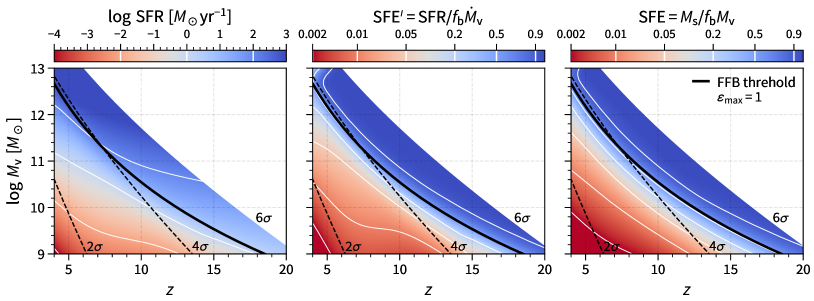
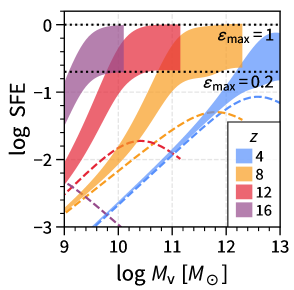
- FFBシナリオを、UM様式の低い値からFFB領域の最大SFE ε_maxへ遷移するSFEとして表現する(ε_maxは0.2–1の範囲)。
- SFRを< SFR_ffb > = ε_max f_b \, dot{M}_v の形で、FFB閾値 M_v,ffb(z)を超える領域での滑らかな遷移(シグモイド関数)としてモデル化する。
- UMベースラインに対するSFR_um+ffb と SFR_um の時間積分差を加えることで median stellar mass M_s(M_v,z) を求める(式7)。
- 質量関数 Φ(log M_s) は条件付き M_s|M_v をハロー質量関数 n(M_v)と畳み込んで導出する(式10)。
- M_v から M_UV のガウス分布と中央値の M_s への関係を用いて UV光度関数 Φ(M_UV) を導出する(式11、式12)。
- 予測された質量関数と光度関数から宇宙密度 ρ_s(z)、ρ_UV(z)、ρ_SFR(z) を推定する(式13–15)。
実験結果
リサーチクエスチョン
- RQ1フィードバックなしスター bursts (FFB) が星形成を支配する redshift とハロー質量の領域はどこか?
- RQ2FFBは標準モデルと比較して z ≳ 6–15 で恒星質量関数とUV光度関数をどのように修正するか?
- RQ3FFB領域における宇宙規模の密度(恒星、UV、SFR)はどうなるか、どのように進化するか?
- RQ4FFB銀河の特徴的な星形成歴と観測可能なburstの署名は何か?
- RQ5FFB予測は UniverseMachine/UM系の外挿やJWSTデータとどう比較されるか?
主な発見
- FFBは赤方偏移(z)と質量の閾値ライン M_v,ffb(z) を確立する; この閾値を超えると銀河は ε_max までのFFB領域に入り、範囲は 0.2–1。
- FFBは z ≥ 6 で標準UM/SAMモデルよりも明るいUV光度関数と大きな恒星質量を予測し、高 z で過剰が拡大する。
- ε_max = 0.2–1 の場合、質量関数は z ∼ 10 以降に M_s ≳ 10^9–10^10 M_sun の massive 銀河がより豊富になることを示す。
- FFBシナリオのUVLFは UM/SAM に対して著しく高く、特に z ∼ 9–12 で顕著。塵補正後でも顕著で、ε_max ∼ 0.2–0.5 の z ∼ 12 で初期JWSTデータと整合する可能性。
- FFBフェーズは約100 Myr 続き、約10 Myr の変動を伴う bursty SFH を特徴とする。銀河サイズはコンパクト(z ∼ 10 で R_e ≈ 0.3 kpc)、風: FWHM ≈ 1400–6700 km/s、ガス分率は < 0.1、金属量は ≲ 0.1 Z_sun、UV減衰 A_UV ≈ 0.5(z ∼ 10、zが上昇で減少)。
- JWSTデータとの比較には留保があるが、ε_max ∼ 0.2–0.5 で大まかに整合と見られる兆候あり。ただし結果は暫定的で、データの完全性に依存。
- 著者は予測を再現するデジタル表とコードを提供している。
この論文を読む
Nubintのビューアで原文を開き、読みながら気になる箇所をすぐに質問できます。
Nubintでこの論文を読むこのレビューはAIが論文の原文をもとに作成しました。引用する前に原文をご確認ください。