
[論文レビュー] Finding the right XAI method -- A Guide for the Evaluation and Ranking of Explainable AI Methods in Climate Science
この論文は気候に焦点を当てた XAI 評価フレームワークを紹介し、頑健性、忠実性、ランダム化、ローカライゼーション、複雑さの観点で複数の局所 XAI 手法を比較し、気候タスクに適した XAI 手法のランク付けと選択のガイドラインを提供します。
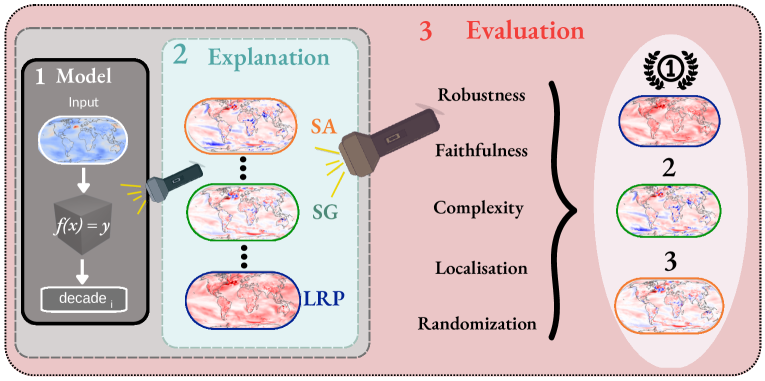
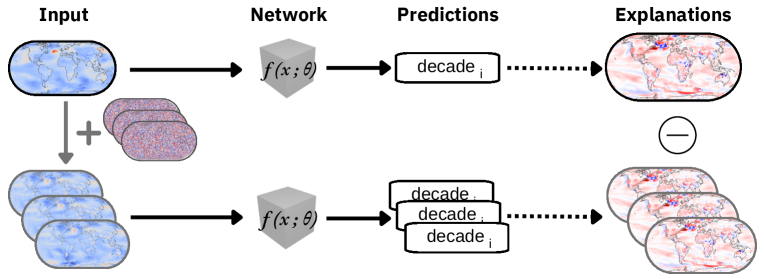
Explainable artificial intelligence (XAI) methods shed light on the predictions of machine learning algorithms. Several different approaches exist and have already been applied in climate science. However, usually missing ground truth explanations complicate their evaluation and comparison, subsequently impeding the choice of the XAI method. Therefore, in this work, we introduce XAI evaluation in the climate context and discuss different desired explanation properties, namely robustness, faithfulness, randomization, complexity, and localization. To this end, we chose previous work as a case study where the decade of annual-mean temperature maps is predicted. After training both a multi-layer perceptron (MLP) and a convolutional neural network (CNN), multiple XAI methods are applied and their skill scores in reference to a random uniform explanation are calculated for each property. Independent of the network, we find that XAI methods Integrated Gradients, layer-wise relevance propagation, and input times gradients exhibit considerable robustness, faithfulness, and complexity while sacrificing randomization performance. Sensitivity methods -- gradient, SmoothGrad, NoiseGrad, and FusionGrad, match the robustness skill but sacrifice faithfulness and complexity for randomization skill. We find architecture-dependent performance differences regarding robustness, complexity and localization skills of different XAI methods, highlighting the necessity for research task-specific evaluation. Overall, our work offers an overview of different evaluation properties in the climate science context and shows how to compare and benchmark different explanation methods, assessing their suitability based on strengths and weaknesses, for the specific research problem at hand. By that, we aim to support climate researchers in the selection of a suitable XAI method.
研究の動機と目的
- 信頼できる XAI を気候科学に動機づけるため、地上真実の説明の不足に対処する。
- 説明を定量化する5つの特性を備えた正式な評価フレームワークを提案する。
- 気候データを用いた CNN および MLP アーキテクチャ上で、局所的でモデル認識型の複数の XAI 手法を比較する。
- 気候タスクに適した XAI 手法を選択するためのランキングガイドラインを提供する。
提案手法
- CESM1 2m 温度マップ(1920–2080)で decade を予測するために MLP と CNN を訓練し、評価のために 20 クラス分類と年次回帰を使用する。
- 予測の説明に対して、局所的でモデル認識型の一連の XAI 手法(Gradient、InputGradients、Integrated Gradients、Layerwise Relevance Propagation、SmoothGrad、NoiseGrad、FusionGrad)を適用する。
- 5つの XAI 評価特性(頑健性、忠実性、ランダム化、ローカライゼーション、複雑さ)を定義・計算し、それに対応する指標(Local Lipschitz Estimate、Avg-sensitivity、ROAD、Faithfulness Correlation、TopK、RRA、entropy、Gini-based sparseness など)を用いる。
- 気候データでの指標の妥当性を評価するために、乱択ベースのテストを用いてメトリックスコアを正規化・比較する。
- 各特性ごとに XAI 手法をランク付けし、特定の気候タスクに適した手法の選択に関するガイダンスを提供する。
実験結果
リサーチクエスチョン
- RQ1気候モデルの予測に対して頑健で忠実かつ局所的な説明を提供する XAI 手法はどれか。
- RQ2気候データに対する CNN および MLP アーキテクチャで、頑健性、忠実性、ローカライゼーション、ランダム化、複雑さの観点からモデル認識型の局所 XAI 手法はどの程度比較可能か。
- RQ3評価に基づくランク付けスキームは、気候科学アプリケーションに適した適切な XAI 手法の選択を支援できるか。
主な発見
- Integrated Gradients、Layer-wise Relevance Propagation (LRP) および InputGradients は、頑健性、忠実性が強く、複雑さが中程度である一方、ランダム化は低めである。
- Gradient ベースの手法(Gradient、SmoothGrad、NoiseGrad、FusionGrad)は、頑健性と忠実性が弱い傾向だが、ランダム化の特性を改善する。
- 入力摂動を用いた説明(SmoothGrad、FusionGrad)は、気候データにおいて頑健性/忠実性を一様に改善しない。
- 同じ予測に対して XAI 手法間で説明に大幅なばらつきがあり、手法選択が科学的結論に影響を与えるリスクを強く示している(例:北大西洋域の重要性は手法によって異なる)。
- 本研究は、気候タスクの要件に適合した XAI 手法を選択するための指標ベースのガイドラインとランキングフレームワークを提供する。
この論文を読む
Nubintのビューアで原文を開き、読みながら気になる箇所をすぐに質問できます。
Nubintでこの論文を読むこのレビューはAIが論文の原文をもとに作成しました。引用する前に原文をご確認ください。