
[論文レビュー] Flares from stars crossing active galactic nuclei disks on low-inclination orbits
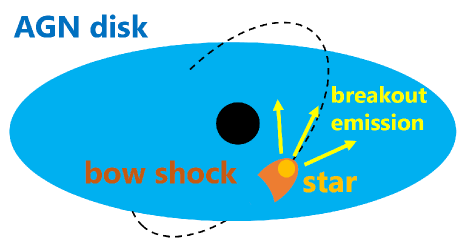
本稿では、X線準周期的噴出(QPEs)が、活動銀河核(AGN)ディスクを横切る後退運動・低傾斜角軌道をとる質量の大きな星によって引き起こされ、ブレークアウトを伴う明るいバッシュショック放射が生成されることを提案している。このモデルは、QPEの持続時間(約1時間)、光度(約10⁴² erg s⁻¹)、複雑な光曲線、および低質量SMBHの特徴を、特定の軌道的・星間条件のもとで形成される高密度で拡張したバッシュショックからの衝撃波ブレークアウトによって説明する。
The origin of the recently discovered new class of transients, X-ray quasi-periodic eruptions (QPEs), remains a puzzle. Due to their periodicity and association with active galactic nuclei (AGN), it is natural to relate these eruptions to stars or compact objects in tight orbits around supermassive black holes (SMBHs). In this paper, we predict the properties of emission from bow shocks produced by stars crossing AGN disks, and compare them to the observed properties of QPEs. We find that when a star's orbit is retrograde and has a low inclination ($\lesssim 40^\circ$) with respect to the AGN disk and the star is massive ($\gtrsim 10$ $M_{\odot}$), the breakout emission from the bow shock can explain the observed duration ($\sim$ hours) and X-ray luminosity ($\sim$few$ imes10^{42}~{ m erg~s^{-1}}$) of QPEs. This model can further explain various observed features of QPEs, such as their complex luminosity evolution, the gradual decline of luminosity of the flares over several years, the evolution of the hardness ratio, the modulation of the luminosity during quiescent phases, and the preference of the central SMBHs to have low masses.
研究の動機と目的
- X線準周期的噴出(QPEs)の起源を解明すること。QPEsは、周期的で明るいフレアを示す新しく発見された瞬間的天体の一種である。
- QPEsが低質量超大質量ブラックホール(SMBH)と強く関連している理由、および複雑な光曲線を示す理由を説明すること。
- AGNディスクとの星の接近時に形成されるバッシュショックからの放射が、観測されたQPE特性を再現できるかどうかを調査すること。
- 観測されたX線光度および時間スケールを再現するための、軌道的・星間パラメータ(質量、傾斜角、運動の向き)を同定すること。
- ディスク不安定性や冷却エンVELOPEを含む代替モデルと、ブレークアウト放射モデルを比較すること。
提案手法
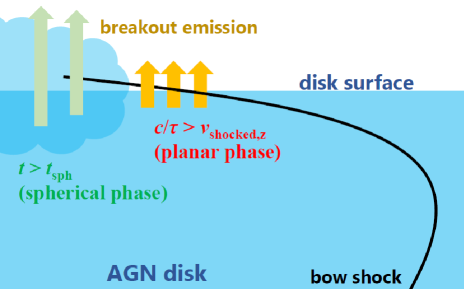
- 星がAGNディスクを横切る際のバッシュショックの形成と進化をモデル化し、衝撃波がディスク表面から脱出するブレークアウト段階に注目する。
- 流体力学的シミュレーションを用いて、衝撃波の構造、密度、温度、および衝撃ガスの放射特性を計算する。
- 放射輸送と冷却則を用いてX線光度を算出し、光学的厚さと薄さの両極限を含む。
- 星の質量、軌道の傾斜角、後退運動の効果を組み込み、高光度で短時間持続の条件を同定する。
- 合成された光曲線とスペクトル進化を、観測されたQPE(eRO-QPE1の複数のピークと徐々に減少する傾向)と比較する。
- 光子拡散時間スケールと熱化効率(η)が観測可能な光度に与える影響を評価する。
実験結果
リサーチクエスチョン
- RQ1AGNディスクを横切る星からのバッシュショック放射が、観測されたX線光度と持続時間のQPEを再現できるか?
- RQ2衝撃波放射がQPE特性を再現するための、軌道的・星間パラメータ(質量、傾斜角、運動の向き)は何か?
- RQ3このモデルでは、X線の硬さ比の進化と、静止状態におけるモodulationはどのように生じるか?
- RQ4なぜQPEsは低質量SMBH系に特に観測されるのか?
- RQ5eRO-QPE1の複雑な複数ピーク光曲線は、衝撃波ブレークアウトとその後の冷却放射の組み合わせで説明可能か?
主な発見
- バッシュショックからのブレークアウト放射は、光度が約10⁴² erg s⁻¹、持続時間が約1時間のX線フレアを生成でき、観測されたQPE特性と一致する。
- AGNディスクに対して後退運動・低傾斜角(40°未満)の軌道をとる質量の大きな星(10 M☉以上)は、最も長く明るい衝撃波を生成し、高い放射を可能にする。
- モデルは、衝撃波表面積の減少と冷却による、数年間にわたるフレア光度の徐々な低下を自然に説明する。
- X線の硬さ比の進化と静止状態におけるモodulationは、ブレークアウトおよび拡張過程における衝撃波幾何学的形状と光学的厚さの変化に起因する。
- 低質量SMBH(10⁵–10⁶ M☉)におけるQPEsの優位性は、必要なディスクスケールヘイトと衝撃波ダイナミクスに起因し、モデルで説明可能である。
- 衝撃波ブレークアウト放射が初期のフレアピークを支配するが、拡張するエンVELOPEからの冷却放射が、後の広がった特徴を形成し、eRO-QPE1のような複数ピーク光曲線を説明する。
この論文を読む
Nubintのビューアで原文を開き、読みながら気になる箇所をすぐに質問できます。
Nubintでこの論文を読むこのレビューはAIが論文の原文をもとに作成しました。引用する前に原文をご確認ください。