
[論文レビュー] Flatten: Video Action Recognition is an Image Classification task
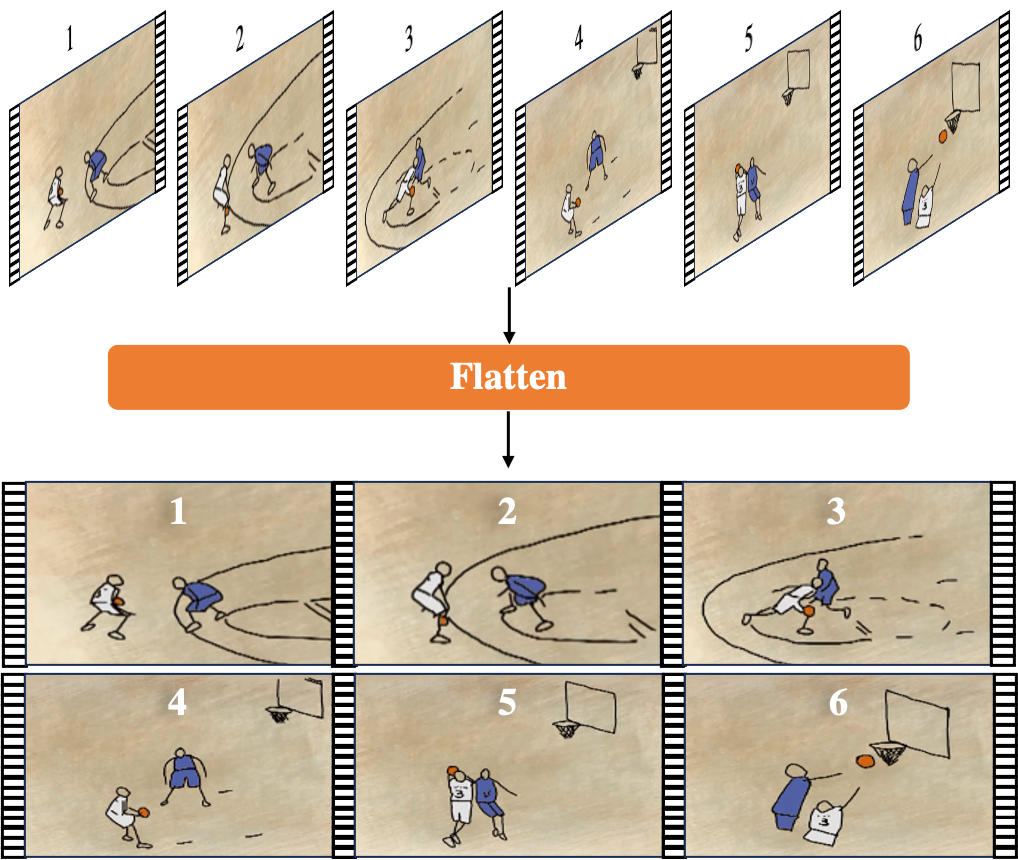
本稿では、3次元動画クリップを行優先フラットネーションによって2次元空間的表現に変換する、プラグアンドプレイ型モジュール「Flatten」を提案する。これにより、標準的な画像分類モデルが動画行動を効果的に認識できるようになる。時間的系列を空間的レイアウトに変換することで、ResNet、SwinV2、Uniformerバックボーンを用いたKinetics-400、Something-Want-2、HMDB-51で最先端の性能を達成し、元の3次元モデルを著しく上回る。
In recent years, video action recognition, as a fundamental task in the field of video understanding, has been deeply explored by numerous researchers.Most traditional video action recognition methods typically involve converting videos into three-dimensional data that encapsulates both spatial and temporal information, subsequently leveraging prevalent image understanding models to model and analyze these data. However,these methods have significant drawbacks. Firstly, when delving into video action recognition tasks, image understanding models often need to be adapted accordingly in terms of model architecture and preprocessing for these spatiotemporal tasks; Secondly, dealing with high-dimensional data often poses greater challenges and incurs higher time costs compared to its lower-dimensional counterparts.To bridge the gap between image-understanding and video-understanding tasks while simplifying the complexity of video comprehension, we introduce a novel video representation architecture, Flatten, which serves as a plug-and-play module that can be seamlessly integrated into any image-understanding network for efficient and effective 3D temporal data modeling.Specifically, by applying specific flattening operations (e.g., row-major transform), 3D spatiotemporal data is transformed into 2D spatial information, and then ordinary image understanding models are used to capture temporal dynamic and spatial semantic information, which in turn accomplishes effective and efficient video action recognition. Extensive experiments on commonly used datasets (Kinetics-400, Something-Something v2, and HMDB-51) and three classical image classification models (Uniformer, SwinV2, and ResNet), have demonstrated that embedding Flatten provides a significant performance improvements over original model.
研究の動機と目的
- 専用の3次元アーキテクチャを必要としないように、動画行動認識を簡素化すること。
- 2次元画像モデルが時間的ダイナミクスをモデル化できるように、画像理解と動画理解のギャップを埋めること。
- 3次元空間時間的モデリングに伴う計算複雑性とトレーニングのオーバーヘッドを軽減すること。
- 最小限の変更で、標準的な画像分類フレームワークを用いて動画行動認識を効果的に解決できることを示すこと。
- 3次元動画データを2次元形式にフラットネーションすることで、時間的関係を保持・活用できることを検証すること。
提案手法
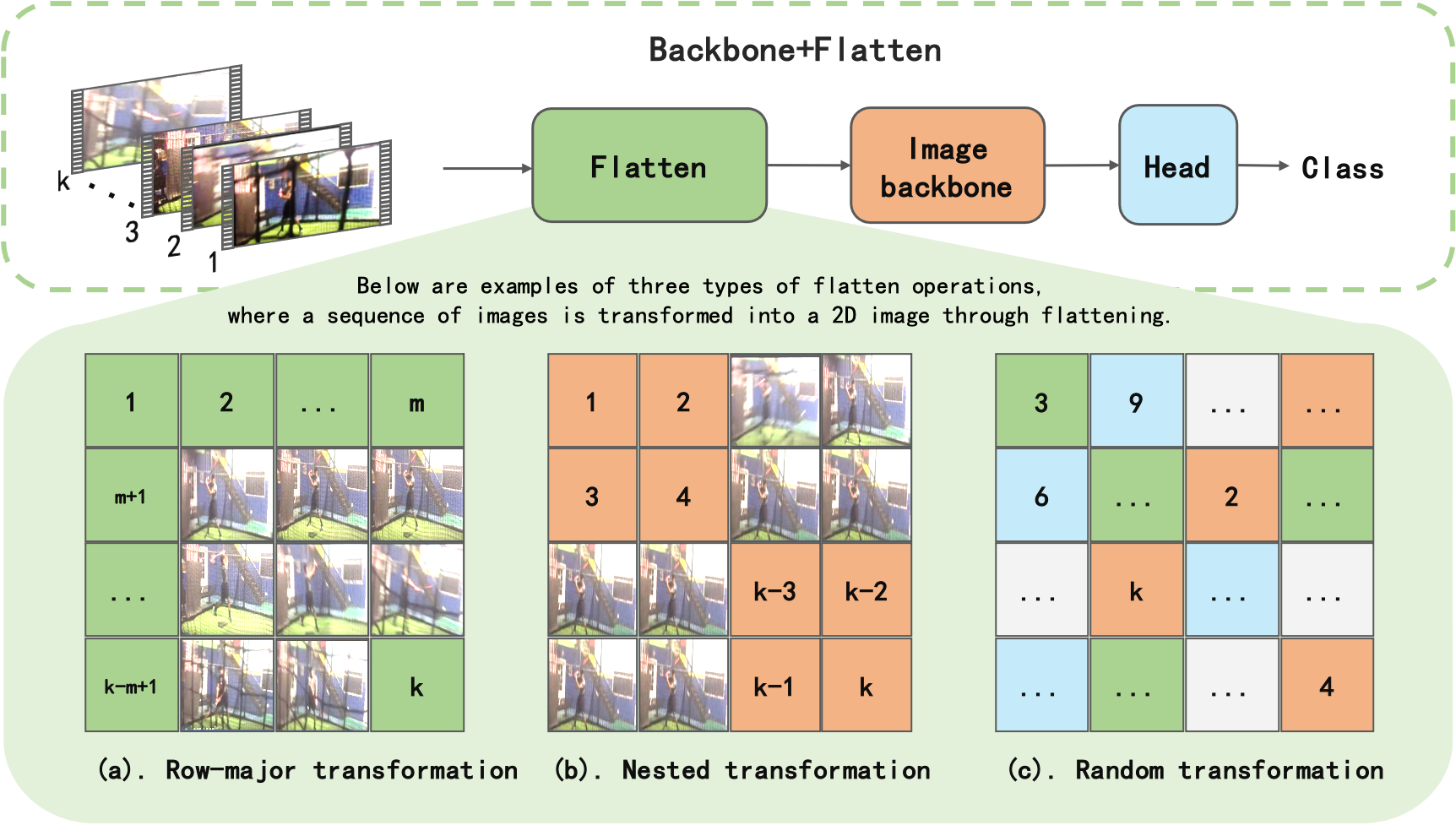
- Flattenモジュールは、動画フレームの系列を1つの2次元画像テンソルに変換する行優先フラットネーション操作を適用する。
- 形状 (T, C, H, W) の入力動画クリップが、T = n×m であるとき、(C, H×n, W×m) に再形状され、空間的および時間的構造が保持される。
- アーキテクチャの変更なしに、標準的な画像分類モデル(例:ResNet、SwinV2、Uniformer)を用いる。
- フラットネーション操作により、2次元レイアウト内の空間的位置エンコーディングを通じて、時間的依存関係をモデルが学習可能になる。
- 本アプローチはプラグアンドプレイである:バックボーンの再トレーニングは不要で、推論前に単一の変換ステップのみが必要。
- 複数のフラットネーションタイプ(例:行優先、列優先)をサポートし、シーケンス長に応じて最適な n と m を動的に選択する。
実験結果
リサーチクエスチョン
- RQ13次元動画データを2次元空間的形状に変換した後、標準的な2次元画像分類モデルを用いて動画行動認識を効果的に行えるか?
- RQ2時間的系列を空間的レイアウトにフラットネーションすることで、正確な行動認識に十分な時間的ダイナミクスが保持されるか?
- RQ3フラットネーションされた動画表現の性能は、従来の3次元畳み込みまたはトランスフォーマー基盤の動画モデルと比べてどうか?
- RQ4ResNet101+Flatten は Kinetics-400 で 83.7% のトップ-1精度を達成し、深層アーキテクチャにおいても一貫した向上を示す。
- RQ5Flattenを用いたモデルの特徴マップ解析により、より深い層が段階的にグローバルな時間的表現を捉えていることが確認され、長距離モデリングが効果的に行われていることが示された。
主な発見
- Flattenは、評価された全データセット(Kinetics-400、Something-Something v2、HMDB-51)において、行動認識の正確性を顕著に向上させる。
- Kinetics-400 において、Uniformer-S+Flatten はトップ-1精度85.1%を達成し、元の3次元 Uniformer-S モデルを上回る。
- SwinV2-T+Flatten は Kinetics-400 でトップ-1精度84.3%を達成し、元の SwinV2-T モデルを上回る。
- ResNet101+Flatten は Kinetics-400 でトップ-1精度83.7%を達成し、深層アーキテクチャにおいても一貫した向上を示す。
- 可視化により、Uniformer-S+Flatten は3次元バージョンと比較して、動きのパターンにより集中した注目を学習していることが示された。
- 特徴マップ解析により、Flattenを強化したモデルのより深い層が、段階的にグローバルな時間的表現を捉えていることが確認され、効果的な長距離モデリングが行われていることが示された。
この論文を読む
Nubintのビューアで原文を開き、読みながら気になる箇所をすぐに質問できます。
Nubintでこの論文を読むこのレビューはAIが論文の原文をもとに作成しました。引用する前に原文をご確認ください。