
[論文レビュー] Forecasting Workload in Cloud Computing: Towards Uncertainty-Aware Predictions and Transfer Learning
本稿では、クラウドコンピューティングにおける不確実性を考慮したワークロード予測のための単変量および二変量ベイジアンディープラーニングモデル—HBNNおよびLSTMDを提案する。アンビエントな不確実性とエピステム的不確実性の両方をモデル化することで、信頼度に基づくリソース割り当てによりサービスレベルの指標が向上する。トランスファーラーニングは、ソースドメインが大きく、ターゲットと類似している場合にのみ成功する。
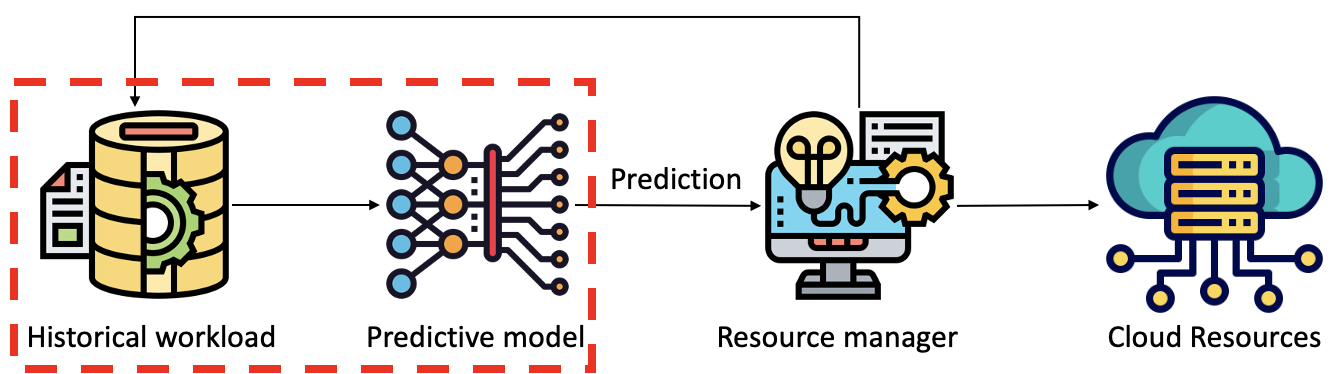
Predicting future resource demand in Cloud Computing is essential for optimizing the trade-off between serving customers' requests efficiently and minimizing the provisioning cost. Modelling prediction uncertainty is also desirable to better inform the resource decision-making process, but research in this field is under-investigated. In this paper, we propose univariate and bivariate Bayesian deep learning models that provide predictions of future workload demand and its uncertainty. We run extensive experiments on Google and Alibaba clusters, where we first train our models with datasets from different cloud providers and compare them with LSTM-based baselines. Results show that modelling the uncertainty of predictions has a positive impact on performance, especially on service level metrics, because uncertainty quantification can be tailored to desired target service levels that are critical in cloud applications. Moreover, we investigate whether our models benefit transfer learning capabilities across different domains, i.e. dataset distributions. Experiments on the same workload datasets reveal that acceptable transfer learning performance can be achieved within the same provider (because distributions are more similar). Also, domain knowledge does not transfer when the source and target domains are very different (e.g. from different providers), but this performance degradation can be mitigated by increasing the training set size of the source domain.
研究の動機と目的
- クラウドリソース需要予測におけるアンビエントな不確実性とエピステム的不確実性の両方を捉える不確実性を考慮したワークロード予測モデルの開発。
- 実世界のGoogleおよびAlibabaのクラウドデータセットを用いた、単変量および二変量ベイジアンニューラルネットワーク(HBNN)および確率的LSTM(LSTMD)の性能評価。
- 異なるクラウドプロバイダーのデータセット間での不確実性を考慮したモデルのトランスファーラーニング能力の調査、特に低データ量または分布外の状況での検証。
- 不確実性の定量化が信頼度に応じたリソース割り当て戦略を可能にすることで、クラウドサービスレベル指標がどのように向上するかの評価。
- トランスファーラーニングがワークロード予測において成功または失敗する条件、特にドメインの類似性とソースデータセットサイズの観点からの特定。
提案手法
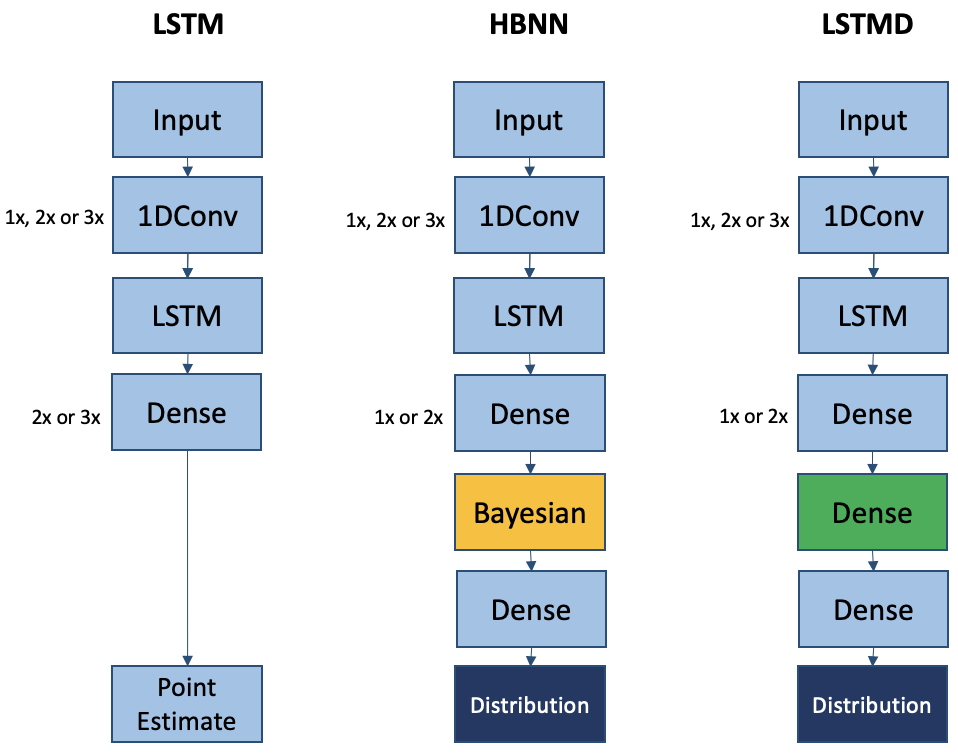
- CPU/GPUおよびメモリ使用量の同時分布を予測できるように、ベイジアンニューラルネットワーク(HBNN)および確率的LSTM(LSTMD)のアーキテクチャを適応させ、不確実性推定を可能にする。
- より大きな二変量学習データに対して表現学習の能力を向上させるために層を追加し、一般化性能を向上させる。
- 複数プロバイダーのデータセット(GoogleおよびAlibaba)を用いて訓練し、ゼロショットおよびファインチューニングのシナリオにおけるトランスファーラーニング性能を評価。
- 所望のサービスレベルに合わせてカスタマイズされた信頼度ベースの予測区間を用い、ポイントワイズの精度ではなくサービスレベル指標を評価基準とする。
- ソースドメイン(例:Google)で学習し、ターゲットドメイン(例:Alibaba)でテストすることでトランスファーラーニングを評価し、ドメインの乖離が進むに従って性能低下を測定。
- 不対称な損失関数および事後分布近似技術を用いて、不確実性推定のロバスト性を向上させる。
実験結果
リサーチクエスチョン
- RQ1不確実性を考慮したディープラーニングモデルは、特にサービスレベル指標の観点から、ポイントワイズ推定を上回るワークロード予測性能を向上させることができるか?
- RQ2アンビエントな不確実性とエピステム的不確実性の両方をモデル化することで、クラウド環境における予測の信頼性とリソース割り当て意思決定にどのような影響を与えるか?
- RQ3異なるクラウドプロバイダーまたはデータ分布間でワークロード予測の知識を転送する場合、どのような条件下でトランスファーラーニングが成功するか?
- RQ4ソースドメインのサイズを増大させることで、非常に異なるターゲットドメインへの転送における性能低下を緩和できるか?
- RQ5不確実性を考慮したモデルは、実世界のクラウドシステムに、妥当な推論遅延とスケーラビリティを満たしながら効果的に導入可能か?
主な発見
- 不確実性のモデル化により、ポイントワイズ精度指標に顕著な優位性が見られない状況でも、信頼度に基づくリソース割り当てによりサービスレベル指標が顕著に向上する。
- 複数のデータセットで学習された二変量HBNN(M-B-HBNN)が、性能と導入の複雑さの両者において最良のトレードオフを達成する。
- ソースドメインとターゲットドメインが異なるクラウドプロバイダーに属する場合、特にソースデータセットが小さい場合には、トランスファーラーニングの性能が著しく低下する。
- ファインチューニングは一貫した性能向上をもたらさず、ソースドメインとターゲットドメインがあまりに異なる場合には知識転送が失敗する。
- ソースドメインが大きく、かつターゲットドメインの多様性を十分に代表している場合にのみ、妥当なトランスファーラーニング性能が達成可能である。
- すべてのモデルの実行時間は、生産環境のクラウド環境におけるリアルタイム導入を支えるのに十分なほど効率的である。
この論文を読む
Nubintのビューアで原文を開き、読みながら気になる箇所をすぐに質問できます。
Nubintでこの論文を読むこのレビューはAIが論文の原文をもとに作成しました。引用する前に原文をご確認ください。