
[論文レビュー] Fourier-Net+: Leveraging Band-Limited Representation for Efficient 3D Medical Image Registration
Fourier-Net+ は、3D 医療画像登錻における計算コストとメモリ使用量を著しく削減する帯域制限付きフーリエ表現を導入することで、最先端の精度を維持しながら、3D-CMR データ上で 9.05× の高速化と、従来モデルの 0.35% の乗加演算量を達成した。
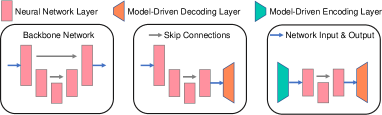
U-Net style networks are commonly utilized in unsupervised image registration to predict dense displacement fields, which for high-resolution volumetric image data is a resource-intensive and time-consuming task. To tackle this challenge, we first propose Fourier-Net, which replaces the costly U-Net style expansive path with a parameter-free model-driven decoder. Instead of directly predicting a full-resolution displacement field, our Fourier-Net learns a low-dimensional representation of the displacement field in the band-limited Fourier domain which our model-driven decoder converts to a full-resolution displacement field in the spatial domain. Expanding upon Fourier-Net, we then introduce Fourier-Net+, which additionally takes the band-limited spatial representation of the images as input and further reduces the number of convolutional layers in the U-Net style network's contracting path. Finally, to enhance the registration performance, we propose a cascaded version of Fourier-Net+. We evaluate our proposed methods on three datasets, on which our proposed Fourier-Net and its variants achieve comparable results with current state-of-the art methods, while exhibiting faster inference speeds, lower memory footprint, and fewer multiply-add operations. With such small computational cost, our Fourier-Net+ enables the efficient training of large-scale 3D registration on low-VRAM GPUs. Our code is publicly available at \url{https://github.com/xi-jia/Fourier-Net}.
研究の動機と目的
- 高解像度ボリュームデータにおける U-Net をベースにした 3D 医療画像登錻の高い計算コストとメモリ使用量に対処すること。
- スペクトルドメイン表現を活用することで、深層学習ベースの登錻におけるネットワークパラメータ数、メモリ使用量、FLOPs の削減を図ること。
- 精度を損なわずに、低 VRAM GPU での学習における推論速度とスケーラビリティを向上させること。
- 段階的なアーキテクチャと帯域制限付き空間表現を U-Net エンコーダーの入力として用いることで、性能を向上させること。
提案手法
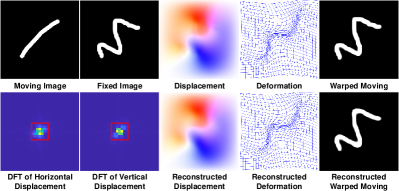
- U-Net の拡張パスを、帯域制限付きフーリエ係数からフル解像度の変位場を再構築するパラメータフリーでモデル駆動のデコーダーに置き換える。
- 変位場の低次元表現をフーリエドメインで学習することで、パラメータ数と演算数を削減する。
- Fourier-Net+ を導入し、U-Net の収縮パスに帯域制限付き空間表現を入力として用いることで、畳み込み層の数と計算コストをさらに削減する。
- 複数の Fourier-Net+ ステージを段階的にスタックすることで、段階的な精錬を施すことで登錻精度を向上させるキャスケードアーキテクチャを適用する。
- 離散フーリエ変換(DFT)を用いて変位場を周波数ドメインに投影し、デコード後に逆 DFT を用いて再構築する。
- フーリエ係数を低周波数領域に制限することで帯域制限を課し、重要な変形情報を保持するとともに、高周波数ノイズを除外する。
実験結果
リサーチクエスチョン
- RQ1変位場の帯域制限付きフーリエ表現は、3D 医療画像登錻における計算コストとメモリ使用量を削減できるか?
- RQ2U-Net のデコーダーをパラメータフリーでモデル駆動の代替に置き換えることで、登錻精度を維持しつつ効率性を向上させられるか?
- RQ3U-Net エンコーダーの入力として帯域制限付き空間表現を用いることで、さらに FLOPs とメモリ使用量を削減できるか?
- RQ4キャスケード型の Fourier-Net+ アーキテクチャは、単一ステージのベースラインと比較して、どのように登錻性能を向上させるか?
- RQ5Fourier-Net+ は、精度や速度を損なわずに、低 VRAM GPU(例:16GB)でも学習を可能にするか?
主な発見
- 3D-CMR データセットにおいて、Fourier-Net+ は TransMorph より 7.1%、LKU-Net より 7.5% の高い Dice スコアを達成した。
- 3D-CMR データセットにおける推論速度では、Fourier-Net+ は TransMorph より 9.05×、LKU-Net より 4.42× 速かった。
- 3D-CMR データセットにおいて、Fourier-Net+ は TransMorph の乗加演算量の 0.35% と、メモリ使用量の 2.07% のみを消費した。
- 2つの脳 MRI データセットと1つの心臓 MRI データセットにおいて、最先端の手法と同等またはそれ以上の登錻精度を達成した。
- キャスケード型の Fourier-Net+ は、単一ステージバージョンと比較して、平均して Dice スコアを 0.5–1.0% まで向上させた。
- Fourier-Net+ は、低 VRAM GPU(例:16GB)でも最小限のメモリオーバーヘッドで学習が可能であり、標準的なハードウェアでも大規模な 3D 登錻が実現可能になった。
この論文を読む
Nubintのビューアで原文を開き、読みながら気になる箇所をすぐに質問できます。
Nubintでこの論文を読むこのレビューはAIが論文の原文をもとに作成しました。引用する前に原文をご確認ください。