
[論文レビュー] FourierGNN: Rethinking Multivariate Time Series Forecasting from a Pure Graph Perspective
FourierGNNは多変量時系列予測をハイバーヴァリアントグラフ上での予測として再構成し、フーリエ空間で畳み込みを実行するフーリエグラフ演算子を使用して、低い計算量で最先端の精度を達成します。
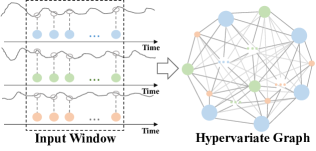
Multivariate time series (MTS) forecasting has shown great importance in numerous industries. Current state-of-the-art graph neural network (GNN)-based forecasting methods usually require both graph networks (e.g., GCN) and temporal networks (e.g., LSTM) to capture inter-series (spatial) dynamics and intra-series (temporal) dependencies, respectively. However, the uncertain compatibility of the two networks puts an extra burden on handcrafted model designs. Moreover, the separate spatial and temporal modeling naturally violates the unified spatiotemporal inter-dependencies in real world, which largely hinders the forecasting performance. To overcome these problems, we explore an interesting direction of directly applying graph networks and rethink MTS forecasting from a pure graph perspective. We first define a novel data structure, hypervariate graph, which regards each series value (regardless of variates or timestamps) as a graph node, and represents sliding windows as space-time fully-connected graphs. This perspective considers spatiotemporal dynamics unitedly and reformulates classic MTS forecasting into the predictions on hypervariate graphs. Then, we propose a novel architecture Fourier Graph Neural Network (FourierGNN) by stacking our proposed Fourier Graph Operator (FGO) to perform matrix multiplications in Fourier space. FourierGNN accommodates adequate expressiveness and achieves much lower complexity, which can effectively and efficiently accomplish the forecasting. Besides, our theoretical analysis reveals FGO's equivalence to graph convolutions in the time domain, which further verifies the validity of FourierGNN. Extensive experiments on seven datasets have demonstrated our superior performance with higher efficiency and fewer parameters compared with state-of-the-art methods.
研究の動機と目的
- 統一的な時空間的視点から予測を動機付け、空間ネットワークと時間ネットワークの分断による不一致を避ける。
- 変量と時刻のすべての値をグラフノードとして表現するハイパーヴァリアントグラフデータ構造を提案する。
- 効率のためにフーリエ空間でグラフ計算を行うフーリエグラフ演算子を用いてFourierGNNを開発する。
- FourierGNNを理論的に分析し、時系列ドメインのグラフ畳み込みと同値であることを確立し、効率向上を実証する。
- より少ないパラメータとより高速な学習で七つの実世界データセットにおいて強い実証性能を示す。
提案手法
- 入力窓X_t in R^{N×T}の各要素をグラフノードとするハイパーヴァリアントグラフを定義し、NTノードの完全連結グラフを得る。
- フーリエ空間でカーネル重み付き畳み込みを計算するフーリエグラフ演算子(FGO)を導入し、O(n log n)演算を実現する。
- 複数のFGOsを積み重ねてFourierGNNを形成し、出力をフーリエ空間で計算し、IDFTを介して時系列ドメインへ還元する。
- FourierGNNの再帰的フーリエ空間乗算が時系列ドメインの多段階グラフ畳み込みに同等であることを証明する(命題1)。
- MTS予測のためにノードを埋め込み、DFTを適用し、FGOsを実行し、完全連結層で未来ステップへ射影して FourierGNNを具体化する。
- フーリエドメインの計算と時系列ドメインのグラフ畳み込みを対比して、計算複雑性を低く抑えられることを強調する。
実験結果
リサーチクエスチョン
- RQ1純粋なグラフベースのモデルは、時系列ネットワークを使わずに、系列間(空間)と系列内(時間的)依存性の両方を捉えられるか。
- RQ2MTSデータをハイパーヴァリアントグラフとして表現することで、従来の二ネットワーク設計よりもより正確で効率的な予測が可能になるか。
- RQ3フーリエグラフ演算子は時系列ドメインのグラフ畳み込みと同等で、実用的な複雑性の利点をもたらすか。
- RQ4FourierGNNは多様な実世界データセットで最先端の予測性能を、パラメータ数を抑えつつ達成できるか。
主な発見
- FourierGNNは七つの実世界データセットで最先端の結果を達成する。
- 平均して、FourierGNNはMAEをベストベースラインより9.4%以上、RMSEを10.9%超上回る。
- FourierGNNは多くの軽量GNNベースラインより約14.6%の学習時間短縮と20%のパラメータ削減を要する。
- グラフ演算の対数線形計算量により、モデルはより高い効率とスケーラビリティを示す。
- アブレーション研究は、ノード埋め込みと多段階拡散が性能向上に重要であることを示す。
- 視覚化は、FourierGNNが学習した隣接パターンに反映された意味のある時間的・空間的依存性を学習していることを示す。

この論文を読む
Nubintのビューアで原文を開き、読みながら気になる箇所をすぐに質問できます。
Nubintでこの論文を読むこのレビューはAIが論文の原文をもとに作成しました。引用する前に原文をご確認ください。