
[論文レビュー] FreeSeg: Unified, Universal and Open-Vocabulary Image Segmentation
FreeSeg は、オープンボキャブラリな語彙空間でのセマンティック、インスタンス、およびパンオプティック分割を実行するため、適応的プロンプトとマスク提案を備え、CLIP ベースのゼロショット分類を活用した、ワンショットで訓練された単一の統一モデルを提示します。
Recently, open-vocabulary learning has emerged to accomplish segmentation for arbitrary categories of text-based descriptions, which popularizes the segmentation system to more general-purpose application scenarios. However, existing methods devote to designing specialized architectures or parameters for specific segmentation tasks. These customized design paradigms lead to fragmentation between various segmentation tasks, thus hindering the uniformity of segmentation models. Hence in this paper, we propose FreeSeg, a generic framework to accomplish Unified, Universal and Open-Vocabulary Image Segmentation. FreeSeg optimizes an all-in-one network via one-shot training and employs the same architecture and parameters to handle diverse segmentation tasks seamlessly in the inference procedure. Additionally, adaptive prompt learning facilitates the unified model to capture task-aware and category-sensitive concepts, improving model robustness in multi-task and varied scenarios. Extensive experimental results demonstrate that FreeSeg establishes new state-of-the-art results in performance and generalization on three segmentation tasks, which outperforms the best task-specific architectures by a large margin: 5.5% mIoU on semantic segmentation, 17.6% mAP on instance segmentation, 20.1% PQ on panoptic segmentation for the unseen class on COCO.
研究の動機と目的
- セマンティック、インスタンス、パンオプティックのタスクをカバーする、統一的でオープンボキャブラリなフレームワークを提案し、分割の断片化を解消する。
- ワンショットで全統合ネットワークを訓練し、タスク間で普遍的なマスク提案を生成。
- 適応的プロンプト学習を組み込み、タスク認識とカテゴリ感度の概念をエンコードして、堅牢な跨タスク一般化を実現。
提案手法
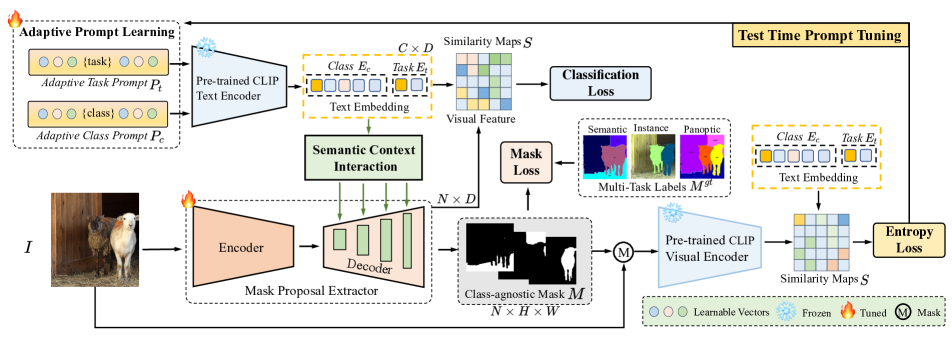
- 2段階のフレームワーク: 第1段階はワンショットのマルチタスク訓練を通じて普遍的なマスク提案を学習; 第2段階では CLIP を用いて適応プロンプトでマスクを分類。
- 適応プロンプト学習は、タスクとカテゴリ情報をテキスト埋め込みに共同エンコードし、マルチグラニュラリティのテキスト表現を形成。
- セマンティック文脈の相互作用は、クロスアテンションを介してテキスト埋め込みとマルチスケールの視覚特徴を整列させ、跨モーダルのマッチングを改善。
- テスト時のプロンプトチューニングは、未知のカテゴリに対する適応クラスプロンプトを最適化し、オープンボキャブラリの性能を向上。
- 訓練損失はマスク監督(Focal損失とDice損失)と、テキスト誘導マスクのためのクロスエントロピー分類損失を組み合わせる。
- このフレームワークは Mask2Former をマスク提案エクストラクタとして、CLIP をテキスト−画像整列のバックボーンとして使用する。
実験結果
リサーチクエスチョン
- RQ1単一の統一モデルが、タスク固有のアーキテクチャなしに、セマンティック、インスタンス、パンオプティックのオープンボキャブラリ分割を達成できるか?
- RQ2適応プロンプト学習は、オープンボキャブラリ分割における未知カテゴリへの一般化を改善するか?
- RQ3セマンティック文脈の相互作用とテスト時プロンプトチューニングは、未知クラスのクロモダル整合性と性能を向上させるか?
主な発見
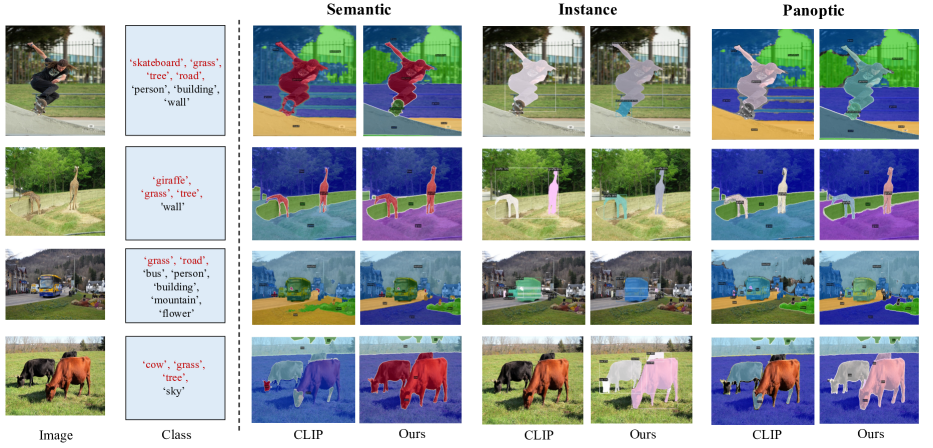
- FreeSeg は COCO と ADE20K のオープンボキャブラリ意味分割で最先端の結果を達成し、見知らぬクラスでそれぞれ従来法より 5.5% mIoU、8.3% mIoU の改善を示した。
- オープンボキャブラリのインスタンス分割で、FreeSeg は見知らぬ COCO カテゴリで 20.6% mAP を達成し、従来の最高手法を 7.0% mAP 上回った。
- オープンボキャブラリのパンオプティック分割では、FreeSeg は見知らぬ COCO カテゴリで 29.8% PQ、79.2% SQ、37.6% RQ を達成し、ZSSeg を大きく上回った。
- 跨データセット一般化全体で、COCO または ADE20K で学習し他のデータセット(例:ADE20K や VOC2012)でテストした場合、FreeSeg はベースラインを上回る。
- アブレーション研究は、適応プロンプト、セマンティック文脈相互作用、テスト時プロンプトチューニングが未知クラスの性能と跨タスクの堅牢性を総じて向上させることを示した。
この論文を読む
Nubintのビューアで原文を開き、読みながら気になる箇所をすぐに質問できます。
Nubintでこの論文を読むこのレビューはAIが論文の原文をもとに作成しました。引用する前に原文をご確認ください。