
[論文レビュー] From Crowdsourced Data to High-Quality Benchmarks: Arena-Hard and BenchBuilder Pipeline
本論文は、クラウドソーシングデータから高品質なプロンプトを抽出して Arena-Hard-Auto v0.1 を構築するデータパイプライン BenchBuilder を提示する。これは完全自動化されたベンチマークで、モデルの識別性が強く、低コストで人間の好みと高い一致を示す。
The rapid evolution of Large Language Models (LLMs) has outpaced the development of model evaluation, highlighting the need for continuous curation of new, challenging benchmarks. However, manual curation of high-quality, human-aligned benchmarks is expensive and time-consuming. To address this, we introduce BenchBuilder, an automated pipeline that leverages LLMs to curate high-quality, open-ended prompts from large, crowd-sourced datasets, enabling continuous benchmark updates without human in the loop. We apply BenchBuilder to datasets such as Chatbot Arena and WildChat-1M, extracting challenging prompts and utilizing LLM-as-a-Judge for automatic model evaluation. To validate benchmark quality, we propose new metrics to measure a benchmark's alignment with human preferences and ability to separate models. We release Arena-Hard-Auto, a benchmark consisting 500 challenging prompts curated by BenchBuilder. Arena-Hard-Auto provides 3x higher separation of model performances compared to MT-Bench and achieves 98.6% correlation with human preference rankings, all at a cost of $20. Our work sets a new framework for the scalable curation of automated benchmarks from extensive data.
研究の動機と目的
- rapidly advancing LLMs に追従する、進化するオープンエンドのベンチマークの必要性を動機づける。
- クラウドソーシングデータから高品質なプロンプトを自動でキュレーションする BenchBuilder を提案する。
- Arena-Hard-Auto v0.1 がモデルを自信を持って区別し、人間の嗜好と整合する能力を示す。
提案手法
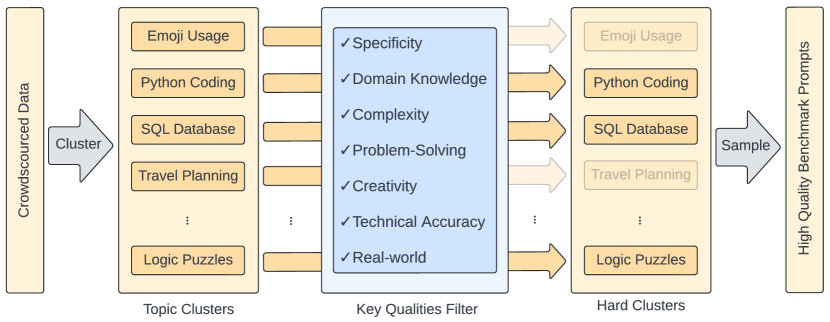
- 七つのプロンプト品質指標を定義する(例:Specificity、Domain Knowledge、Complexity、Problem-Solving、Creativity、Technical Accuracy、Real-world Application)と、プロンプトをスコアリングするための LLM アノテータを使用する。
- 埋め込みベースのトピックモデリング(BERTopic with OpenAI embeddings、UMAP、HDBSCAN)を用いてトピッククラスタを形成する。
- 平均品質でクラスタをフィルタリングし、クラスタ間で均等にプロンプトをサンプリングして多様性を確保する。
- GPT-3.5-Turbo/GPT-4-Turbo を用いてプロンプトをスコアリングし、GPT-4-Turbo をジャッジとして人間の好みの整合性を LLM 判断で評価する。
- ブートストラップ信頼区間と Bradley-Terry フレームワークを用いてモデルランキングを評価し、最終スコアを算出する。
- Arena-Hard-Auto v0.1 を MT-Bench および AlpacaEval と separability と agreement の観点で比較し、オープンソースのベンチマークと BenchBuilder パイプラインを公開する。
実験結果
リサーチクエスチョン
- RQ1クラウドソーシングデータから構築された生きたベンチマークは、最新モデルを自信をもって分離できるのか。
- RQ2七つの定義されたプロンプト品質指標は、自動キュレーションを導いて高品質で多様なベンチマークを作成できるのか。
- RQ3LLM ベースのジャッジは、モデル評価に対する人間の嗜好との信頼できる自動整合性を提供するのか。
- RQ4Arena-Hard-Auto v0.1 は、分離性と人間のランキングとの一致の点で既存のベンチマークとどう比較されるのか。
主な発見
- Arena-Hard-Auto v0.1 は MT-Bench および AlpacaEval に対して、信頼区間をより狭くし、強い分離性を示す。
- Arena-Hard-Auto v0.1 は Chatbot Arena の人間ランキングと 89.1% の一致を、評価あたり $25 のコストで示す。
- BenchBuilder は 200,000 件の Chatbot Arena クエリから高品質なプロンプトを抽出し、多様で困難なタスクに分散した 500 件のプロンプトを得る。
- GPT-4-Turbo をジャッジとして採用すると、グラウンドトゥルースラベルに対して 85.6% の精度を達成し、アノテータとしての使用を裏付ける。
- 複数のジャッジ(例:GPT-4-Turbo + Gemini-1.5-Pro)をアンサンブルすると、同意と分離性が向上する。
- Arena-Hard-Auto v0.1 は人間の嗜好との強い整合性を示し、ランダムなプロンプトのサブセットよりも優れ、モデルペア間での頑健性を示す。

この論文を読む
Nubintのビューアで原文を開き、読みながら気になる箇所をすぐに質問できます。
Nubintでこの論文を読むこのレビューはAIが論文の原文をもとに作成しました。引用する前に原文をご確認ください。