
[論文レビュー] From slides (through tiles) to pixels: an explainability framework for weakly supervised models in pre-clinical pathology
本論文は、スライドレベルのラベルのみを用いて、全スライド画像(WSIs)におけるマルチインスタンス学習(MIL)を用いた弱教師あり深層学習モデルの文脈的説明可能AI(XAI)フレームワークを提案する。このフレームワークは、病理医のアノテーションおよびセグメンテーションモデルの予測と相関するピクセルレベルのヒートマップを生成し、組織境界における形態的特徴の検出を通じてモデルの意思決定を可視化する。安定性と忠実性を示しており、病理学的意義のある解釈を提供する。
In pre-clinical pathology, there is a paradox between the abundance of raw data (whole slide images from many organs of many individual animals) and the lack of pixel-level slide annotations done by pathologists. Due to time constraints and requirements from regulatory authorities, diagnoses are instead stored as slide labels. Weakly supervised training is designed to take advantage of those data, and the trained models can be used by pathologists to rank slides by their probability of containing a given lesion of interest. In this work, we propose a novel contextualized eXplainable AI (XAI) framework and its application to deep learning models trained on Whole Slide Images (WSIs) in Digital Pathology. Specifically, we apply our methods to a multi-instance-learning (MIL) model, which is trained solely on slide-level labels, without the need for pixel-level annotations. We validate quantitatively our methods by quantifying the agreements of our explanations' heatmaps with pathologists' annotations, as well as with predictions from a segmentation model trained on such annotations. We demonstrate the stability of the explanations with respect to input shifts, and the fidelity with respect to increased model performance. We quantitatively evaluate the correlation between available pixel-wise annotations and explainability heatmaps. We show that the explanations on important tiles of the whole slide correlate with tissue changes between healthy regions and lesions, but do not exactly behave like a human annotator. This result is coherent with the model training strategy.
研究の動機と目的
- 前臨床病理学におけるピクセルレベルのアノテーションの不足を解消するため、弱教師ありモデルに説明可能なAIを提供すること。
- 手動でのピクセルレベルのアノテーションを必要とせず、スライドレベルの予測を局所的でピクセルレベルの説明で強化するフレームワークの開発。
- 病理医がアノテートした病変領域およびセグメンテーションモデルの出力と照合した、説明の忠実性と安定性の検証。
- モデル生成のヒートマップを用いて病理医がリスクの高いスライドを優先し、生物学的に関連する領域に集中できるように支援すること。
提案手法
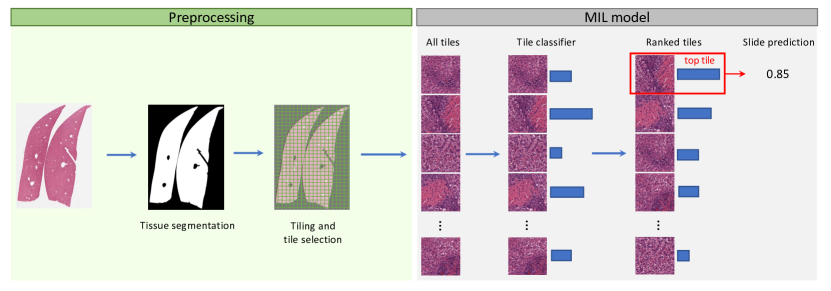
- 最近のXAI技術を、スライドレベルの診断ラベルのみで学習されたマルチインスタンス学習(MIL)モデルに適応する。
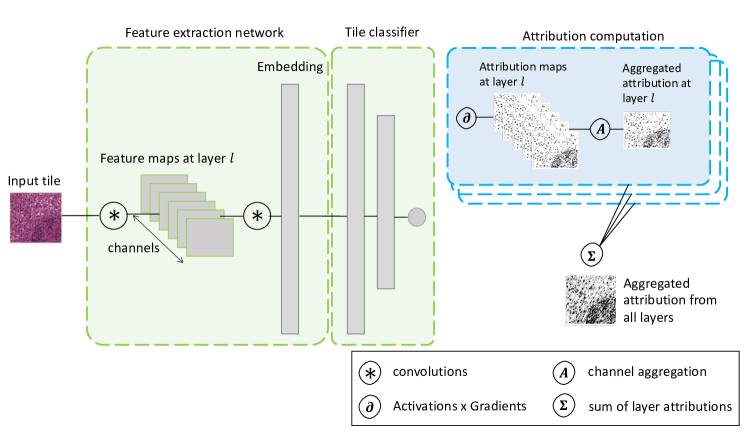
- 全スライド画像(WSIs)から抽出したパッチ上でMILモデルの注目マップを分析し、タイル単位でヒートマップの説明を生成する。
- 高得点のタイルを高解像度で局所化されたヒートマップに精錬する文脈的説明ワークフローを適用する。
- 2つのゴールドスタンダード(病理医がアノテートした病変境界および、ピクセルレベルのアノテーションで学習された完全教師ありセグメンテーションモデルの予測)と照合して説明を検証する。
- 入力の摂動に対して説明の安定性を評価し、モデル性能の向上と相関関係を検証する。
- Pado Visualizeパッケージを用いて、インタラクティブなスライド優先順位付けと可視化を実現する臨床ワークフローにフレームワークを統合する。
実験結果
リサーチクエスチョン
- RQ1弱教師ありMILモデルが生成するXAIヒートマップは、病理医がアノテートした病変境界とどの程度相関しているか?
- RQ2モデルの説明は、ピクセルレベルのアノテーションで学習された完全教師ありセグメンテーションモデルの予測とどの程度一致するか?
- RQ3スライドにわずかな摂動やシフトが加えられた場合、説明はどの程度安定しているか?
- RQ4基礎となるMILモデルの性能が向上するにつれて、説明の忠実性はどのように変化するか?
- RQ5モデルの意思決定プロセスを解明する上で、ヒートマップはラット肝臓スライドにおける壊死の検出に関してどのような生物学的インサイトを示しているか?
主な発見
- XAIで生成されたヒートマップは、病理医がアノテートした病変境界および完全教師ありセグメンテーションモデルの予測の両方と有意に正の相関を示す。
- 入力のスライドにわずかなずれが加えられても説明が安定しており、スライドの外観や前処理の微小な変化に対して頑健であることが示された。
- モデルの性能が向上するにつれて、説明の忠実度が向上し、診断支援としての信頼性が確認された。
- ヒートマップは、健全な組織と壊死組織の境界で色、テクスチャ、細胞構造の形態的変化を強調しており、生物学的意義と整合的である。
- モデルの説明は人間のアノテーションを正確に再現するものではなく、スライドレベルの診断とピクセルレベルのセグメンテーションというタスクの根本的な違いを反映している。
- このフレームワークにより、病理医はリスクの高いスライドを優先し、生物学的に関連する領域に集中できるようになり、診断の効率が向上した。
この論文を読む
Nubintのビューアで原文を開き、読みながら気になる箇所をすぐに質問できます。
Nubintでこの論文を読むこのレビューはAIが論文の原文をもとに作成しました。引用する前に原文をご確認ください。