
[論文レビュー] FSCE: Few-Shot Object Detection via Contrastive Proposal Encoding
FSCEはRoIヘッドに対照的な proposal encoding ブランチを導入し、監督付き対照学習損失を用いて few-shot object detection を改善し、すべての shot 設定で PASCAL VOC と COCO において最先端の結果を達成します。
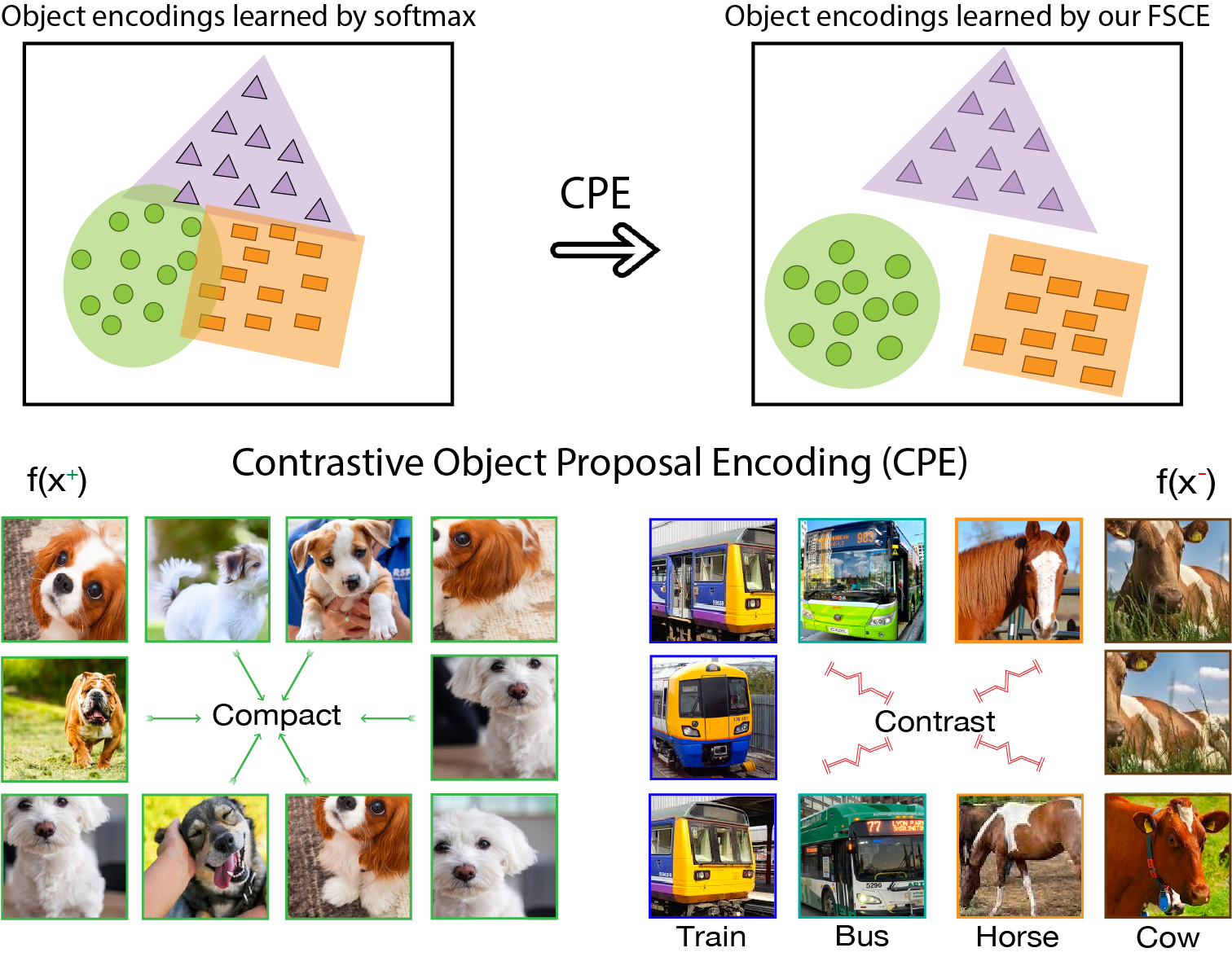
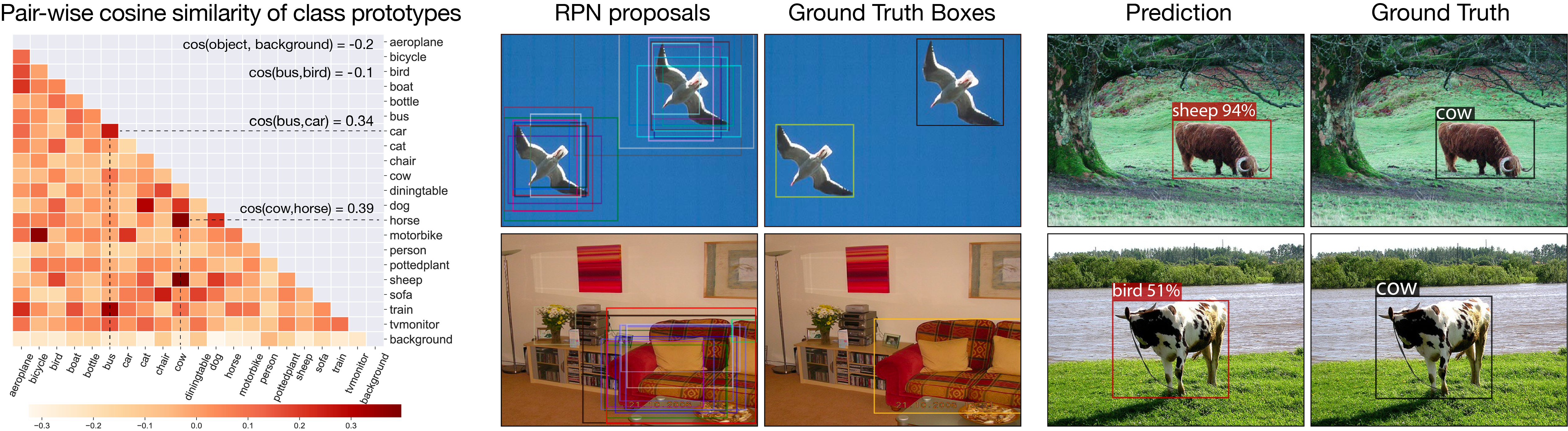
Emerging interests have been brought to recognize previously unseen objects given very few training examples, known as few-shot object detection (FSOD). Recent researches demonstrate that good feature embedding is the key to reach favorable few-shot learning performance. We observe object proposals with different Intersection-of-Union (IoU) scores are analogous to the intra-image augmentation used in contrastive approaches. And we exploit this analogy and incorporate supervised contrastive learning to achieve more robust objects representations in FSOD. We present Few-Shot object detection via Contrastive proposals Encoding (FSCE), a simple yet effective approach to learning contrastive-aware object proposal encodings that facilitate the classification of detected objects. We notice the degradation of average precision (AP) for rare objects mainly comes from misclassifying novel instances as confusable classes. And we ease the misclassification issues by promoting instance level intra-class compactness and inter-class variance via our contrastive proposal encoding loss (CPE loss). Our design outperforms current state-of-the-art works in any shot and all data splits, with up to +8.8% on standard benchmark PASCAL VOC and +2.7% on challenging COCO benchmark. Code is available at: https: //github.com/MegviiDetection/FSCE
研究の動機と目的
- 極度のデータ不足の下で堅牢で識別可能なオブジェクト提案表現を学習することによって FSOD の改善を動機づける。
- 領域提案に対する監督付き対照学習を通じて、クラス内のコンパクト性とクラス間の分離を活用する。
- トレーニングパイプラインを大幅に変更せずに、Faster R-CNN フレームワークへ対照的な proposal encoding loss(CPE)を統合する。
- 標準ベンチマークで 1, 2, 3, 5, 10, 30-shot 設定のすべてで最先端の性能を示す。
提案手法
- Faster R-CNN を拡張し、RoI ヘッドに並列の対照ブランチを追加して、提案を小さな MLP ヘッドを介して対照特徴にエンコードする。
- RoI 特徴にコサイン類似度ベースの分類器を用い、対照目的に合わせて温度スケールの損失を適用する。
- 提案に対してクラス内のコンパクト性とクラス間の分離を強制する CPE 損失を定義し、IoU ベースの提案整合性で加重する。
- 2 段階の訓練プロトコルを採用する:ベースクラスで訓練し、バックボーンを凍結したまま新規データとベースデータのバランスの取れた混合でファインチューニングする。
- ファインチューニング時に L_rpn, L_cls, L_reg と lambda*L_CPE を組み合わせて多タスク学習のバランスを取る。
- 2 段階検出器に組み込むことができ、コストがほとんどかからないシンプルな対照ヘッドで方法が機能することを示す。
実験結果
リサーチクエスチョン
- RQ1領域提案におけるインスタンスレベルの対照学習は、FSOD において新規オブジェクトを混同しやすいベースクラスとして誤分類するリスクを減らせるか。
- RQ2データ不足の状況で対照学習対応の提案埋め込みを学習することは、類似する物体カテゴリ間の分離を改善するか。
- RQ3IoUベースの提案整合性コントロールが CPE 損失の効果に与える影響は何か。
主な発見
- FSCE は PASCAL VOC と COCO のすべての-shot 設定で最先端の結果を達成します。
- VOC では、FSCE は Novel Split 3 で前の SOTA より最大 +8.8 AP を得るとともに、手法はベースクラスの性能を維持します。
- COCO では、FSCE は 以前の SOTA より +2.7 AP75 を達成します。
- アブレーション実験は、RPN と RoI 特徴を同時にファインチューニングして強力なベースラインに切り替えると、新規オブジェクトの性能が大幅に向上することを示している。
- CPE 損失はクラス内提案を引き締め、クラス間マージンを拡大し、t-SNE の可視化と定量的な改善で裏付けられている。
- 提案された IoU ベースの提案整合性コントロール(phi と g)は、特に非常に少数ショットの状況でロバスト性を向上させる。
この論文を読む
Nubintのビューアで原文を開き、読みながら気になる箇所をすぐに質問できます。
Nubintでこの論文を読むこのレビューはAIが論文の原文をもとに作成しました。引用する前に原文をご確認ください。